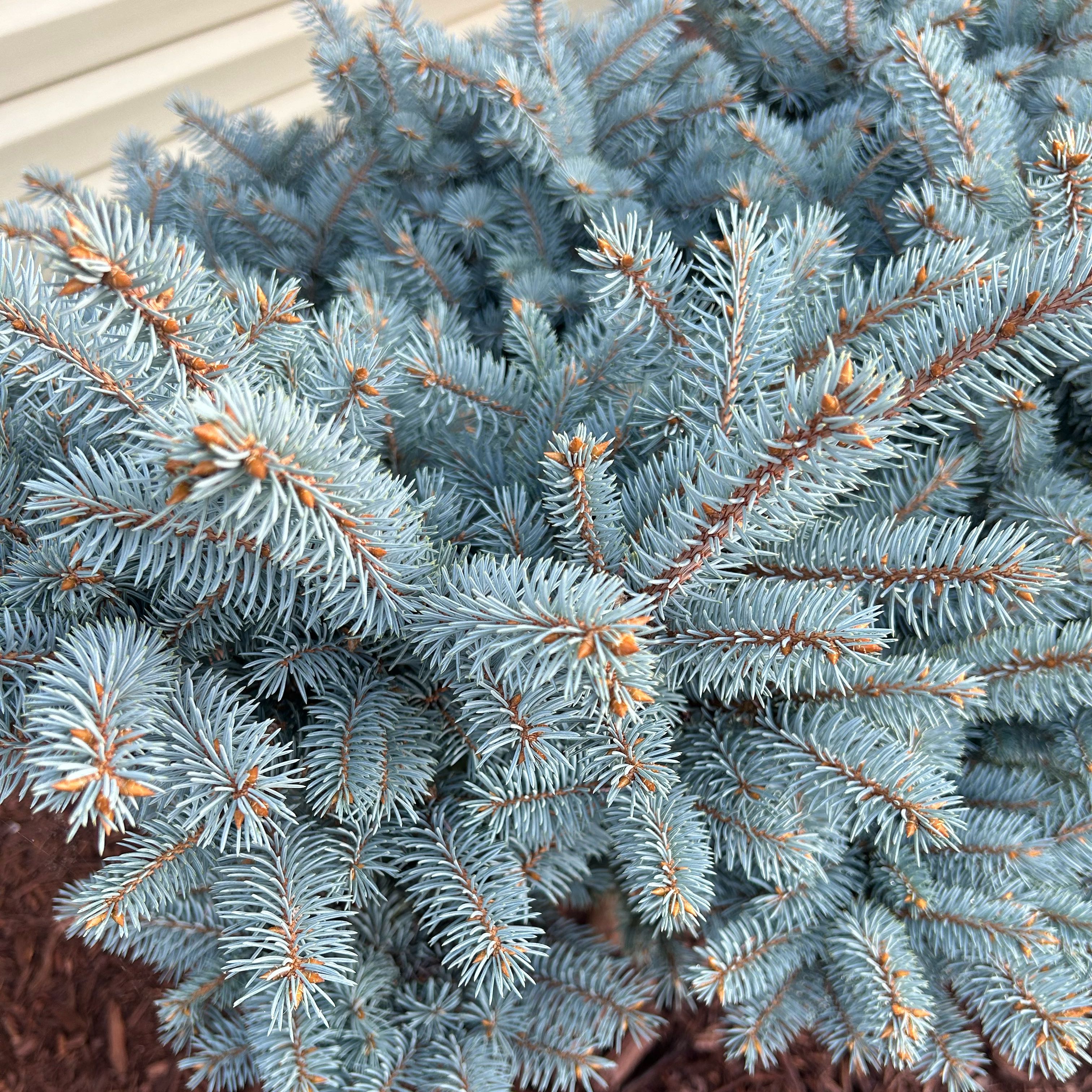
Blue Spruce

How to Prune Blue Spruce

Picea pungens
Reviewed by Kiersten Rankel M.S.
Quick Answer
Prune your blue spruce in late spring after the new candle growth has expanded but before it hardens. Trim candles by half to control size and encourage denser growth. Never cut back into bare, old wood on a blue spruce because conifers won't sprout new growth from brown branches.

When is the best time to prune?

Blue spruce produces one flush of new growth (candles) in spring, and that narrow window is the only safe time to prune without risking permanent bare spots.

US pruning regions map
Pacific
May–Jun
Mountain
Jun–Jul
Midwest
May–Jun
Northeast
May–Jun
Southeast
Apr–May
Stay on top of plant care
Get seasonal reminders for watering and fertilizing — personalized for your plants.
Try Greg Free

Why Should I Prune My Blue Spruce?

Blue spruce has a naturally symmetrical, pyramidal shape that rarely needs much pruning. When you do prune, the goal is usually to keep the tree from outgrowing its space or to fix damage from snow, wind, or disease.

The critical rule with all spruces is to never cut into old, bare wood. Unlike deciduous trees, conifers can only grow new needles from buds on recent growth. If you cut a branch back to a section with no green needles, it stays bare forever. That's why timing matters so much.

Prune during the candle stage in late spring, when the light-green new growth tips are still soft and flexible. You can pinch or cut these candles back by up to half their length. This keeps the tree compact without leaving gaps.

For dead or diseased branches, you can prune any time of year. Cut them back to the trunk or to a side branch that still has green growth. If you notice a dead zone in the center of the tree where light can't reach, there's no fix through pruning. That interior browning is natural for mature spruces.

Know Before You Cut

Difficulty Moderate
Max removal Up to half of new candle growth
Growth pattern Pyramidal conifer
Tools Pruners or hedge shears

What Should I Remove?

Trim new candle growth by up to half
Remove dead or diseased branches at the trunk
Maintain the natural pyramidal shape
Keep the central leader (top) intact
Never cut into old wood with no green needles
Don't remove the central leader
Don't prune after candles harden in summer

How Do I Prune Step by Step?

1
Wait for candle stage
Watch for the light-green new growth tips in late spring. They should be soft and flexible, not yet stiffened into mature branches.
2
Pinch or trim candles
Cut each candle back by one-third to one-half using hand pruners or pinch them with your fingers. This encourages denser growth behind the cut.
3
Remove dead branches any time
Cut dead or brown branches back to the trunk or to a live side branch with green needles. Don't leave stubs.
4
Preserve the central leader
If the top leader is damaged and you have competing tops, remove all but the straightest one. Stake it upright if needed.
5
Step back and check shape
Walk around the tree after pruning to check symmetry. The bottom should be widest and each tier should taper evenly upward.

Frequently Asked Questions

Can I cut my blue spruce back to make it smaller?
Only within the current year's growth. You can't cut into old wood and expect it to fill back in. If a spruce has outgrown its space, the only real option is removal.
Why is the inside of my blue spruce brown and bare?
Interior needle drop is normal. Dense outer growth blocks light from reaching interior branches. This isn't fixable with pruning. It's just how spruces grow.
My blue spruce lost its top in a storm. What do I do?
Choose the strongest remaining upper branch and tie it upright with a soft stake. Over a few years it will become the new leader and the tree will regain its shape.
When should I NOT prune a blue spruce?
Avoid pruning after midsummer when growth has hardened, and never in fall or early winter. Late pruning can stimulate tender growth that gets killed by frost.
Is it okay to shear a blue spruce like a hedge?
You can shear the candle growth in spring for a very manicured look, but be careful not to cut past the green growth. Shearing into old wood creates permanent bare patches.
Stay on top of plant care
Get seasonal reminders for watering and fertilizing — personalized for your plants.
Try Greg Free

About This Article

Kiersten Rankel M.S.
Botanical Data Lead at Greg · Plant Scientist
About the Author
Kiersten Rankel holds an M.S. in Ecology & Evolutionary Biology from Tulane University. A certified Louisiana Master Naturalist, she has over a decade of experience in science communication, with research spanning corals, cypress trees, marsh grasses, and more. At Greg, she curates species data and verifies care recommendations against botanical research.
See Kiersten Rankel's full background on LinkedIn.
Editorial Process
Pruning guidance verified against Picea pungens growth data from Greg's botanical database, cross-referenced with USDA hardiness zone data and published horticultural research.
466+ Greg users growing this plant
USDA hardiness zones 2a–7b
Grow plants with confidence