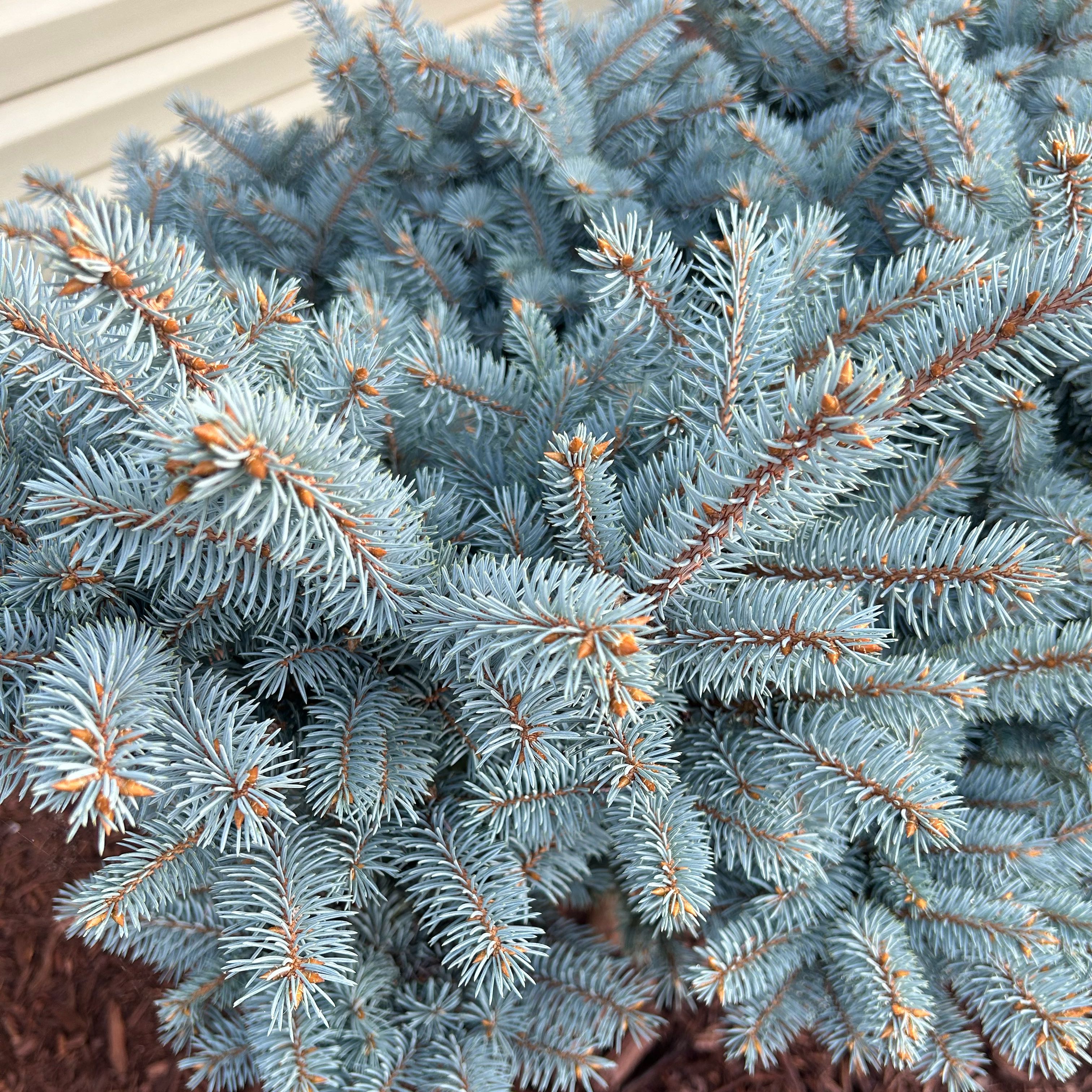
How to Water Blue Spruce
Picea pungens
Reviewed by Kiersten Rankel M.S.
Quick Answer
Water newly planted Blue Spruce deeply once a week through the first 2 growing seasons. After it is established, deep-soak every 2–3 weeks during dry summer stretches.
The goal is deep soaks that wet the entire root zone, never a daily sprinkle. Year one and two is when most losses happen.

Stay on top of plant care
Get seasonal reminders for watering and fertilizing — personalized for your plants.
How Often and How Much to Water
Adjust the sliders below for your pot size, light, and setting. The numbers assume a well-draining loam or amended planting hole and a site with drainage.
Setting
Every
9days
Use
1cup
Your Watering Rhythm Across the Year
Soil dries faster in the growing season, which varies by region. Slow down watering in the off-season to avoid overwatering.
Pacific
Mountain
Midwest
Northeast
Southeast
JFMAMJJASOND
Growing season
Growing season
9days
Resting season
3–4weeks
How to Water Your Blue Spruce
Soak deeply, drain fully. Blue Spruce roots run wide and shallow, so the watering pattern should soak the soil out to the dripline rather than just at the trunk.
1
Pour slowly at the base of the trunk in a wide ring out to the dripline. A soaker hose or slow drip works far better than a sprinkler.
2
Soak until water has reached at least 12 inches deep. Stick a screwdriver into the soil to test, it should slide in easily through the wet zone.
3
Water in the morning so the needles dry by night. Damp inner foliage overnight invites needlecast disease.
4
Add 2 to 3 inches of mulch out to the dripline but keep it 3 inches off the trunk. Mulch holds moisture between waterings.
Should You Water Your Blue Spruce Today?
Always check the soil before you water. Blue Spruce handle a long dry stretch better than soggy roots, and the most common cause of needle browning is overwatering or poor drainage, not under.
Hold off
Soil 6 inches down still feels damp
Inner needles look full and blue-green
New tips firm and uniform
No yellow or brown patches inside the canopy
Recent rain in the last week or two
Ready for water
Soil 6 inches down dry and crumbly
Outer needles looking dull or grayish
New tips wilting in the afternoon sun
It has been over 3 weeks since rain or watering
Soil pulls back from the trunk leaving a small gap
If Something Looks Off
Underwater and overwater can both turn a Blue Spruce brown. The soil moisture, the pattern of damage, and the timeline tell them apart.
Underwatered
Soil
Bone-dry 6 inches down and pulled back from the trunk
Leaves
Outer needles brown from the tips inward and the damage spreads slowly
Pace
Slow decline that stabilizes within a week of a deep soak
Next steps
Run a slow soaker hose at the dripline for 60 to 90 minutes
Check by pushing a screwdriver into the soil to confirm it has reached 12 inches deep
Repeat once a week for 4 weeks even if it rains lightly
Existing brown needles won't green back up but new growth in spring fills in. Do not trim brown sections until you see fresh green in the same branch
Overwatered
Soil
Stays soggy a week after watering with mossy or mushroom growth at the base
Stem
Bark softening or weeping near the soil line
Leaves
Inner needles yellow and drop and lower branches die back first
Pace
Steady decline that worsens through wet weeks even after you stop watering
Next steps
Stop watering immediately and pull mulch back 6 inches from the trunk
If the planting hole sits in standing water, score drainage channels away from the tree
Wait at least 3 weeks before watering again and only after the top 6 inches go dry
Remove any branches that have died back to bare wood once the tree stabilizes
Got More Questions?
Why are the lower branches of my Blue Spruce dying?
Lower branch dieback in Blue Spruce is most often caused by needlecast disease, which thrives in soils that stay too wet and on trees that get watered overhead. The fungus settles on inner needles, especially on the lowest branches.
Stop overhead watering, pull back mulch from the trunk, improve drainage, and water only at the soil line in the morning. If dieback continues, a certified arborist can confirm the disease and prescribe a fungicide.
How often does a newly planted Blue Spruce need water?
Through the first 2 growing seasons plan on a deep soak once a week, more often if there has been no rain for 10 days and the soil is dry 6 inches down. Each watering should run a soaker hose for an hour at the dripline.
After year 2 the tree is usually self-sufficient outside of long droughts. Year 3 and beyond, water only during dry stretches over 3 weeks.
Should I water my Blue Spruce in winter?
In zones with mild winters where the ground doesn't freeze, give it a deep soak once a month if there has been no significant rain. Evergreens lose water through their needles all winter and a dry root zone before a freeze causes winter burn.
In zones with frozen ground, stop watering after the ground freezes and resume in spring once it thaws.
Why are the new tips on my Blue Spruce limp and pale?
Limp pale new growth in late spring is usually a watering swing rather than a steady issue. Either the tree dried out hard during budbreak or the soil stayed too wet during cool weather and the roots are stressed.
Check the soil 6 inches down. If dry, deep-soak. If wet, hold off and improve drainage. The new growth firms up within 2 to 3 weeks once the soil moisture stabilizes.
How long can my Blue Spruce go without water if I'm on vacation?
Established Blue Spruce handle 4 to 6 weeks easily in mild summer weather. In a hot dry stretch, deep-soak before you leave and ask a neighbor to run the soaker for an hour at the 3 week mark.
Newly planted Blue Spruce in their first year cannot safely go more than 10 days without water in summer. Set up a timer or have someone check.
Is overhead sprinkler watering OK for Blue Spruce?
No. Overhead watering wets the inner foliage and feeds the fungal diseases that Blue Spruce is most prone to, especially needlecast and Cytospora canker.
Use a soaker hose at the soil line and run it for an hour at a time rather than a sprinkler that hits the canopy. Morning watering is also gentler than evening because the tree dries fully before nightfall.
Stay on top of plant care
Get seasonal reminders for watering and fertilizing — personalized for your plants.
About This Article

Kiersten Rankel M.S.
Botanical Data Lead at Greg · Plant Scientist
Editorial Process
Watering guidance verified against Picea pungens growth data from Greg's botanical database, cross-referenced with USDA hardiness zone data and published horticultural research.
499+ Greg users growing this plant
USDA hardiness zones 2a–7b