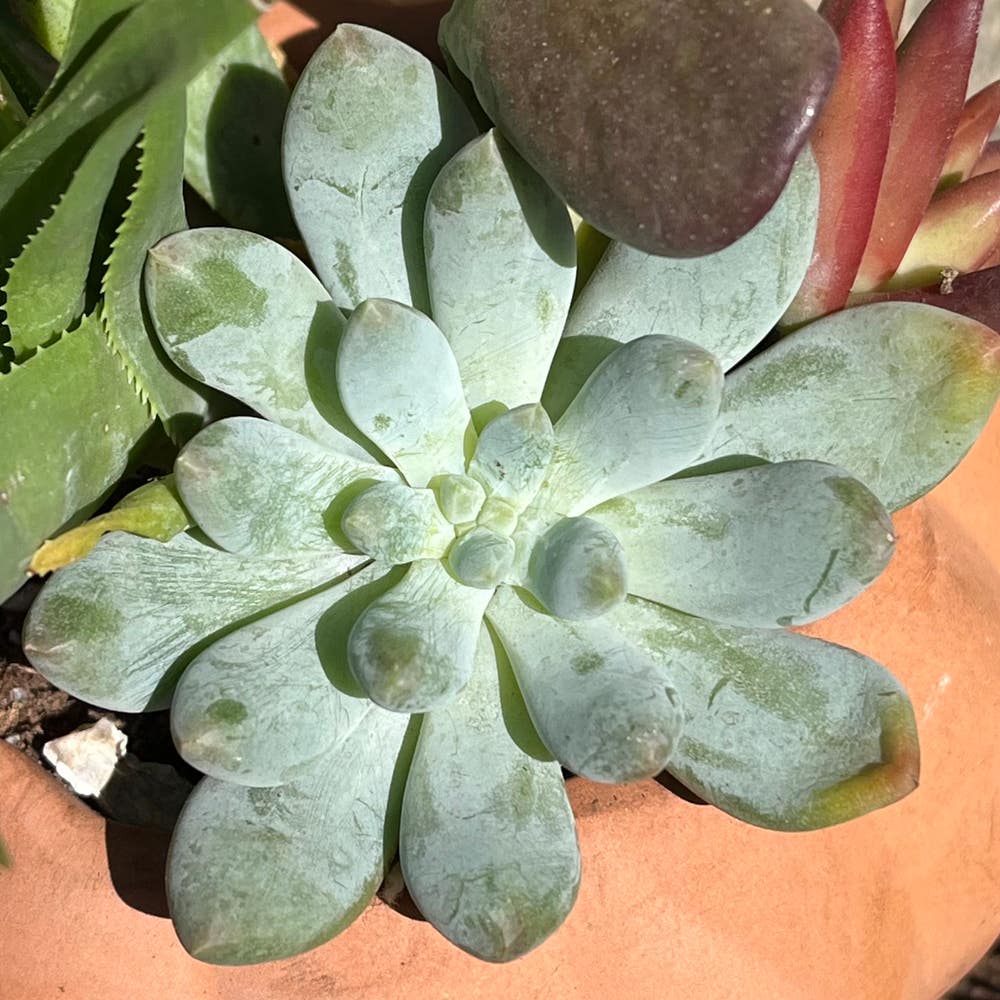
Why Are My Pachyphytum 'Starburst' Leaves Curling?
Pachyphytum 'Starburst'
By the Greg Editorial Team
Jun 18, 2024•4 min read
This article was created with the help of AI so we can cover more plants for you. May contain errors. See one? Report it here.
Unravel the mystery behind your Pachyphytum 'Starburst's curling leaves and fix it! 🌟
- Curling leaves signal distress; look for yellowing, puffiness, or black dots.
- Over/underwatering, light, pests—all can cause leaf curling. Adjust care accordingly.
- Prevent curling by fine-tuning water, light, and pest control.
Spotting the Signs of Leaf Curling
🍃 Visual Symptoms
Crisp edges and a scroll-like roll-up are red flags in Pachyphytum 'Starburst' leaves. If your succulent's leaves resemble a gymnast's ribbon, it's time for a closer look.
🚨 When to Worry
Not all leaf variations spell trouble. It's the unnatural curling—leaves twisting or coiling—that signals distress. Yellowing or discoloration, along with puffiness or black dots, are urgent signs.
Early detection is key, as these symptoms can quickly escalate. Regular monitoring for changes in leaf appearance will help you catch issues before they become severe.
Remember, your plant communicates through its leaves. If they're curling or changing color, it's trying to tell you something. Listen up and adjust care accordingly.
Keep an eye out for discoloration and unusual patterns; they could be distress flares signaling nutrient deficiencies or toxicity. Yellowing often cries out for nitrogen, while crispy edges might be pleading for potassium. Conversely, brown tips or leaf scorch could mean, "I'm stuffed; no more fertilizer, please!"
When it comes to pests, look for widespread symptoms rather than discrete damage. Powdery mildew, for example, leaves a white, powdery residue on leaves. If you spot unusual spotting or growths, it's time to consider a fungal problem.
Distinguishing between the plant's quirky leaf shapes and the onset of problematic curling is crucial. Look for leaves that start to roll or twist in an unnatural manner, deviating from their typical flat or slightly curved form.
Lastly, erratic watering is a fast track to stress city for your plants. Water evenly, aiming for moist soil that's not waterlogged. Remember, consistency is key.

Getting to the Root of the Problem
💧 Too Much H2O? The Overwatering Effect
Overwatering can turn your Pachyphytum 'Starburst' into a soggy spectacle. Leaves may curl outward and downward, feeling more like water balloons than succulent foliage. To diagnose, heft the pot; if it's got the weight of a kettlebell, you've probably gone overboard with watering. Swampy soil is another dead giveaway, squelching at the slightest touch.
🏜️ Thirsty Plant? The Underwatering Issue
Underwatering, on the other hand, leaves your plant looking like it's trying to hoard every last drop. Leaves curl up, getting crispy at the edges. A pot that's as light as your smartphone is a clear sign of thirst. And if the soil is pulling away from the pot's edges, it's definitely time for a drink.
🌞 Feeling the Heat: Light and Temperature Factors
Don't overlook the impact of light and temperature. Too much sun can have your Pachyphytum 'Starburst' leaves curling like they're trying to escape the heat. Conversely, too little light can lead to a similar fate. The goal is to find that Goldilocks zone—not too hot, not too cold, just right.
🐜 Unwanted Guests: Pest Infestations
Pests love a plant in distress, and they can exacerbate leaf curling. Look out for uninvited guests like aphids or mealybugs, which can be spotted as tiny moving dots or cotton-like clusters. Their presence often leads to leaves curling as a defense mechanism. Touch is your ally here; a gentle leaf inspection can reveal these freeloaders.

Turning Over a New Leaf: Solutions and Prevention
💧 Fine-Tuning Watering Habits
Watering your Pachyphytum 'Starburst' is a delicate dance. Overwatering turns your succulent's home into a swamp, while underwatering leaves it parched. To strike the right balance, let the soil dry out slightly between waterings. If the soil clings to your finger like a desperate koala, hold off on the water. Conversely, if it's as dry as a comedian's humor, it's time to hydrate.
🌞 Creating the Ideal Sunbath and Chill Zone
Light and temperature can make or break your 'Starburst'. It craves bright, indirect sunlight—think of it as the plant's perfect day at the beach without the risk of a sunburn. Temperature swings are a no-go; keep it as stable as your favorite dive bar's happy hour. If the air's drier than a prohibition-era bar, consider a humidifier or a pebble tray to up the humidity without going full rainforest.
🐜 Showing Pests the Door
Pests are the uninvited party crashers of the plant world. If you spot these freeloaders, it's time to show them the door. Introduce beneficial insects like ladybugs, or use insecticidal soap for a less buggy brunch. Regular inspections are your bouncer, keeping pests from turning your 'Starburst' into an all-you-can-eat buffet.

⚠️ Safety First
This content is for general information and may contain errors, omissions, or outdated details. It is not medical, veterinary advice, or an endorsement of therapeutic claims.
Always consult a qualified healthcare professional before using any plant as food, medicine, or supplement.
Never eat any plant (or feed one to pets) without confirming its identity with at least two trusted sources.
If you suspect poisoning, call Poison Control (800) 222-1222, the Pet Poison Helpline (800) 213-6680, or your local emergency service immediately.
Spotted an error? Please report it here.
Prevent your Pachyphytum 'Starburst' from the distress of curling leaves by letting Greg fine-tune 🛠 your watering, lighting, and pest control, keeping your succulent in tip-top shape!