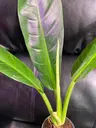
Xanthosoma delannayi
Taxonomy

Xanthosoma delannayi
Xanthosoma
Araceae
Alismatales

How to care for Xanthosoma delannayi
How often to water your Xanthosoma delannayi

every 9
Xanthosoma delannayi needs 0.5 cups of water every 9 when it doesn’t get direct sunlight and is potted in a 5" pot.
Use our water calculator to personalize watering recommendations to your environment or download Greg for more advanced recommendations for all of your plants.
Water 0.5 cups every
9
Finding light for Xanthosoma delannayi in your home

a window
Xanthosoma delannayi may have difficulty thriving, and will drop leaves 🍃, without ample sunlight.
Place it less than 3 feet from a south-facing window to maximize the potential for growth.
Select your region to see how the current weather in your area affects the placement of Xanthosoma delannayi in your home 🏡.
How to fertilize Xanthosoma delannayi

Most potting soils come with ample nutrients which plants use to produce new growth.
By the time your plant has depleted the nutrients in its soil it’s likely grown enough to need a larger pot anyway.
To replenish this plant's nutrients, repot your Xanthosoma delannayi after it doubles in size or once a year—whichever comes first.
-
So my Mickey Mouse plant had aphids… I removed it from the soil and cleaned off the plants and sprayed with a hydrogen peroxide solution +neem oil. Will it be okay in water with nutrients or do I need to repot into soil #MickeyMouseAlocasia #MickeyMouseTaro
-
Wilting & Crispy Leaves Hello, I bought this Mickey Mouse plant last Friday, repotted it and it seems like it’s struggling. I added nutrients to prevent shock from the repotting but not sure what’s going on. #MickeyMouseAlocasia #MickeyMouseTaro
-
Help identify my mystery alocasia corm!🌱🕵🏼♀️ The seller is thinking it may be alocasia Calidora, Gageana or pink dragon? Any thoughts?? #lAlocasiaAddicts #Alocasia #AlocasiaPinkDragon #AlocasiaPolly #AlocasiaSilverDragon #identify #AlocasiaAmazonica
-
My plant has spider mites. How do I fix this ?
-
Emily is seeking to be struggling a little. I repotted her to a larger pot a couple weeks ago because she seemed to be growing unhappy and she hasn’t recovered. How can I help?!
-
Any recommendations on getting this little one more full and sprouting more than 2 leaves at a time? In a 1:1:2 ratio of perlite:o bark:o potting soil, but was recently repotted to that. Gave her a bigger home when I did that. The Greg App says not to fertilize but wondering what others have done.
-
Hi, My arrowhead is growing great but it gets to the point where its leaves get too heavy and then the stem cracks and dies. Could this be too much water or too little? Or does it need more support? The leaves tend to lose their color a little as well. #ArrowleafElephantEar
-
A lot of my leaves have started to turn yellow and drop. I haven’t changed any if the conditions does this look like over watering? Or something else? 😭 #MickeyMouseTaro
-
beautiful new growth on my #ArrowleafElephantEar #ElephantEar !!
-
read below! my elephant ear has just sprouted out a new leaf (yay!) BUT!! one of the old leaves is turning yellow. both the other old and the new leaf are all perfectly green but this one isn’t :/ any ideas?


Care Summary for Xanthosoma delannayi
Xanthosoma delannayi
 Greg recommends:
 Water
Water
0.5 cups every 9 days
 Placement
< 3ft from a window
 Nutrients
Repot after 2x growth
Based on the 4” pot your plant is in, and that it doesn’t get direct sunlight.
 Trending in your area













 Similar to Xanthosoma delannayi


✨ Discover rare plants

Aglaonema Spitfire

Ace of Spades

Ceropegia simoneae

Milky Widow's Thrill

Large Leaf Elephant B…

Aglaonema 'Green Bowl'

Maroon Pitcher Plant

Fagraea ceilanica

Bonsai Crassula

Betel

Echeveria 'Joan Danie…

Orange Lipstick Plant

Philodendron eximium

Parrot Pitcher Plant

Kudu Lily

Scotch Moss