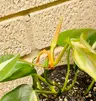
Piper papillicaule
Taxonomy

Piper papillicaule
Piper
Piperaceae
Piperales

How to care for Piper papillicaule
How often to water your Piper papillicaule

every 9
Piper papillicaule needs 0.5 cups of water every 9 when it doesn’t get direct sunlight and is potted in a 5" pot.
Use our water calculator to personalize watering recommendations to your environment or download Greg for more advanced recommendations for all of your plants.
Water 0.5 cups every
9
Finding light for Piper papillicaule in your home

a window
Piper papillicaule may have difficulty thriving, and will drop leaves 🍃, without ample sunlight.
Place it less than 3 feet from a south-facing window to maximize the potential for growth.
Select your region to see how the current weather in your area affects the placement of Piper papillicaule in your home 🏡.
How to fertilize Piper papillicaule

Most potting soils come with ample nutrients which plants use to produce new growth.
By the time your plant has depleted the nutrients in its soil it’s likely grown enough to need a larger pot anyway.
To replenish this plant's nutrients, repot your Piper papillicaule after it doubles in size or once a year—whichever comes first.
-
How to make them healthy? #Betel how shall I resolve this issue? What is the cause of this issue? Why are my betel leaves shrinking?
-
What type of pest is on my plant? I just noticed this on one of my plants. What is it? #PlantAddict #PestControl #help
-
HOLY CRAP!!! Now I find this on Piper. Can you believe it!. I am getting a crash course in pests and disease this summer. Are those black dots eggs??? #happyplants #plantsmakepeoplehappy #jodisplace #pestcontrol #redbetel
-
Can you see this tiny little round hole? Recently, I had a plant with Thripes. Diagnosed on leaf damage. Now I have a plant with 2 leaves that have perfectly round little holes in them. Is this also from thripes. You can see both holes in the one photo. This is the same plant that has all those little beads all over it all the time. Should I remove them? #happyplants #plantsmakepeoplehappy #plantaddict #jodisplace #redbetel
-
Hey plant experts! My Greg app is saying this is a Caladium/ Heart of Jesus. Is this accurate? Just wanna know how to care for this pink princess. Got her at an estate sale and she’s getting a lil droopy. Had her 2 weeks and only watered her once. Soil is not dry yet and have been giving her extra sun since she seems to be not getting enough? Any thoughts are welcome! Happy planting 🪴🤞🏼
-
What am I doing wrong here? My plant has a dying leaf on the bottom, and the new leaf at the top died. I follow Greg watering and always use meter to test. There are no drafts where she is, no vents etc.
-
My Piper Crocatum is dropping seemingly healthy leaves. Would anyone have any insight as to why she might be doing this? #HappyPlants #PlantsMakePeopleHappy #PlantAddict
-
Pipes was losing her battle with the moss pole. It was just too heavy. So, I switched it out for a Super Trellis! #HappyPlants #PlantsMakePeopleHappy #PlantAddict #PlantTherapy #PLANTMAFIA #tgw
-
I feel like Greg isn’t telling me when I should water my piper… is anyone else having this issue? #PiperPals #RedBetel
-
I found some white and black specs all over my plant that looks like salt and pepper, what do I do☹️ #RedBetel


Care Summary for Piper papillicaule
Piper papillicaule
 Greg recommends:
 Water
Water
0.5 cups every 9 days
 Placement
< 3ft from a window
 Nutrients
Repot after 2x growth
Based on the 4” pot your plant is in, and that it doesn’t get direct sunlight.
 Trending in your area













 Similar to Piper papillicaule



✨ Discover rare plants

Chinese Evergreen 'Go…
Stanhopea tigrina

Aglaonema 'Green Bowl'

Caladium

Ruby Ball

Sedum 'White Diamond'

Picasso's Paintbrush

Haworthia emelyae com…
Thelocactus macdowell…

Black Monkey Thorn Tr…

Kilimanjaro Plant

Lithops

Vatricania guentheri

Burro's Tail

Sarcochilus fitzgeral…

Electric Blue Gecko

Starfish Snake Plant