


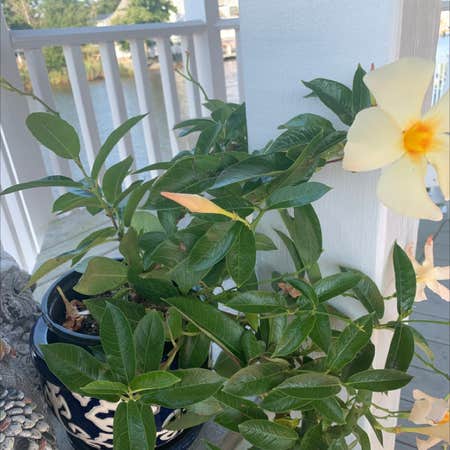


bush allamanda
About bush allamanda
bush allamanda is a super rare houseplant 🌿 that is isn’t challenging to grow and needs regular watering to thrive. They do best in long-lasting, direct light ☀️ and should be less than 1 foot from a window.
bush allamanda likes soil that is well draining. You may want to supplement with a gentle, organic fertilizer throughout the peak growing season.
bush allamanda belongs to the Allamanda genus, and is native to Northeastern Argentina and Southern Brazil.
⚠️ bush allamanda is extremely dangerous if consumed. If you, a family member, or a pet has ingested any amount of plant material contact Poison Control, US (800) 222-1222, or your veterinarian immediately. These plants are not recommended for homes with children, cats, or dogs.
Taxonomy

Allamanda schottii
Allamanda
Apocynaceae
Gentianales

How to care for bush allamanda
How often to water your bush allamanda

every 9
bush allamanda needs 0.5 cups of water every 9 when it doesn’t get direct sunlight and is potted in a 5" pot.
Use our water calculator to personalize watering recommendations to your environment or download Greg for more advanced recommendations for all of your plants.

Water 0.5 cups every
9
Finding light for bush allamanda in your home

a window
bush allamanda love being close to bright, sunny windows 😎.
Place it less than 1ft from a south-facing window to maximize the potential for growth.
bush allamanda does not tolerate low-light 🚫.
Select your region to see how the current weather in your area affects the placement of bush allamanda in your home 🏡.
How to fertilize bush allamanda

Most potting soils come with ample nutrients which plants use to produce new growth.
By the time your plant has depleted the nutrients in its soil it’s likely grown enough to need a larger pot anyway.
To replenish this plant's nutrients, repot your bush allamanda after it doubles in size or once a year—whichever comes first.
-
somebody please help !! does anyone have an idea of what may be causing this yellow discoloration? #HappyPlants #PlantsMakePeopleHappy #PlantAddict #NewGrowth #yellowalamanda #alamanda #GoldenTrumpet #BushAllamanda #oliviasoasis #GregGang #greggivesback
-
hello, does anyone know why the leaves are yellowing:( ? #GoldenTrumpet #plantadvice #HappyPlants #PlantsMakePeopleHappy #PlantAddict #NewGrowth #oliviasoasis #GregGang #greggivesback
-
hello, can anyone tell me why the leaves are yellowing ? :( #GoldenTrumpet
-
I like too know name of the plant i look under the name Allmanda but is not looking like the plant on the picture


Care Summary for bush allamanda

bush allamanda
 Greg recommends:
 Water
Water
0.5 cups every 9 days
 Placement
< 1ft from a window
 Nutrients
Repot after 2x growth
Based on the 4” pot your plant is in, and that it doesn’t get direct sunlight.
 Trending in your area









 Similar to bush allamanda


✨ Discover rare plants

Haworthia emelyae com…

Lavandula Pedunculata

Kudu Lily

Picasso's Paintbrush

Hoya 'Millie'

Aglaonema Spitfire

Anthurium Fingers

Black Monkey Thorn Tr…
Phalaenopsis schiller…

Raphionacme flanaganii

Philodendron 'Glorius'

Large Leaf Elephant B…

Munstead Lavender

Chandelier Plant

Echeveria Arrow

Aloe 'Lavender Star'
Graptopetalum 'Marqui…
