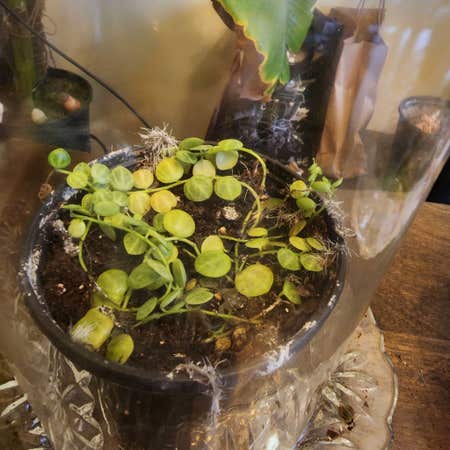
String of Turtles
About String of Turtles
Did you know Peperomia plants belong to the pepper family, along with black peppercorns? Their fruits and seeds have traveled one of the longest distances ever recorded, over 3000 miles to an island in the middle of the Atlantic ocean, while stuck to a bird's feet! 🦅 They can be easily propagated by leaves which make them super easy to share with friends!
Taxonomy

Peperomia Prostata
Peperomia
Piperaceae
Piperales
Also known as
Trailing Peperomia

How to care for String of Turtles
How often to water your String of Turtles

every 9
String of Turtles needs 0.5 cups of water every 9 when it doesn’t get direct sunlight and is potted in a 5" pot.
Use our water calculator to personalize watering recommendations to your environment or download Greg for more advanced recommendations for all of your plants.

Water 0.5 cups every
9
Finding light for String of Turtles in your home

a window
String of Turtles may have difficulty thriving, and will drop leaves 🍃, without ample sunlight.
Place it less than 3 feet from a south-facing window to maximize the potential for growth.
Select your region to see how the current weather in your area affects the placement of String of Turtles in your home 🏡.
How to fertilize String of Turtles

Most potting soils come with ample nutrients which plants use to produce new growth.
By the time your plant has depleted the nutrients in its soil it’s likely grown enough to need a larger pot anyway.
To replenish this plant's nutrients, repot your String of Turtles after it doubles in size or once a year—whichever comes first.
-
My peperomia was potted in way to big of a pot when I bought it so it rotted. I chopped it from the trunk and stuck it in water and now it's rooting. What should my next move be? Will it be successful in soil? #Peperomia
-
How do you plant a propagated pup? I water propped my sister’s baby rubber plant (Peperomia obtusifolia) and it grew roots and a pup 🥹 but I don’t know how to transfer it to soil 😅 Can anyone tell me how to transfer this? Do I remove the pup or just put the whole thing with the big leaf and everything in the new pot? #Peperomia #PropagationStation #Propagation #HappyPlants #PlantsMakePeopleHappy #PlantAddict #NewGrowth
-
#PropagationStation #Peperomia
-
So long story short, I think I under watered them over watered and the leaves started to fall off and then the stem turned black. Do you think it’ll come back to life? Thank you! #Peperomia
-
How can i help my peperomia? #Peperomia #succulentlove #happyplants #plantsmakepeoplehappy My baby isnt doing well, she has many damaged/cut leaves from when i first got her, she has a big mushy brown spot on one leaf, and the leafs look some what curled at the edges aswell and bent, help! Should i prune all the damaged leafs? Will it ruin how much grows back?
-
Leaves are browning help #Peperomia what is wrong my watermelon plant's leaves
-
Is this Normal? My plant looks dry at the root. I have loved it to better lighting and bottom watered so as to not over water her. She feels like she’s doing good until I looked deeper. Is this normal??? #Peperomia
-
Early evening; the uninvited guest. Wow, they're so cute. Gecko #Peperomia #plantsmakepeoplehappy #peperomiapals #greggang #happyplants
-
Happy #freshleaffriday to those that "Friday" is a thing 😂 the times I've had jobs where "finally friday" meant something were great, but none of them were my favorite. 🤷🏽 I have SO many photos to share today! I tried to narrow it down but I just can't so they are continued in the comments. NEW PLANTS: 🌱 Hopefully I'm alright at this #corm thing because @lemrobs sent me four more! 🌱 I couldn't pass up @angelw1975 offer so I am about to build my own #lithopsarmy! PROPS: 🌱 My two pots of #snakeplant props both put out pups, or as I like to called them, snakelets! 🌱 My #watermelonpeperomia props are finally popping out of the soil! 🌱 The #monstera that I chopped and propped is putting out not one, but two new leaves! 🌱 #dwarfumbrellatree top is putting out it's first new growth since I put it in soil! 🌱 The #swisscheesevine I chopped and propped is also putting out it's first leaves! FLOWERS: 🌱 Both of my #kenyanviolet rescues are blooming for the first time since I saved them! PLANTS: 🌱 I cut my largest #rubberplant to try and convince her to branch better. Well, I have these three huge ones and five more that are teasing me! 🌱 My #ficusgem has been putting out the most perfect leaves lately, four and counting! 🌱 The #hoyarosita I got from #plantproper is throwing out the cutest new leaves! 🥺 🌱 My #krimsonqueen from PP is also throwing out it's first pink leaves! 🌱 Last but not least, 2/3 of my #strawberrybegonia are throwing out babes! Phew! I think that is everyone! #alocasia #alocasiamaharani #alocasiaaddicts #lithops #sanserveria #peperomia #monsteradeliciosa #monsteramob #monsteraadonsonii #chopandprop #propdontshop #ficus #ficusgang #ficusfam #hoya #hoyahangout #hoyaheads #begonia #begoniabunch #happyplants 🌱 #NewEnglandGregGang 🌱 #MaineGang 🌱 #ThePlantMompy
-
I got new babies welcoming all tips and tricks. Thanks in advance. Look at this beauty.


Care Summary for String of Turtles

String of Turtles
 Greg recommends:
 Water
Water
0.5 cups every 9 days
 Placement
< 3ft from a window
 Nutrients
Repot after 2x growth
Based on the 4” pot your plant is in, and that it doesn’t get direct sunlight.
 Trending in your area









 Similar to String of Turtles


✨ Discover rare plants
Stanhopea tigrina

Tuber Fleeceflower

Chinese Evergreen 'Go…
Hoya 'Memoria'

Sedum 'White Diamond'

Burro's Tail

Caladium

Radiator Plant

Aloe 'Lavender Star'

Crassula 'Purple Drag…

Miss All-American Bea…

Aglaonema 'Green Bowl'

Ace of Spades

Thelocactus macdowell…

Scindapsus pictus 'Si…

Milky Widow's Thrill