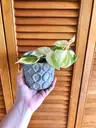
Dianthus guttatus subsp. dicaricatus
Taxonomy

Dianthus guttatus subsp. dicaricatus
Dianthus
Caryophyllaceae
Caryophyllales

How to care for Dianthus guttatus subsp. dicaricatus
How often to water your Dianthus guttatus subsp. dicaricatus

every 9
Dianthus guttatus subsp. dicaricatus needs 0.5 cups of water every 9 when it doesn’t get direct sunlight and is potted in a 5" pot.
Use our water calculator to personalize watering recommendations to your environment or download Greg for more advanced recommendations for all of your plants.
Water 0.5 cups every
9
Finding light for Dianthus guttatus subsp. dicaricatus in your home

a window
Dianthus guttatus subsp. dicaricatus love being close to bright, sunny windows 😎.
Place it less than 1ft from a south-facing window to maximize the potential for growth.
Dianthus guttatus subsp. dicaricatus does not tolerate low-light 🚫.
Select your region to see how the current weather in your area affects the placement of Dianthus guttatus subsp. dicaricatus in your home 🏡.
How to fertilize Dianthus guttatus subsp. dicaricatus

Most potting soils come with ample nutrients which plants use to produce new growth.
By the time your plant has depleted the nutrients in its soil it’s likely grown enough to need a larger pot anyway.
To replenish this plant's nutrients, repot your Dianthus guttatus subsp. dicaricatus after it doubles in size or once a year—whichever comes first.
-
What is going on with flowers? I came home and just see this spot forming in the middle. What can I do differently to help whatever this is ? #help #Dianthus
-
Hello Everyone. I’ve just progressed to being an outside plant mom. I’m growing Dianthus, Marigold, and Lavender. I hope the deer don’t eat them. I read the smell should be an animal deterrent. Either way excited about my growing plant family. Open to tips or trade secrets. 🤗
-
How do I delete a picture on this app? #ChinesePink
-
I don't know why my plant is drying.I water it regularly. #BorderCarnation
-
Why does my plant hate life? #SweetWilliam
-
Why is my plant suddenly wilting? I have made sure to water it and it shows it’s trying to grow new leaves but it’s suddenly started to wilt. It’s in sunlight outside. Please help!
-
Is this plant toxic? Calling all people who grow this plant! (Which is a small amount of people 😝) Can you help me find out whether or not this plant is toxic?
-
I got this from a flower bouquet we sell. It fell off the stem. I've been keeping the pieces in water to try and get a root going. It isn't showing up correctly in this app. I need advice on how to propagate this. It says it is a dianthus green trick. #SweetWilliam
-
@MusicalRedmint What should I name my new plant? Same Greek/Underworld theme as usual!
-
Hi, my sweet Willam isn’t doing good at all…does anyone know if there’s something I could do to fix it? #SweetWilliam


Care Summary for Dianthus guttatus subsp. dicaricatus
Dianthus guttatus subsp. dicaricatus
 Greg recommends:
 Water
Water
0.5 cups every 9 days
 Placement
< 1ft from a window
 Nutrients
Repot after 2x growth
Based on the 4” pot your plant is in, and that it doesn’t get direct sunlight.