


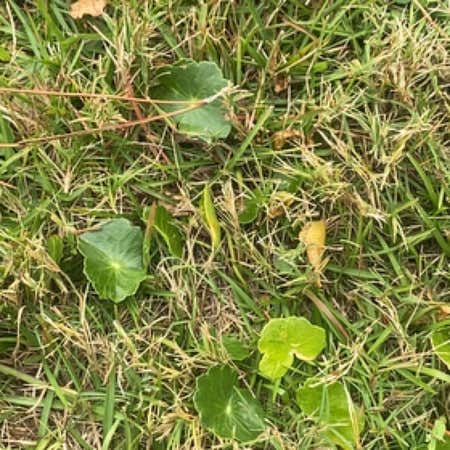
Marsh Pennywort
Kiersten Rankel
Kiersten lives in New Orleans, LA and graduated with her masters degree in Ecology and Evolutionary Biology from Tulane University in 2019.
She has conducted or assisted on research studies covering trees such as the bald cypress, swamp maple, and water tupelo, as well as important marsh grasses including Juncus, Spartina, and Phragmites.
Kiersten is a certified Louisiana Master Naturalist and regularly volunteers with local community gardens and nonprofits to help restore critical ecosystems along the Gulf Coast.
About Marsh Pennywort
Marsh Pennywort is a super rare houseplant 🌿 that is easy to grow and needs lots of water to thrive. They do best in long-lasting, direct light ☀️ and should be less than 1 foot from a window.
Marsh Pennywort likes soil that is good at retaining moisture. Your plant shouldn't need added fertilizers if you repot each time it doubles in size.
Marsh Pennywort belongs to the Hydrocotyle genus, and is native to Northern Africa and Europe.
Taxonomy

Hydrocotyle vulgaris
Hydrocotyle
Apiaceae
Apiales
Also known as
Hydrocotle vulgaris

How to care for Marsh Pennywort
How often to water your Marsh Pennywort

every 7
Marsh Pennywort needs 0.5 cups of water every 7 when it doesn’t get direct sunlight and is potted in a 5" pot.
Use our water calculator to personalize watering recommendations to your environment or download Greg for more advanced recommendations for all of your plants.

Water 0.5 cups every
7
Finding light for Marsh Pennywort in your home

a window
Marsh Pennywort love being close to bright, sunny windows 😎.
Place it less than 1ft from a south-facing window to maximize the potential for growth.
Marsh Pennywort does not tolerate low-light 🚫.
Select your region to see how the current weather in your area affects the placement of Marsh Pennywort in your home 🏡.
How to fertilize Marsh Pennywort

Most potting soils come with ample nutrients which plants use to produce new growth.
By the time your plant has depleted the nutrients in its soil it’s likely grown enough to need a larger pot anyway.
To replenish this plant's nutrients, repot your Marsh Pennywort after it doubles in size or once a year—whichever comes first.
-
My one of the favorites.. I use to sit besides it and talk to it. So peaceful and happy plant. I want a balcony full of pennywort. ✳️
-
Unfortunately, Walt the manyflower marshpennywort has passed away. We will always remember his single leaf and teacup pot. 😭 #PlantGraveyard #ManyflowerMarshpennywort #DeadPlant #Remember #DIYPlanter
-
Why does it only have one leaf? My manyflower marshpennywort can only have one leaf at a time? It used to have 5 and 3 died then it grew 2 more then 4 died leaving it with one. It seems to be able to only have one leaf. Anyone know how to deal with this? The poor plant looks depressed. 😔 #ManyflowerMarshpennywort #WeirdPlants #PlantAddict #BeforeAndAfter
-
Do Pennyworts thrive in water only environment? #ManyflowerMarshpennywort


Care Summary for Marsh Pennywort

Marsh Pennywort
 Greg recommends:
 Water
Water
0.5 cups every 7 days
 Placement
< 1ft from a window
 Nutrients
Repot after 2x growth
Based on the 4” pot your plant is in, and that it doesn’t get direct sunlight.
 Trending in your area








 Similar to Marsh Pennywort

✨ Discover rare plants

Caladium

Pseudorphipsalis 'Blu…
White Apple Moth Orch…
Chinese Evergreen 'Ga…

Scindapsus pictus 'Si…

Fernleaf Lavendar

Miss All-American Bea…

Graptoveria 'Douglas …

Aeonium 'Blushing Bea…

Chinese Evergreen 'Go…
Skeleton Key Pothos

Raphionacme flanaganii

Anastasia Weeping Fig
Thelocactus macdowell…

Pine Cone Plant

Anthurium Fingers

Aglaonema Spitfire
Greg’s plant care information is derived from first-principles biology and physics and supported by peer-reviewed research, academic institutions, and industry experts. We are committed to providing the highest-quality plant care information available, so if you have any concerns about our content, feel free to reach out to our support.
- Plants for a Future. “Plant Database.” pfaf.org. N.p., n.d. Web.
- Encyclopedia of Life. “Encyclopedia of Life.” eol.org. N.p., n.d. Web.