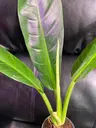
Petunia 'Baby Duck'
Taxonomy

Petunia 'Baby Duck'
Petunia
Solanaceae
Solanales

How to care for Petunia 'Baby Duck'
How often to water your Petunia 'Baby Duck'

every 9
Petunia 'Baby Duck' needs 0.5 cups of water every 9 when it doesn’t get direct sunlight and is potted in a 5" pot.
Use our water calculator to personalize watering recommendations to your environment or download Greg for more advanced recommendations for all of your plants.
Water 0.5 cups every
9
Finding light for Petunia 'Baby Duck' in your home

a window
Petunia 'Baby Duck' love being close to bright, sunny windows 😎.
Place it less than 1ft from a south-facing window to maximize the potential for growth.
Petunia 'Baby Duck' does not tolerate low-light 🚫.
Select your region to see how the current weather in your area affects the placement of Petunia 'Baby Duck' in your home 🏡.
How to fertilize Petunia 'Baby Duck'

Most potting soils come with ample nutrients which plants use to produce new growth.
By the time your plant has depleted the nutrients in its soil it’s likely grown enough to need a larger pot anyway.
To replenish this plant's nutrients, repot your Petunia 'Baby Duck' after it doubles in size or once a year—whichever comes first.
-
Help me name my plant I don’t know for sure if I got the type of plant it it but it’s what the GregID gave me
-
I love this plant
-
Petunia I just got these today, for mothers day. I'm not sure what soil to use, what pots, I'm just not sure how to keep these alive. Could use some advice #petunia
-
Why does it seem like some of the leaves are dying on my firefly Petunia ? So I got three fire petunias it’s been at least 2 months since I got them. I struggled a lot at first because it seems my firefight between us did not like any of the grow lights that I had and we’re slowly dying off. I tried putting them in my self watering pot with grow light embedded in it, but they were still dying. Now they seem to be doing a lot better. I bought high wattage lights, I have them both in plastic pots with a very well draining soil. I do a constant feed regimen. I do notice they seem to like to be slightly moist. Like I checked the drip trays and if they look wet, then I don’t water the plant because it’s happy like that, if the drip tray does end up going dry that’s when I start to see leaves dying. My issue is with the bigger of the two plants that are still alive. Seems to have some wilting leaves despite the fact that it seems happy and its current state. #FireflyPetunia #help
-
I NEED HELP!! What grow light can I Buy to keep my firefly petunias from dying !?? So I have my three beautiful firefly petunias and I feel like I’m slowly watching them die😭. I don’t think my grow lights are strong enough. And I get NO direct sunlight where I live. Please help !!! #FireflyPetunia #help
-
This is my FIREFLY PETUNIA
-
Say hello to my new leaf baby “Firefly Petunia”
-
I need help! Please this is supposed to be a petunia plant.! What should I do to help it? I found an eastern lubber grasshopper in her a couple of days ago. I think it has laid eggs and they are still eating her!
-
One of the 3 visitors that came to visit my flowers! It went to my petunia and rose! (Sorry couldn’t add a second plant)
-
Possibly Dying? My lovely petunias, Fraya, I got recently (I believe the 11th) because I felt as though these little guys could use some extra TLC their flowers are drying out near the edges, and I just had an entire flower, not even fully bloomed, fall off this morning as I was checking on them. I watered them the day I got them and am planning on getting a larger pot within the next couple of weeks. I am placing them outside for about 3 hours in morning sunlight then I move them to my northwest facing window for indirect light the rest of the day. If there is anything else that I can do to try and help keep these beauties alive please let me know ❣️ #plantdad #petunia #plantsmakepeoplehappy #newplantdad #sickplants


Care Summary for Petunia 'Baby Duck'
Petunia 'Baby Duck'
 Greg recommends:
 Water
Water
0.5 cups every 9 days
 Placement
< 1ft from a window
 Nutrients
Repot after 2x growth
Based on the 4” pot your plant is in, and that it doesn’t get direct sunlight.
 Trending in your area









 Similar to Petunia 'Baby Duck'


✨ Discover rare plants

Bonsai Crassula

Lavandula Pedunculata

Electric Fern

Sedum 'White Diamond'

Christmas Candle

Burro's Tail

Hoya pottsii 'Khao Ya…
Phalaenopsis schiller…

Sarcochilus fitzgeral…

Euphorbia

Philodendron eximium

Eden Climbing Rose

Kudu Lily
Crassula 'Calico Kitt…

Miss All-American Bea…

Black Monkey Thorn Tr…