

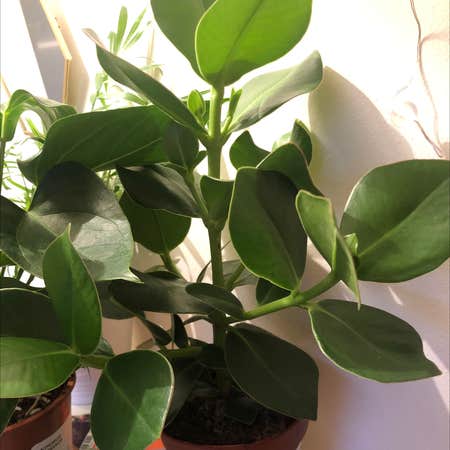


Carissa Macrocarpa
About Carissa Macrocarpa
Natal Plum is an easy to grow spiny evergreen shrub with dense leathery green leaves, fragrant white flowers and showy edible red fruits. It can be used as a hedge, security screen or foundation planting where it is hardy or it can be grown in a container that is brought indoors in the winter.
Taxonomy

Carissa macrocarpa
Carissa
Apocynaceae
Gentianales
Also known as
Natal Plum, Natal Plum, Large num-num, Amathungulu, Umthungulu obomvu and Noem-noem

How to care for Carissa Macrocarpa
How often to water your Carissa Macrocarpa

every 9
Carissa Macrocarpa needs 0.5 cups of water every 9 when it doesn’t get direct sunlight and is potted in a 5" pot.
Use our water calculator to personalize watering recommendations to your environment or download Greg for more advanced recommendations for all of your plants.

Water 0.5 cups every
9
Finding light for Natal Plum in your home

a window
Carissa Macrocarpa love being close to bright, sunny windows 😎.
Place it less than 1ft from a south-facing window to maximize the potential for growth.
Carissa Macrocarpa does not tolerate low-light 🚫.
Select your region to see how the current weather in your area affects the placement of Carissa Macrocarpa in your home 🏡.
How to fertilize Carissa Macrocarpa

Most potting soils come with ample nutrients which plants use to produce new growth.
By the time your plant has depleted the nutrients in its soil it’s likely grown enough to need a larger pot anyway.
To replenish this plant's nutrients, repot your Carissa Macrocarpa after it doubles in size or once a year—whichever comes first.
-
Showing some growth & progress on my very 1st official #Bonsai. A little more then a year of training & growing to form this from when I 1st got this plant, This small tree looks so old to me that bark is just ancient. Thinking of taking it out of the pot & replanting it into a much larger container to get some thicker growth. Thoughts on overall look, shape, opinions or suggestions/tips On my Bonsai would be appreciated. I’m new to the style and growth habit even though I have been putting trees in pots for years. A lot of you have as well and you have official bonsai trees because definition is a tree in a pot so all of you who have a tree in a pot should get a little bit more into this style of growing. Just my opinion Show off your #bonsai trees today just curious what everyone has as far as natures manipulated artwork. I have a serious question for the true bonsai enthusiast about planting in ground to grow trunk mass.. question is let’s say I have a small unused pool or very large capacity container like an old freezer. Would that be considered large enough of a container to get the trunk to thicken on trees faster or would it actually need to be in the ground ? Because my thoughts fight with each other and says it will never be able to get the nutrients from a confined space, even though the other side of my mind says the roots won’t ever get that big enough to get all the nutrients from a larger space. I know there is no official right answer but just wondering what kind of experience we have out there 🫶🏽 feed the soil microbes 🦠 right? Thanks #HappyPlants #PlantsMakePeopleHappy #PlantAddict #NewGrowth #Bonsai
-
Why's he dropping leaves? My #natalplum has dropped a few leaves yesterday, hadn't hey all look like this? All have this brown in the middle and is in generel very bendy and soft?? (the two brown dots are from my fingers pressing down on it.)


Care Summary for Carissa Macrocarpa

Carissa Macrocarpa
 Greg recommends:
 Water
Water
0.5 cups every 9 days
 Placement
< 1ft from a window
 Nutrients
Repot after 2x growth
Based on the 4” pot your plant is in, and that it doesn’t get direct sunlight.
 Trending in your area
Jelly Bean Plant

Blushing Bride Air Pl…

Majesty Palm

Pincushion Peperomia
Monstera
Dieffenbachia

White Bird of Paradise

Tomato Plant

Arabian Coffee Plant

Ficus Ginseng
Jade Pothos
Split Leaf Philodendr…
Kentia Palm
Rubber Plant
Marble Queen Pothos

String of Buttons

Emerald Ripple Pepero…
Sweet Basil
 Similar to Carissa Macrocarpa


✨ Discover rare plants

Vatricania guentheri

Begonia lubbersii

Bonsai Crassula

Burro's Tail

Electric Blue Gecko

Radiator Plant

Thelocactus macdowell…
Carolina Reaper

Variegated Arrowhead …

Aglaonema 'Green Bowl'

Fernleaf Lavendar

Philodendron eximium

Scindapsus pictus 'Si…

Begonia hydrocotylifo…

Cereus peruvianus 'Pa…

Anthurium Fingers
Skeleton Key Pothos
