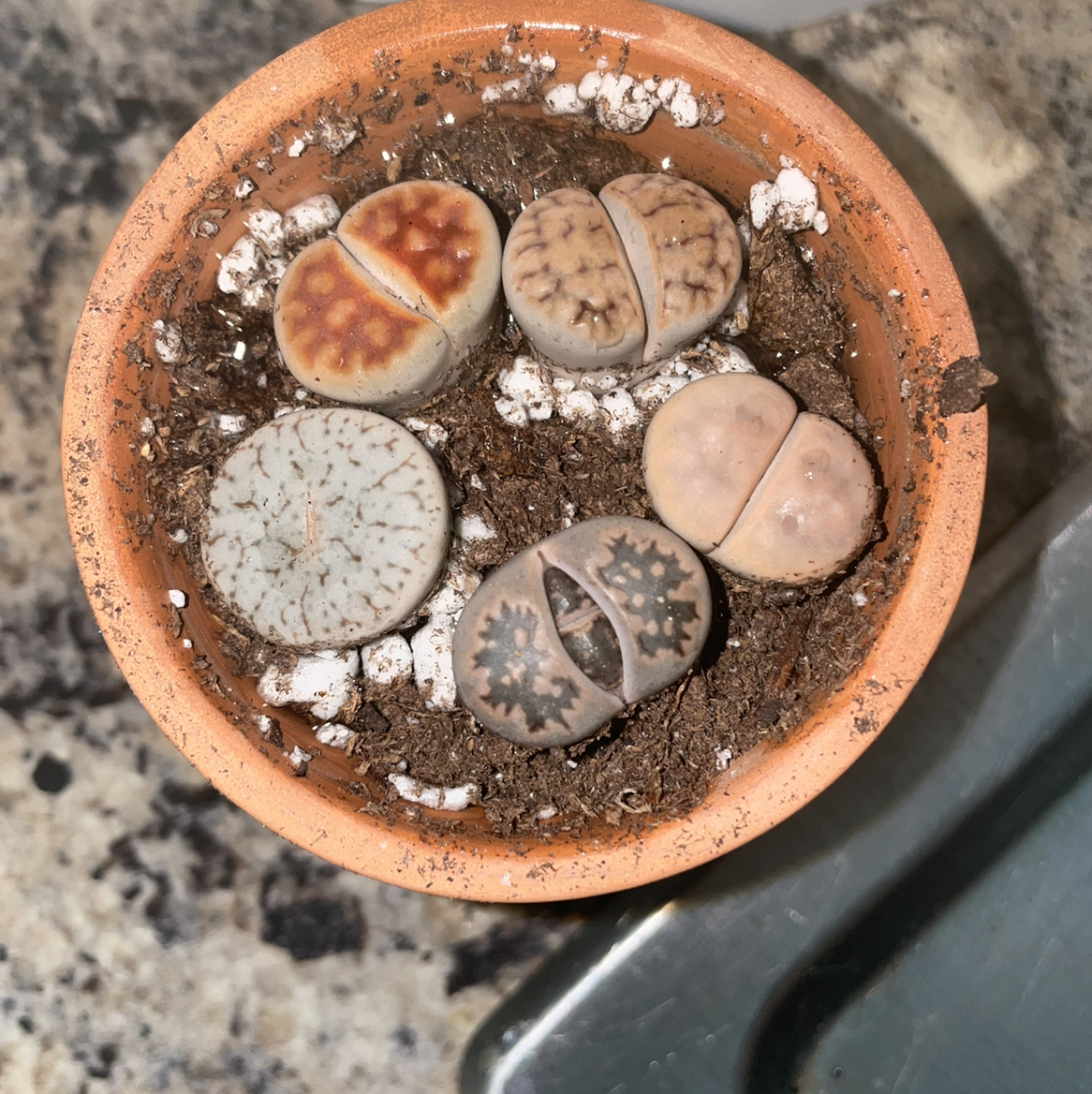
Lithops bromfieldii

How to Fertilize Lithops bromfieldii

Lithops bromfieldii
Reviewed by Kiersten Rankel M.S.
Quick Answer
Lithops barely need fertilizer. Use a dilute cactus-succulent formula (2-7-7 or similar low-nitrogen blend) at quarter strength once in early fall when new leaf pairs emerge. Skip feeding entirely during their summer dormancy and winter splitting phase.

When Should I Start Feeding My Lithops?

Lithops follow an unusual growth cycle where active growth occurs in fall rather than spring, so feeding timing is opposite to most houseplants.

US feeding regions map
Pacific Sep–Nov
Mountain Sep–Oct
Midwest Sep–Oct
Northeast Sep–Oct
Southeast Sep–Nov
Stay on top of plant care
Get seasonal reminders for watering and fertilizing — personalized for your plants.
Try Greg Free

How Often Should I Fertilize My Lithops?

Once or twice per year is plenty. Feed once in early fall when you see new leaf pairs beginning to push through, and optionally a second time about a month later if the plant looks healthy.

Do not fertilize during the summer dormancy period when Lithops rest, or in winter and spring while the old leaves are splitting and transferring moisture to the new pair. Feeding during these phases can cause swelling or rot.

Signs of over-fertilizing include mushy or discolored leaves. If you are ever unsure, skip the feeding entirely. Lithops are adapted to nutrient-poor soil and will do fine without it.

Feeding Calendar
Spring
No feeding (old leaves splitting)
Summer
No feeding (dormancy)
Early Fall
Quarter-strength cactus fertilizer, once or twice
Late Fall & Winter
No feeding (splitting cycle begins)

What Is the Best Fertilizer for Lithops?

Lithops thrive on very little. A low-nitrogen cactus and succulent fertilizer with a ratio like 2-7-7 or 1-2-2 is ideal because too much nitrogen causes soft, stretched growth that invites rot.

Use a liquid formula diluted to one-quarter the label rate. That tiny dose delivers enough phosphorus and potassium to support root health and the annual leaf-splitting cycle without pushing the plant beyond its natural pace.

Granular or slow-release fertilizers are too concentrated for Lithops. Stick with a dilute liquid so you have precise control over how much reaches the roots.

Synthetic
Low-nitrogen liquid designed for succulents. Dilute to quarter strength for Lithops, roughly 3-4 drops per quart.
Pre-diluted pump formula that is gentle enough for sensitive succulents. One pump per watering during fall.
Organic
Gentle organic liquid with low nitrogen. Dilute to half the label rate for Lithops.
Sprinkle a thin layer on the soil surface once in fall. Releases nutrients slowly without risk of burn.

How Do I Fertilize My Lithops?

1
Wait for active growth
Only fertilize when you see new leaf pairs emerging in early fall. If the old leaves are still plump and intact, the plant is not ready.
2
Water the soil first
Give the soil a light watering and let it absorb for about 30 minutes. This protects the roots from fertilizer burn.
3
Dilute to quarter strength
Mix your cactus-succulent liquid fertilizer at one-quarter the label rate. For most products, that is roughly 1/8 teaspoon per gallon of water.
4
Apply to the soil only
Pour the diluted solution directly onto the soil, avoiding the leaf surfaces. Lithops can trap moisture between their leaves, which leads to rot.
5
Let the soil dry completely
After feeding, allow the soil to dry out fully before the next watering. Lithops roots are extremely rot-prone in wet conditions.

Got More Questions?

Can I use regular houseplant fertilizer on Lithops?
It is not recommended. Standard houseplant fertilizers are too high in nitrogen, which causes Lithops to swell and become vulnerable to rot. Use a low-nitrogen cactus formula instead.
What happens if I over-fertilize my Lithops?
The leaves may become soft, swollen, or develop brown spots. In severe cases the plant splits open or rots from the inside. If you suspect over-fertilizing, flush the soil with plain water and skip all future feedings for at least six months.
Should I fertilize Lithops during the splitting phase?
No. When old leaves are shriveling and new ones are emerging underneath, the plant draws all its moisture and nutrients from the old pair. Adding fertilizer disrupts this process and can cause the new leaves to grow unevenly.
Can I use coffee grounds or banana peels on Lithops?
Coffee grounds are too acidic and retain too much moisture for Lithops. Banana peels do not deliver meaningful nutrients to potted plants and can attract pests. Stick with a proper cactus fertilizer once a year.
Do Lithops need fertilizer at all?
They can survive without it. In the wild, Lithops grow in extremely poor soil. A light annual feeding supports healthy leaf splitting and subtle color patterns, but skipping it entirely will not harm the plant.
Stay on top of plant care
Get seasonal reminders for watering and fertilizing — personalized for your plants.
Try Greg Free

About This Article

Kiersten Rankel M.S.
Botanical Data Lead at Greg · Plant Scientist
About the Author
Kiersten Rankel holds an M.S. in Ecology & Evolutionary Biology from Tulane University. A certified Louisiana Master Naturalist, she has over a decade of experience in science communication, with research spanning corals, cypress trees, marsh grasses, and more. At Greg, she curates species data and verifies care recommendations against botanical research.
See Kiersten Rankel's full background on LinkedIn.
Editorial Process
Fertilizer recommendations verified against Lithops bromfieldii growth data from Greg's botanical database, cross-referenced with USDA hardiness zone data and published horticultural research.
503+ Greg users growing this plant
USDA hardiness zones 10a–11b