

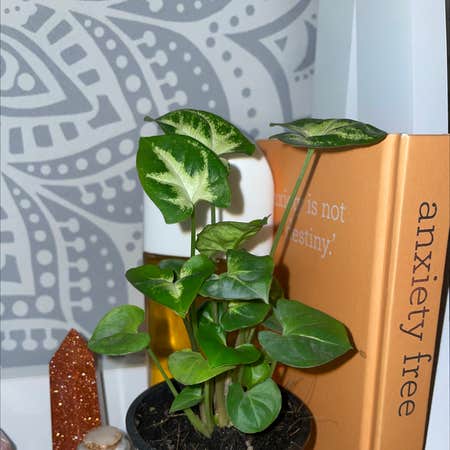


Syngonium Pixie
About Syngonium Pixie
Syngonium podophyllum is a popular, easy-to-care-for houseplant with beautiful arrowhead shaped leaves. You’ll often see these plants grown in their juvenile stage, but given something to climb on and abundant sunlight you may see them mature into their adult stage! The leaf shape changes as they mature and may even appear to split into three individual leaves. In the wild they can climb up to 65 feet tall. Be sure to handle them with care, as their sap contains oxalic acid which can be very irritating to the skin and eyes. 👀
Taxonomy

Syngonium podophyllum 'Pixie'
Syngonium
Araceae
Alismatales
Also known as
Syngonium podophyllum Pixie, Syngonium Pixie and Syngonium 'Pixie'

How to care for Syngonium Pixie
How often to water your Syngonium Pixie

every 9
Syngonium Pixie needs 0.5 cups of water every 9 when it doesn’t get direct sunlight and is potted in a 5" pot.
Use our water calculator to personalize watering recommendations to your environment or download Greg for more advanced recommendations for all of your plants.

Water 0.5 cups every
9
Finding light for Syngonium Pixie in your home

a window
Syngonium Pixie can tolerate being far from a window and light source.
Place it less than 6 feet from a south-facing window to ensure it receives enough light to survive 💪.
Select your region to see how the current weather in your area affects the placement of Syngonium Pixie in your home 🏡.
How to fertilize Syngonium Pixie

Most potting soils come with ample nutrients which plants use to produce new growth.
By the time your plant has depleted the nutrients in its soil it’s likely grown enough to need a larger pot anyway.
To replenish this plant's nutrients, repot your Syngonium Pixie after it doubles in size or once a year—whichever comes first.
-
I seen this plant on a 50% off wrack in my favorite plant shop. It wasn’t doing well but I thought it would be a fun little plant project. I’ve never heard of a Syngonium ‘Mickey’ before! It’s supposed to get really pink! I’m excited to watch this one grow! #HappyPlants #PlantsMakePeopleHappy #PlantAddict #NewGrowth #PlantTherapy #syngonium #syngoniumpodophyllum #mickey #sungoniummickey #syngoniumpodophyllummickey #BeforeAndAfter
-
Which type of pot is best for my pink syngonium? #Syngonium
-
There are tiny brown spots on the white areas of the leaves, please help, just brought home from local nursery today. They aren’t pests from what I can see, they do not rub off etc. already tried to clean the leaf #Syngonium
-
Humidity Huddle while watering today!! #HappyPlants #Fittonia #Syngonium #Aglaonema #PlantsMakePeopleHappy #NewGrowth #PlantTherapy #GrowLights #PlantCorner #philodendron #PlantLove #humidityhuddle @Maddsplantz
-
Hello new here we recently moved house and this guy ended up left in a box for the last 6 weeks and it’s not looking good. Any suggestions to help bring them back? #Syngonium
-
Should my plant have white lines on the leaves? #Syngonium I've had my syngonium plant for a while now and it's doing really well! 😍 It's gotten really big and seems healthy. Except it doesn't have white lines on the leaves like all the pictures... Should I be worried? ☹️
-
Is this the milk confetti of my dreams?? @lifeis2short 💙 A little late for #freshleaffriday as usual, but look at this stunner 🤩 The variegation is crazy!! There's a speckled half moon right there!! #happyplants #plantsmakepeoplehappy #plantaddict #newgrowth #syngonium #syngoniumsquad
-
This little pink Syngonium followed me home… can I keep her? 😁 #HappyPlants #PlantsMakePeopleHappy #PlantAddict #PlantAddict #Syngonium #SyngoniumSquad #PinkSyngonium
-
I think aurea maybe one of my fav var i just love both my aurea syngos so very much #HappyPlants #PlantsMakePeopleHappy #PlantAddict #Syngonium #SyngoniumSquad #aureasyngonium
-
Syngonium propogation I have this syngonium (white butterfly I think?) I got as a cutting from a friend. It's growing so well for me but I've accidentally let it get slightly too dry as I figured out its care needs, so it's dropped lower leaves and looks ridiculous now. All of the new growth has a much tighter internodal spacing than the previous growth had, I'm guessing due to higher light in my plant room, so I'm struggling to figure out the best place(s) to cut her to propogate for more growth and to have new plants to pot back in with her. #syngonium #syngoniumsquad #aroids #notsohappyplants #plantaddict #plantsmakepeoplehappy #propagationstation #texasgreggang #northtexasgreggang


Care Summary for Syngonium Pixie

Syngonium Pixie
 Greg recommends:
 Water
Water
0.5 cups every 9 days
 Placement
< 6ft from a window
 Nutrients
Repot after 2x growth
Based on the 4” pot your plant is in, and that it doesn’t get direct sunlight.
 Trending in your area













 Similar to Syngonium Pixie


✨ Discover rare plants

Ace of Spades

Scindapsus pictus 'Si…

Bonsai Crassula

Rainbow Echeveria
Astroloba congesta

Crassula 'Calico Kitt…
Rosularia platyphylla

Crassula 'Purple Drag…

Vatricania guentheri

Fagraea ceilanica

Pink Ruby Sedevaria
Skeleton Key Pothos

Tuber Fleeceflower

Chinese Evergreen 'Go…

Begonia lubbersii
Hoya 'Memoria'

Aglaonema Spitfire
