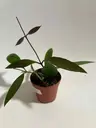
Philodendron Melanochrysum
About Philodendron Melanochrysum
Philodendrons grow aerial roots that grip the bark of trees, allowing them to grow over 20 feet tall! Their leaves change shape as they climb and can grow larger than a dinner plate. Fossils show Philodendrons growing as far back as 30 million years ago when South America was still connected to Antarctica! ❄️
Taxonomy

Philodendron melanochrysum
Philodendron
Araceae
Alismatales
Also known as
Black Gold Philodendron, Black Gold Philodendron, philo melano, p. melano, P. melanochrysum, Philodendron Melano and melanochrysum

How to care for Philodendron Melanochrysum
How often to water your Philodendron Melanochrysum

every 7
Philodendron Melanochrysum needs 0.5 cups of water every 7 when it doesn’t get direct sunlight and is potted in a 5" pot.
Use our water calculator to personalize watering recommendations to your environment or download Greg for more advanced recommendations for all of your plants.

Water 0.5 cups every
7
Finding light for Black Gold Philodendron in your home

a window
Philodendron Melanochrysum may have difficulty thriving, and will drop leaves 🍃, without ample sunlight.
Place it less than 3 feet from a south-facing window to maximize the potential for growth.
Select your region to see how the current weather in your area affects the placement of Philodendron Melanochrysum in your home 🏡.
How to fertilize Philodendron Melanochrysum

Most potting soils come with ample nutrients which plants use to produce new growth.
By the time your plant has depleted the nutrients in its soil it’s likely grown enough to need a larger pot anyway.
To replenish this plant's nutrients, repot your Philodendron Melanochrysum after it doubles in size or once a year—whichever comes first.
-
Failed leaves #Philodendron I am at a loss with my philo melano. It has several failed leaves and I'm not sure why. It sits about a foot from west window and a bit off to side so not getting direct sun. Any ideas? I haven't had a new leaf in probably 6 months and the last one that actually developed is smaller than previous ones. Btw I live in Arizona, so not sure if maybe it's my dry air.
-
Hello, All! Is like to introduce my newest baby, Nubia Golden. Any tips for her care? #Philodendron
-
Just installed my moss pole on my #Philodendron Melanochrysum. Very excited :) I studied a lot - including here on Greg - and finally got around to making and installing the first of many moss poles to come in the next few weeks. The first one was for my Melano, which, although not very big, was already showing loooots of aerial roots. It was an awesome experience. Ended up looking cool. Btw, the broken pot - it broke during shipping, the store is gonna send another one, but I thought it looked cool like this too! lol #HappyPlants #PlantsMakePeopleHappy #PlantAddict
-
Dream plant alert! #PlantMail Meet Meire, my #Philodendron #Melanochrysum #PhilodendronMelanochrysum This was on my shopping list for a loooong time. I finally got it! Received it today. It's still a baby, so I'll wait for a bit before I install a pole, but be sure I will because I want to see these leaves GROW!! However, look at this beautiful brown leaf already! Isn't it beautiful? It's in a 10 centimeter pot and I can't stop looking at it. #HappyPlants #PlantsMakePeopleHappy #PlantAddict #PlantTherapy #GregGang
-
Melanie was getting too tall again so it was time to chop. Not sure what I am going to do with 4 more Philodendrons melanochrysum but that's for future RJG to figure out. #Philodendron #PhiloFlock #philodendronmelanochrysum #PropagationStation #HappyPlants #ChopAndProp #GregGang #RJGroup
-
Calling All Propagation Experts Is this enough rootage to pot up this bad boy? He seems to be stuck at this level with two fangs 🧛🏻♂️. I was hoping for much more. I have zero propagatience. #PropagationStation #Propagation #Propagatience #NoPatience #Melanochrysis #melanochrysum
-
Propagation Melanochrysis H.E.L.P…. I bought a Melanochrysum starter plant 2 months ago. I lost a few of her leaves right away. Then she lost all but 2 leaves from some sort of root or soil mites. Not a good start for a dramatic plant. So here we are with a new leaf, the only one left. She’s been in perlite and has 2 tiny healthy roots (fangs) at the base. I just wrapped them in sphagnum today. 💡☢️ I had her under a very bright grow light (nuclear) on my succulent rack. ☀️I moved her recently to my plant table, which has a normal grow light on 12 hrs/day. She has a bit of water in the 2nd cup, and plastic wrap to keep humidity. Is there anything else I can do for her? I know some of you are experts at propagating! 🙏🙏🙏 #melanochrysum #melanochrysis #help #Propagation #PropagationStation #HappyPlants #Philodendron #philodendronmelanochrysum #PhiloFlock
-
Unidentified I just got this plant yesterday and I think it might be a Melanochrysum but Greg is saying something different, it has big leaves,has long air roots, and looks like it wants to climb.
-
Weird new leaves on my #melanochrysum Hey yall - my amazing #Philodendron #melanochrysum has been growing like crazy and popped out two leaves at once - but they look deformed. Nothing has changed for him, no pests, etc. What do you think?
-
had some extra super trellis pieces so Melanie got some added support. #Philodendron #philodendronmelanochrysum #PhiloFlock #RJGroup


Care Summary for Philodendron Melanochrysum

Philodendron Melanochrysum
 Greg recommends:
 Water
Water
0.5 cups every 7 days
 Placement
< 3ft from a window
 Nutrients
Repot after 2x growth
Based on the 4” pot your plant is in, and that it doesn’t get direct sunlight.
 Trending in your area










 Similar to Philodendron Melanochrysum

Adelonema palidinervi…

Aglaonema Eileen

Adelonema crinipes

Aglaonema 'Golden Flu…

Aglaonema 'Beauty'

Aglaonema 'Legacy Pin…

Aglaonema ‘Cocomelon'

Aglaonema ‘First Diam…

Aglaonema

Aglaonema 'Coconut De…

Aglaonema 'Parrot Jun…

African Fantasy Thaum…

Aglaonema 'Night Spar…

Adelonema peltatum

Aglaonema 'Black Drag…
✨ Discover rare plants

Cleistocactus icosago…

Large Leaf Elephant B…

Electric Blue Gecko

Kudu Lily

Scindapsus pictus 'Si…

Vatricania guentheri

Sarcochilus fitzgeral…

Dinteranthus microspe…

Hoya fitchii

Starfish Snake Plant
Astroloba congesta
Anthurium papillilami…

Echeveria 'Joan Danie…

Bonsai Crassula

Munstead Lavender

Graptoveria 'Douglas …