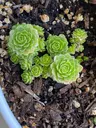
Heptapleurum crassifolium
Taxonomy

Heptapleurum crassifolium
Heptapleurum
Araliaceae
Apiales

How to care for Heptapleurum crassifolium
How often to water your Heptapleurum crassifolium

every 9
Heptapleurum crassifolium needs 0.5 cups of water every 9 when it doesn’t get direct sunlight and is potted in a 5" pot.
Use our water calculator to personalize watering recommendations to your environment or download Greg for more advanced recommendations for all of your plants.
Water 0.5 cups every
9
Finding light for Heptapleurum crassifolium in your home

a window
Heptapleurum crassifolium may have difficulty thriving, and will drop leaves 🍃, without ample sunlight.
Place it less than 3 feet from a south-facing window to maximize the potential for growth.
Select your region to see how the current weather in your area affects the placement of Heptapleurum crassifolium in your home 🏡.
How to fertilize Heptapleurum crassifolium

Most potting soils come with ample nutrients which plants use to produce new growth.
By the time your plant has depleted the nutrients in its soil it’s likely grown enough to need a larger pot anyway.
To replenish this plant's nutrients, repot your Heptapleurum crassifolium after it doubles in size or once a year—whichever comes first.
-
What fertilizer should I use? #Schefflera
-
Why do the leaves keep falling off? They do not appear to be dry or spotty. #DwarfUmbrellaTree
-
My umbrella plant is dying. What could be the cause? I also just replanted it. Does it need a moment to come back? I also water it every 11 days. #Schefflera
-
My plant looks exhausted. #Schefflera it has some brown leaves and some black spots on the leaves. Help.
-
Dwarf umbrella tree I know it's probably too late to save it. But I'm trying to figure out what I did wrong. Over the past 2 months it has browning at the leaf tips then dropping branches after a white film developed on the tips of the leaves. The plant was in the area of a mealy bug outbreak on some other plants so I was applying neem oil preventively. I also re-potted and changed the soil a week ago to try to stop the shedding. Thank you so much
-
How can I get mine to be bushier? It just keeps growing taller. There was a moment of time where I accidentally was under watering so it lost some leaves. But is doing better now. It’s dropped a few leaves recently due to moving to a new house. #DwarfUmbrellaTree
-
She seems droopy #DwarfUmbrellaTree
-
Umbrella tree pruning Can anyone give me tips on pruning my dwarf umbrella tree plant please? #UmbrellaTree #UmbrellaPlant #PlantsMakePeopleHappy #PlantAddict #pruning #pruning101
-
A few yellow leaves. Does this mean over watering? #DwarfUmbrellaTree
-
What does he need? I feel like this plant is at a stand still and has been, not sure how to make it happier…..thoughts? #UmbrellaTree


Care Summary for Heptapleurum crassifolium
Heptapleurum crassifolium
 Greg recommends:
 Water
Water
0.5 cups every 9 days
 Placement
< 3ft from a window
 Nutrients
Repot after 2x growth
Based on the 4” pot your plant is in, and that it doesn’t get direct sunlight.
 Trending in your area










 Similar to Heptapleurum crassifolium

✨ Discover rare plants
Linnaei Kunth

Stomatium acutifolium

Croton Nervia

Euphorbia baioensis

Chandelier Plant

Ceropegia simoneae

Bonsai Crassula

Hoya kalimantan
Carolina Reaper

Philodendron eximium

Begonia lubbersii

Vatricania guentheri

Peperomia 'Harmony's …
Chinese Evergreen 'Ga…
Astroloba congesta

Lavandula Pedunculata

Betel