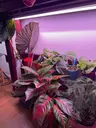
Dendrobium wulaiense
Taxonomy

Dendrobium wulaiense
Dendrobium
Orchidaceae
Asparagales

How to care for Dendrobium wulaiense
How often to water your Dendrobium wulaiense

every 9
Dendrobium wulaiense needs 0.5 cups of water every 9 when it doesn’t get direct sunlight and is potted in a 5" pot.
Use our water calculator to personalize watering recommendations to your environment or download Greg for more advanced recommendations for all of your plants.
Water 0.5 cups every
9
Finding light for Dendrobium wulaiense in your home

a window
Dendrobium wulaiense may have difficulty thriving, and will drop leaves 🍃, without ample sunlight.
Place it less than 3 feet from a south-facing window to maximize the potential for growth.
Select your region to see how the current weather in your area affects the placement of Dendrobium wulaiense in your home 🏡.
How to fertilize Dendrobium wulaiense

Most potting soils come with ample nutrients which plants use to produce new growth.
By the time your plant has depleted the nutrients in its soil it’s likely grown enough to need a larger pot anyway.
To replenish this plant's nutrients, repot your Dendrobium wulaiense after it doubles in size or once a year—whichever comes first.
-
My plant is starting to look like this, anyone knows what may be happening? I’m from Brazil, now is summer here and the last days have been particularly hot. Pleeease help me help Glinda
-
My orchid is covered with little white bugs Hello! My noble dendrobium has some strange white furry creatures which seem to secret a substance similar to spider webs. Its mainly on the bottom side of leaves- any idea? Any solution? Thanks in advance for your wisdom!
-
I couldn’t find dearei, is derryi similar?
-
What are the new shoots and how do I look after them? Are they part of the same plant? #NobleDendrobium
-
It took almost a year, but she’s blooming again! #OrchidLovers
-
Leaves seem to be curling? Hi, I am new to keep plants. 👋👋 Just got this orchid 2 days ago but I can only keep it beside my east facing windows. 🥲 The leaves started curling today. What should I do with it?
-
Another day, another orchid bloom. Apparently orchids really like infrequent watering, lots of fertilizer and sitting on a British south-facing window sill above a heater! #OrchidLovers #PlantsMakePeopleHappy #NewGrowth
-
#flowerfans Hey 👋 to all those flower fans out there and in particular those who love orchid flowers 🌸🌺🌼🌸 I saw these orchid blooms at a local nursery I visited so I thought I would share once again. Although I need to emphasize #NotMyPlant Enjoy 😊 #HappyPlants #PlantsMakePeopleHappy #PlantAddict #OrchidLovers #PhalaenopsisOrchid #OrchidOrg #GregGang #theamigos #Seymour
-
#NotMyPlant Orchid Colors So I recently posted my own first orchid bloom for spring here and now I see they are wheeling the big guns at a local garden Centre for a profusion of orchids and colors. Here’s a sample And no, none of these are my plants …yet) but I thought I’d share for orchid lovers out there #OrchidLovers #PhalaenopsisOrchid #HappyPlants #PlantsMakePeopleHappy #PlantAddict #NewGrowth #PlantTherapy #GregGang #PLANTMAFIA #theamigos #Seymour
-
Tips of leaves turning black #NobleDendrobium Hi guys Do you know why the tips of my plant's leave are turning black and how to treat it?


Care Summary for Dendrobium wulaiense
Dendrobium wulaiense
 Greg recommends:
 Water
Water
0.5 cups every 9 days
 Placement
< 3ft from a window
 Nutrients
Repot after 2x growth
Based on the 4” pot your plant is in, and that it doesn’t get direct sunlight.
 Trending in your area

Lipstick Echeveria

False Christmas Cactus
Waxplant
Baby Rubber Plant
Rubber Plant

Window Leaf

Cathedral Windows
Bird of Paradise

Golden Barrel Cactus
Heartleaf Philodendron
Arrowhead Plant
Cornstalk Dracaena

Zebra Plant

String of Buttons

Tradescantia Zebrina

Arabian Coffee Plant
Sweet Basil
Marble Queen Pothos
 Similar to Dendrobium wulaiense
✨ Discover rare plants

Munstead Lavender

Begonia hydrocotylifo…
Rosularia platyphylla

Begonia lubbersii

White Apple Moth Orch…

Red Mistletoe Cactus

Betel

Scindapsus pictus 'Si…

Kudu Lily
Philodendron 'Gabby'

Royal Flush Split Rock

Haworthia emelyae com…

Electric Blue Gecko

Vatricania guentheri

Hoya pottsii 'Khao Ya…

Aglaonema 'Green Bowl'

Scotch Moss