
Variegated Clivia
Taxonomy

Clivia miniata f. variegata
Clivia
Amaryllidaceae
Asparagales

How to care for Variegated Clivia
How often to water your Variegated Clivia

every 9
Variegated Clivia needs 0.5 cups of water every 9 when it doesn’t get direct sunlight and is potted in a 5" pot.
Use our water calculator to personalize watering recommendations to your environment or download Greg for more advanced recommendations for all of your plants.
Water 0.5 cups every
9
Finding light for Variegated Clivia in your home

a window
Variegated Clivia may have difficulty thriving, and will drop leaves 🍃, without ample sunlight.
Place it less than 3 feet from a south-facing window to maximize the potential for growth.
Select your region to see how the current weather in your area affects the placement of Variegated Clivia in your home 🏡.
How to fertilize Variegated Clivia

Most potting soils come with ample nutrients which plants use to produce new growth.
By the time your plant has depleted the nutrients in its soil it’s likely grown enough to need a larger pot anyway.
To replenish this plant's nutrients, repot your Variegated Clivia after it doubles in size or once a year—whichever comes first.
-
There are white splotches on the leaves. Looks like a mold of some kind. Does that mean I have been watering it too much? and should I wipe them off? #BushLily
-
My bush lily is quite large but no flowers.when will it get flowers #BushLily
-
My plant has flowered for the first time in a couple years, and the flowers are squished between the plant’s leaves with little room to grow. Should I do something to make room? Newbie to plant care and welcome advice #BushLily
-
I have two Bush Lily’s and each has a baby. I want to split one plant out to gift to a friend. When is the best time to do this? What is the best way to lift one of these big girls out and into a new planter? #BushLily
-
I have two large Bush Lily’s in the planter and each one has a baby! I want to split a plant into another pot to gift it to a friend. When is the best time and what is the best way to separate them? #BushLily
-
Why does it only have one huge leaf? It doesn’t look like it will grow any new leaves. What should I do to help it? #BushLily
-
My outer leaves are yellowing and I'm not sure why? Soil is moist, not in direct light. What's making Robert Plant Ill? #bushlilly #BushLily
-
I thought this was just named an Amaryllis. So there are different types? #BushLily
-
Another added to the family.
-
What can I do to help this lil one? She was a gift but my house is so dry. A few leaves fell off and the clipped ones looked very sad. Will she make it? Any tips would be appreciated. #BushLily


Care Summary for Variegated Clivia
Variegated Clivia
 Greg recommends:
 Water
Water
0.5 cups every 9 days
 Placement
< 3ft from a window
 Nutrients
Repot after 2x growth
Based on the 4” pot your plant is in, and that it doesn’t get direct sunlight.
 Trending in your area









 Similar to Variegated Clivia

✨ Discover rare plants
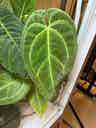
Ace of Spades

Variegated Arrowhead …

Aeonium 'Blushing Bea…

Crassula 'Purple Drag…
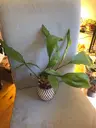
Stanhopea tigrina
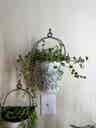
Crassula 'Calico Kitt…

Chinese Evergreen 'Go…

Cereus peruvianus 'Pa…

Scindapsus pictus 'Si…

Parrot Pitcher Plant

Hoya kalimantan

Aglaonema Spitfire

Hoya sipitangensis

Fagraea ceilanica

Vatricania guentheri

Sedum 'White Diamond'

Croton Nervia
