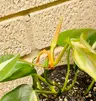
Aglaonema 'Pictum Tricolor'
Taxonomy

Aglaonema rotundum x Aglaonema pictum 'Pictum Tricolor'
Aglaonema
Araceae
Alismatales

How to care for Aglaonema 'Pictum Tricolor'
How often to water your Aglaonema 'Pictum Tricolor'

every 7
Aglaonema 'Pictum Tricolor' needs 0.5 cups of water every 7 when it doesn’t get direct sunlight and is potted in a 5" pot.
Use our water calculator to personalize watering recommendations to your environment or download Greg for more advanced recommendations for all of your plants.

Water 0.5 cups every
7
Finding light for Aglaonema 'Pictum Tricolor' in your home

a window
Aglaonema 'Pictum Tricolor' can tolerate being far from a window and light source.
Place it less than 6 feet from a south-facing window to ensure it receives enough light to survive 💪.
Select your region to see how the current weather in your area affects the placement of Aglaonema 'Pictum Tricolor' in your home 🏡.
How to fertilize Aglaonema 'Pictum Tricolor'

Most potting soils come with ample nutrients which plants use to produce new growth.
By the time your plant has depleted the nutrients in its soil it’s likely grown enough to need a larger pot anyway.
To replenish this plant's nutrients, repot your Aglaonema 'Pictum Tricolor' after it doubles in size or once a year—whichever comes first.
-
I keep finding the amount Greg suggests I water is too high. Anyone else find this too? The water pools at the bottom of my pot and I always find the soil very moist. #Aglaonema
-
What can I do to help my plant it’s getting brown and sad #Aglaonema
-
How do I deal with dead/ugly leaves? #Aglaonema
-
I’m not sure I have it in correct place. It’s facing north west lots of sun in the afternoon and is in front of a picture window #Aglaonema
-
I’ve had browning, dying leaves (that I’ve trimmed off) since I got it a few weeks ago. I’ve also noticed tiny holes in some of the leaves recently. What is going on? #Aglaonema
-
It seems there are more dried leaves #Aglaonema
-
The 14 hour progression of the flowerpot parasol (Leucocoprinus birnbaumii) mushrooms that appeared in my aglaonema. No signs of overwatering otherwise so I guess that’s good 😂 #Aglaonema #flowerpotparasol #parasol #mushrooms
-
I'm not sure if the soil should be completely dry before water or if I should keep it moist at all times #Aglaonema
-
Look at this!!! My first flower from her! ❤️😍🥰
-
New Aglaonema. Welcome to your new home, sweetie. ☺️


Care Summary for Aglaonema 'Pictum Tricolor'

Aglaonema 'Pictum Tricolor'
 Greg recommends:
 Water
Water
0.5 cups every 7 days
 Placement
< 6ft from a window
 Nutrients
Repot after 2x growth
Based on the 4” pot your plant is in, and that it doesn’t get direct sunlight.
 Trending in your area











 Similar to Aglaonema 'Pictum Tricolor'


✨ Discover rare plants

Anastasia Weeping Fig

Aglaonema 'Green Bowl'

Cereus peruvianus 'Pa…

Red Mistletoe Cactus

Sedeveria 'Blue Elf'

Euphorbia

Pseudorphipsalis 'Blu…

Pink Ruby Sedevaria
Linnaei Kunth

Orange Lipstick Plant

Rhipsalis clavata

Starfish Snake Plant

Hoya sipitangensis

Anthurium 'Fantasy Lo…

Eden Climbing Rose

Echeveria 'Joan Danie…

Croton Nervia