

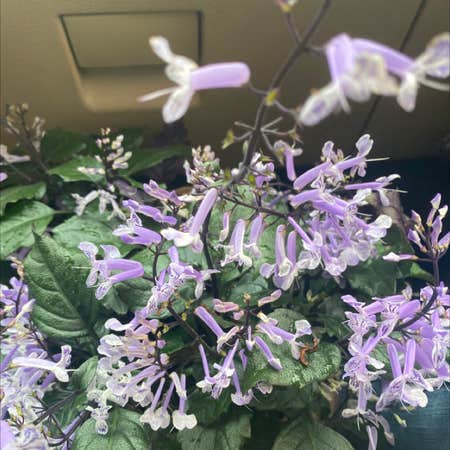


Plectranthus ecklonii
Taxonomy

Plectranthus ecklonii
Plectranthus
Lamiaceae
Lamiales

How to care for Plectranthus ecklonii
How often to water your Plectranthus ecklonii

every 9
Plectranthus ecklonii needs 0.5 cups of water every 9 when it doesn’t get direct sunlight and is potted in a 5" pot.
Use our water calculator to personalize watering recommendations to your environment or download Greg for more advanced recommendations for all of your plants.

Water 0.5 cups every
9
Finding light for Plectranthus ecklonii in your home

a window
Plectranthus ecklonii love being close to bright, sunny windows 😎.
Place it less than 1ft from a south-facing window to maximize the potential for growth.
Plectranthus ecklonii does not tolerate low-light 🚫.
Select your region to see how the current weather in your area affects the placement of Plectranthus ecklonii in your home 🏡.
How to fertilize Plectranthus ecklonii

Most potting soils come with ample nutrients which plants use to produce new growth.
By the time your plant has depleted the nutrients in its soil it’s likely grown enough to need a larger pot anyway.
To replenish this plant's nutrients, repot your Plectranthus ecklonii after it doubles in size or once a year—whichever comes first.
-
Is the yellow from too much sun for my Swedish Ivy?
-
Can I trim the leaves, it grow wild and is overflowing my window area? #SwedishIvy
-
Leaves are suddenly turning yellow and falling off! #SwedishIvy
-
When should I repot? This Sedish Ivy is the easiest plant 🪴 is have. Im newnto plants and have re-potted him once. When do I re-pot again? #greggers #happyplants #greggang #newplantmom
-
How do I get her to grow up? #SwedishIvy My plant is doing great and really growing. Should I put him somewhere that she will hang down, or can I put a trellis for her to grow upward. Any suggestions?
-
My Swedish ivy has done so well with her transplant into soil from water propagation! Her she has gone from purple to green 💜💚 #HappyPlants #PlantsMakePeopleHappy #NewGrowth #PlantAddict
-
What should I do? So… he nearly died of dehydration and now is reviving. I also have given him plant food. So any tips? Also the plant analyzer isn’t right in what type of plant it is and I have no idea.
-
I have transplanted this beauty into my “courtyard” garden. I think he will love it here. #OutdoorGrowing #HappyPlants #PlantAddict #NewGrowth
-
My Swedish Ivy’s limp and the leaves are thinning out. What do I do? I got my swedish ivy a week ago. I only watered it once and kept it by the window with plenty of sunlight, but now it’s flopped over, the leaves are drooping and they feel thin. I don’t think I’m overwatering it, but I have no idea what’s wrong. Does anyone know what’s happening? How can I get my plant back in good health? #SwedishIvy #PlantsMakePeopleHappy #help
-
Okay can I put my ivory on top of my water tank of my toilet #SwedishIvy


Care Summary for Plectranthus ecklonii

Plectranthus ecklonii
 Greg recommends:
 Water
Water
0.5 cups every 9 days
 Placement
< 1ft from a window
 Nutrients
Repot after 2x growth
Based on the 4” pot your plant is in, and that it doesn’t get direct sunlight.
 Trending in your area

White Bird of Paradise
Heartleaf Philodendron
Bird's Nest Fern

Elephant Bush

String of Buttons

African Violet

Rose Calathea
Cornstalk Dracaena
Mini Monstera

Rattlesnake Plant
Polka Dot Plant

Cylindrical Snake Pla…

Parlour Palm
Spider Plant

Aloe vera

String of Hearts

Chinese Money Plant

Golden Barrel Cactus
 Similar to Plectranthus ecklonii


✨ Discover rare plants

Cleistocactus icosago…

Blue Moon Wisteria

Miss All-American Bea…

Bonsai Crassula

Munstead Lavender

Hoya fitchii

Stomatium acutifolium
Rosularia platyphylla

Kilimanjaro Plant
Linnaei Kunth
Philodendron 'Rio'
Philodendron 'Silver …
Stanhopea tigrina
Phalaenopsis schiller…
Carolina Reaper

Fagraea ceilanica

Philodendron 'Glorius'
