


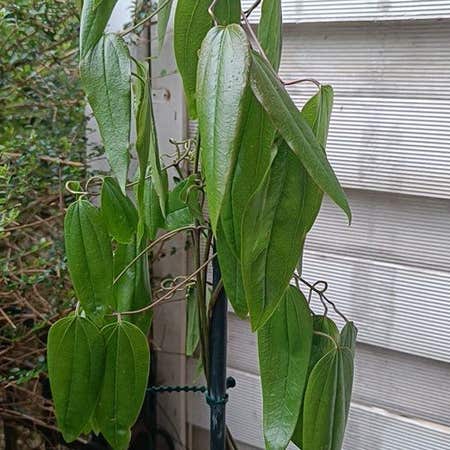


Evergreen clematis
About Evergreen clematis
Evergreen clematis is a super rare houseplant 🌿 that is isn’t challenging to grow and needs regular watering to thrive. They do best in long-lasting, direct light ☀️ and should be less than 1 foot from a window.
Evergreen clematis likes soil that is good at retaining moisture. Your plant shouldn't need added fertilizers if you repot each time it doubles in size.
Evergreen clematis belongs to the Clematis genus, and is native to Central and South China to Burma.
⚠️ Evergreen clematis is extremely dangerous if consumed. If you, a family member, or a pet has ingested any amount of plant material contact Poison Control, US (800) 222-1222, or your veterinarian immediately. These plants are not recommended for homes with children, cats, or dogs.
Taxonomy

Clematis armandii
Clematis
Ranunculaceae
Ranunculales
Also known as
Armand clematis

How to care for Evergreen clematis
How often to water your Evergreen clematis

every 9
Evergreen clematis needs 0.5 cups of water every 9 when it doesn’t get direct sunlight and is potted in a 5" pot.
Use our water calculator to personalize watering recommendations to your environment or download Greg for more advanced recommendations for all of your plants.

Water 0.5 cups every
9
Finding light for Evergreen clematis in your home

a window
Evergreen clematis love being close to bright, sunny windows 😎.
Place it less than 1ft from a south-facing window to maximize the potential for growth.
Evergreen clematis does not tolerate low-light 🚫.
Select your region to see how the current weather in your area affects the placement of Evergreen clematis in your home 🏡.
How to fertilize Evergreen clematis

Most potting soils come with ample nutrients which plants use to produce new growth.
By the time your plant has depleted the nutrients in its soil it’s likely grown enough to need a larger pot anyway.
To replenish this plant's nutrients, repot your Evergreen clematis after it doubles in size or once a year—whichever comes first.
-
Can this be planted outside
-
Hi! I’m Jess. This is my 13 year old Clematis-usually it grows and blooms beautifully! This year, no blooms, severely stunted growth, and leaves this yucky color.. Do you think its life cycle has just finally come to an end? The roots reaching from the ground are all a deadly brown.
-
Will they bloom again if I nip the bud off after they die? #WesternBlueVirginsbower
-
Can I move my clematis? #WesternBlueVirginsbower
-
What soil should i use when i repot my clematis?
-
New growth! This plant is soooo weird... It looks dead but there is growth coming from it. Super weird but super awesome! #newgrowth
-
I live in S. CA and in the high desert 🏜 . It's not in the direct heat of the day on the patio, but it looks like she needs something to bring out her bloom.
-
How do I cancel this app #CrimsonClematis
-
Do I have to cut the branches down every spring or can I let new growth come from last year’s growth thank you
-
Got a tiny bit of new growth!

Care Summary for Evergreen clematis

Evergreen clematis
 Greg recommends:
 Water
Water
0.5 cups every 9 days
 Placement
< 1ft from a window
 Nutrients
Repot after 2x growth
Based on the 4” pot your plant is in, and that it doesn’t get direct sunlight.
 Trending in your area











 Similar to Evergreen clematis
✨ Discover rare plants

Aloe 'Lavender Star'

Red Mistletoe Cactus

Maroon Pitcher Plant

Raphionacme flanaganii

Croton Nervia

Echeveria 'Joan Danie…

Aeonium 'Blushing Bea…

Anthurium Fingers

Eden Climbing Rose
Hoya 'Memoria'

Crassula 'Purple Drag…

Electric Blue Gecko
Stanhopea tigrina

Scotch Moss

Royal Flush Split Rock

Peperomia 'Harmony's …

White Apple Moth Orch…
