

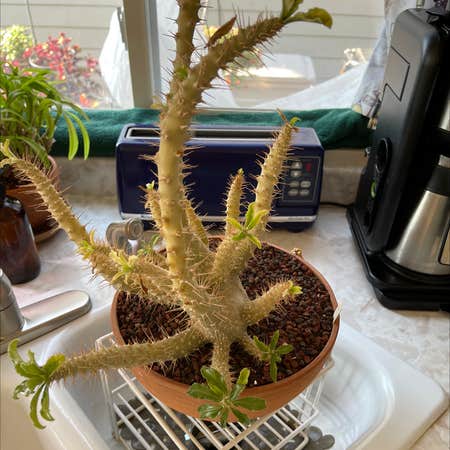


Pachypodium lealii
Taxonomy

Pachypodium lealii
Pachypodium
Apocynaceae
Gentianales

How to care for Pachypodium lealii
How often to water your Pachypodium lealii

every 12
Pachypodium lealii needs 0.5 cups of water every 12 when it doesn’t get direct sunlight and is potted in a 5" pot.
Use our water calculator to personalize watering recommendations to your environment or download Greg for more advanced recommendations for all of your plants.

Water 0.5 cups every
12
Finding light for None in your home

a window
Pachypodium lealii love being close to bright, sunny windows 😎.
Place it less than 1ft from a south-facing window to maximize the potential for growth.
Pachypodium lealii does not tolerate low-light 🚫.
Select your region to see how the current weather in your area affects the placement of Pachypodium lealii in your home 🏡.
How to fertilize Pachypodium lealii

Most potting soils come with ample nutrients which plants use to produce new growth.
By the time your plant has depleted the nutrients in its soil it’s likely grown enough to need a larger pot anyway.
To replenish this plant's nutrients, repot your Pachypodium lealii after it doubles in size or once a year—whichever comes first.
-
One of the leaves on my Madagascar palm is yellow. What does that mean?  #MadagascarPalm
-
Is it a cactus or a succulent? #MadagascarPalm
-
Suggestions as to why this cactus has bent to the side and has grown multiple pods? (I’ve already made/heard the jokes about what is happening here!)
-
Due to the rainy season it gets wet outside often , what can I do about it? #MadagascarPalm
-
Why my plant is so that? What's it's problem? #MadagascarPalm
-
Leaf turning yellow plant is outside? #MadagascarPalm
-
I was out buying soil accoutrment at Wal-Mart, and look what happened. Impossible to photograph, there are maybe 20 pups in there. #madagascarpalm #succulentsquad
-
I just wandered upon this beautiful Pachypodium Lamerei tonight at of all places my local Home Depot and couldn't resist. It's about 12 inches tall, beautiful and appears extremely healthy, and it's growing another. Super excited! Any advice it's my first #MadagascarPalm
-
All new growth on my pachypodium. It’s been happy with me since taking it home. #HappyPlants #NewGrowth #PachypodiumLamerei #SucculentSquad #CactusClique #Cactus #WhatTheSuccWednesday
-
My pachypodium lamerei is doing wonderfully since potting it up. It’s put out a new growth tip and a full set of new leaves! Super stoked on this buddy. #HappyPlants #PlantsMakePeopleHappy #NewGrowth #SucculentSquad #SucculentLove #PachypodiumLamerei


Care Summary for Pachypodium lealii

Pachypodium lealii
 Greg recommends:
 Water
Water
0.5 cups every 12 days
 Placement
< 1ft from a window
 Nutrients
Repot after 2x growth
Based on the 4” pot your plant is in, and that it doesn’t get direct sunlight.
 Trending in your area

















 Similar to Pachypodium lealii


✨ Discover rare plants

Chinese Evergreen 'Ga…

Echeveria 'Joan Danie…

Eden Climbing Rose

Orange Lipstick Plant
Astroloba congesta

Crassula 'Purple Drag…

White Apple Moth Orch…

Ceropegia simoneae

Ace of Spades

Philodendron 'Glorius'

Echeveria Esther

Tuber Fleeceflower

Treasure Flower

Fernleaf Lavendar

Raphionacme flanaganii

Chinese Evergreen 'Go…

Hoya kalimantan
