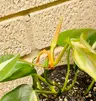
Widowscross
About Widowscross
Plants in the Sedum genus are super diverse, and are native to regions all over the world. Horticulturalists have bred them to create even more variietes that come in all manner of shapes and colors! Their succulent leaves help store water, and they are incredibly easy to propagate. Just gently pop off one of the leaves and with water and sunlight it will grow into a whole new plant. 🪴
Taxonomy

Sedum pulchellum
Sedum
Crassulaceae
Saxifragales

How to care for Widowscross
How often to water your Widowscross

every 12
Widowscross needs 0.5 cups of water every 12 when it doesn’t get direct sunlight and is potted in a 5" pot.
Use our water calculator to personalize watering recommendations to your environment or download Greg for more advanced recommendations for all of your plants.
Water 0.5 cups every
12
Finding light for Widowscross in your home

a window
Widowscross love being close to bright, sunny windows 😎.
Place it less than 1ft from a south-facing window to maximize the potential for growth.
Widowscross does not tolerate low-light 🚫.
Select your region to see how the current weather in your area affects the placement of Widowscross in your home 🏡.
How to fertilize Widowscross

Most potting soils come with ample nutrients which plants use to produce new growth.
By the time your plant has depleted the nutrients in its soil it’s likely grown enough to need a larger pot anyway.
To replenish this plant's nutrients, repot your Widowscross after it doubles in size or once a year—whichever comes first.
-
What’s happening to my #Sedum ? Hey, guys! My sedum has this nasty white/brown stuff on it. I thought it was just dirt at first, but it’s spread across pretty much all the leaves now. To me it looks like some sort of fungus, but I’m not sure. Does anyone know what’s happening, and if so, how do I fix it? #helpneeded #PlantClinic
-
Can you plant the petals to grow another plant? So many of mine fell off when I replanted #Sedum
-
I just got this plant I just placed it in succulent soil and hopefully it goes. Do I water it now or wait? Also it says from my search it's a coral reef? Can anyone verify? It does look like what I saw but want to make sure TIA #Sedum
-
Moved some of my established succulents back outside this week - and the colors are amazing! 😍 🌞 Yay Sunny weather and days getting longer! 🌄 🌵 💜💙 I love the purple tips on the Jelly Beans! 🥰 #socalgreg #outdoorgrowing #happyplants #succulentsquad #succulentlove #plantaddict #greggang #gregteam #plantsmakepeoplehappy #jellybean #sedum #pachyveria #graptosedum
-
Can I cut this where there are leaves missing and just stick it back in the pot? Will it root and grow if I do this? #Sedum #happyplants #newgrowth #jodisplace
-
Good evening #Greggers I’d like to show you how one plant grows different under different #GrowLights Here is my Ghost Plant. Pic1- mother plant, pic2- it’s head that I cut off couple month ago. Pic1- plant grows under Barrina light, pic2- plant grows under SpiderFarmer300. #SucculentSquad #SucculentLove #Succulents #GhostPlant #Sedum #GraptopetalumParaguayense
-
my little collection. it's been two weeks since I started collecting these babies #cactus #sedum
-
Not thriving. #Sedum she was so beautiful when I got her. Not so much now.
-
i accidentally snapped my succulent in half(it was already very top-heavy). anything i can do to salvage it? #Sedum
-
My small collection #succulents #lovesuccs #SucculentSquad #SucculentLove #Succulent #sedumclavatum #Sedum #Jade


Care Summary for Widowscross
Widowscross
 Greg recommends:
 Water
Water
0.5 cups every 12 days
 Placement
< 1ft from a window
 Nutrients
Repot after 2x growth
Based on the 4” pot your plant is in, and that it doesn’t get direct sunlight.
 Trending in your area
















 Similar to Widowscross


✨ Discover rare plants

Hoya pottsii 'Khao Ya…

Anastasia Weeping Fig

Eden Climbing Rose

Black Monkey Thorn Tr…
Stanhopea tigrina

Aloe 'Lavender Star'

Crassula 'Calico Kitt…

Maroon Pitcher Plant

Bonsai Crassula

Munstead Lavender

Chandelier Plant

Peperomia 'Harmony's …

Milky Widow's Thrill
Hoya crassipetiolata

Kilimanjaro Plant

Burro's Tail

Linnaei Kunth