
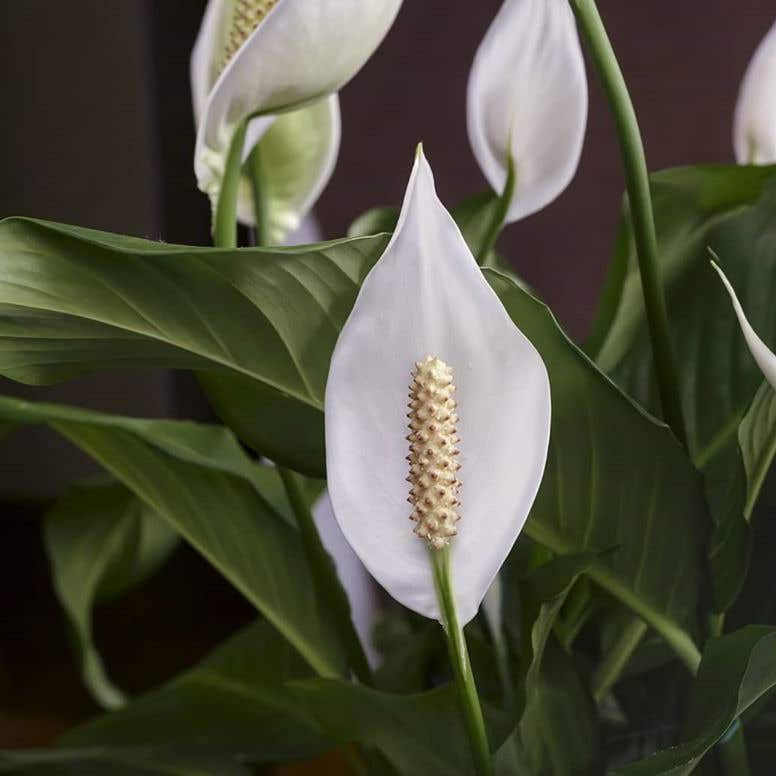


White Peace Lily
About White Peace Lily
The peace lily is a popular, elegant plant and not actually a lily at all! In fact, they’re more closely related to other houseplants like pothos and Monstera than actual lilies. The white ‘flowers’ are also not flowers, but specialized leaves that protect the tiny blossoms on the stalk in the center. Their ‘flowers’ may last as long as two months and they will continue to rebloom over time in the right conditions. ☮️
Taxonomy

Spathiphyllum cochlearispathum
Spathiphyllum
Araceae
Alismatales
Also known as
Spathiphyllum cochlearispathum 'Cupido'

How to care for White Peace Lily
How often to water your White Peace Lily

every 9
White Peace Lily needs 0.5 cups of water every 9 when it doesn’t get direct sunlight and is potted in a 5" pot.
Use our water calculator to personalize watering recommendations to your environment or download Greg for more advanced recommendations for all of your plants.

Water 0.5 cups every
9
Finding light for White Peace Lily in your home

a window
White Peace Lily may have difficulty thriving, and will drop leaves 🍃, without ample sunlight.
Place it less than 3 feet from a south-facing window to maximize the potential for growth.
Select your region to see how the current weather in your area affects the placement of White Peace Lily in your home 🏡.
How to fertilize White Peace Lily

Most potting soils come with ample nutrients which plants use to produce new growth.
By the time your plant has depleted the nutrients in its soil it’s likely grown enough to need a larger pot anyway.
To replenish this plant's nutrients, repot your White Peace Lily after it doubles in size or once a year—whichever comes first.
-
This peace lily is 8 years old. Was thriving in a larger pot and filling it out- I split it into several smaller pots months ago. All but this one has died. Help me help her, please! #PeaceLily
-
Help! My peacey keeps going into shock after watering. Is it okay to sit outside on porch or sit near a window? Currently I use 2 direct lights and it seems ok until after I water then a few days it goes back to looking thirsty?! #newpeaceMOm
-
My tiny little Peace Lilly has so many flowers for some reason 😅 #PeaceLily
-
My plant sits on my porch and only gets morning sun. But deals with La humidity during spring, summer and Fall. Winter its inside. How to water it then? #PeaceLily
-
Can it recover? So I've been taking care of this Peace Lily for a while now, almost a year, but there was a period where it dried up significantly and I had to trim a lot of dead parts off. It stayed in a glazed clay pot for a while, but a few days ago, I repotted it into a plastic, smaller, more breathable one. However, I'm a bit confused since it looks as if it's sprouting new leaves which still haven't extended yet (are curled up), but also some of the older ones are drying up, and even if I trimmed the dried parts so the plant doesn't waste energy to try and repair them, they still continue to dry. And I'm wondering if there is anything I can do so the plant recovers better? Or any tips on how to take care of such a plant?
-
Does my peace lily need more water added? So I got this peace lily the other day and added water to the self watering pot—it’s been a couple days and it soaked up all the water. The soil feels nice and moist on top, and the pot is empty—do I need to go ahead and add water back into the pot for it to take in water as needed and just keep water for it to drink, or am I supposed to wait until the soil is dry about an inch or so on top to add more into the self watering pot? Thank you! <3 #HappyPlants #PlantsMakePeopleHappy #PlantAddict #PlantTherapy #NewPlantMom #PetsAndPlants #PeaceLily
-
New Peace Lily Owner here!! I believe this is my first peace lily I’ve ever owned! I thought the self watering pot was really neat—but I wanted to ask and make sure that that’s a proper or safe way to water one, and if so—how often do I add water? Each time it runs dry? Any tips on how to care for it, water it, how much sun eTC would help a lot, thank you! <3 #HappyPlants #PlantsMakePeopleHappy #PlantAddict #NewGrowth #PlantTherapy #NewPlantMom #PeaceLily
-
Help, plz! Is my peace lily getting too much water? Not enough water? Or is something else going on? I'm guessing that I need to cut these off, right? Also, the spathe used to be white...is it normal for it to go green like this? Thx in advance! #PeaceLily
-
I just got her today. She shipped monday. She was a day late getting here. She arrived today Thursday. She was packaged wall. But she was dry. I just watered and set outside. And suggestion new plant mom. #PeaceLily
-
I repotted my plant 4 days ago & she's been droppy.dropping. #PeaceLily


Care Summary for White Peace Lily

White Peace Lily
 Greg recommends:
 Water
Water
0.5 cups every 9 days
 Placement
< 3ft from a window
 Nutrients
Repot after 2x growth
Based on the 4” pot your plant is in, and that it doesn’t get direct sunlight.
 Trending in your area
Cornstalk Dracaena

Tomato Plant

String of Pearls

Rose Calathea

White Bird of Paradise

Philodendron Brasil
Dieffenbachia
Golden Torch

Fiddle Leaf Fig

False Christmas Cactus

Cylindrical Snake Pla…

Small-Leaf Spiderwort

Baby Rubber Plant

Heartleaf Philodendron

Ponytail Palm

Jade Pothos
Snake Plant

Peace Lily
 Similar to White Peace Lily


✨ Discover rare plants

Hoya 'Millie'

Miss All-American Bea…

Sedeveria 'Blue Elf'

Picasso's Paintbrush

Chinese Evergreen 'Ga…

Philodendron eximium

Starfish Snake Plant

Stomatium acutifolium

Hoya pottsii 'Khao Ya…

Aglaonema 'Green Bowl'
Philodendron 'Gabby'

Vatricania guentheri
Rosularia platyphylla

Euphorbia

Raphionacme flanaganii
Stanhopea tigrina
