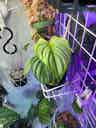
Philippines Aglaonema
About Philippines Aglaonema
Chinese evergreens have been growing in homes throughout Asia for centuries as symbols of good fortune. They were introduced to the Western world in 1885. Their ancestors were cultivated starting in the 1930s and became especially successful in Florida, where most foliage plants are now produced. 🤞
Taxonomy

Aglaonema philippinense
Aglaonema
Araceae
Alismatales

How to care for Philippines Aglaonema
How often to water your Philippines Aglaonema

every 7
Philippines Aglaonema needs 0.5 cups of water every 7 when it doesn’t get direct sunlight and is potted in a 5" pot.
Use our water calculator to personalize watering recommendations to your environment or download Greg for more advanced recommendations for all of your plants.

Water 0.5 cups every
7
Finding light for Philippines Aglaonema in your home

a window
Philippines Aglaonema can tolerate being far from a window and light source.
Place it less than 6 feet from a south-facing window to ensure it receives enough light to survive 💪.
Select your region to see how the current weather in your area affects the placement of Philippines Aglaonema in your home 🏡.
How to fertilize Philippines Aglaonema

Most potting soils come with ample nutrients which plants use to produce new growth.
By the time your plant has depleted the nutrients in its soil it’s likely grown enough to need a larger pot anyway.
To replenish this plant's nutrients, repot your Philippines Aglaonema after it doubles in size or once a year—whichever comes first.
-
#freshleaffriday #PHILO My Mccolley's finale, black cherry pink princess, white princess, Brazil & ring of fire philodendron #happyplants #plantsmakepeoplehappy #plantaddict #planttherapy #plantmafia #newgrowth #gregplantshop #greggers #greggang #succulentlove #succulentsquad #newplantmom #dracaena #aglaonema #chineseevergreen
-
My plant is not happy. It has been yellowing but I do have a new leaf. It’s still a baby. Is my plant too wet? Can anyone help me out please? #Aglaonema
-
Humidity Huddle while watering today!! #HappyPlants #Fittonia #Syngonium #Aglaonema #PlantsMakePeopleHappy #NewGrowth #PlantTherapy #GrowLights #PlantCorner #philodendron #PlantLove #humidityhuddle @Maddsplantz
-
Does anyone have any tips for bottom leaves turning yellow and curling inwards? I just got this a week ago and have only watered it once after the soil was very dry #Aglaonema #ChineseEvergreen
-
#thegreenshouse #HappyPlants #PlantsMakePeopleHappy #PlantAddict #NewGrowth #PropagationStation #SnakePlant #SnakePlantSquad #Sansevieria #SucculentLove #SucculentLove #PlantTherapy #floweringsnake #Sanserveriaflowering #PothosPack #Monstera #CalatheaCrew #Calathea #Hoya #HoyaHangout #HoyaHeads #PrayerPlant #Philodendron #VariegatedPinkLemon #ZamioculcasZamiifolia #ZzPlant #RavenZzPlant #Aglaonema #AlocasiaAddicts #Bonsai #Ficus #FiddleLeafFig #Anthurium #WhaleFinSnakePlant #ZeylanicaSnakePlant #WhitneySanserveria #SayuriSnakePlant #Cacti #AfricanMilkBush #dragonboneeuphorbia #VariegatedOpuntia , #PricklyPearCactusvariegated https:// I am a person who normally doesn’t try new sellers, but this one popped up in my Etsy (because you viewed section) and I did some research and looked at comments so I said why not…….I received such a beautiful shipment from #thegreenshouse yesterday……Richard (I assume he’s the owner) helped me pick out 3 basic plants. They arrived in perfect condition. My heart just 💕 swelled with joy. I posted his Etsy shop above. The blooming (smells like heaven) #sansevieriablackcoral has sooo many new babies and the pot is about to bust open from the new growth. #happywifehappylife
-
#NewPlants #PlantAddict #HappyPlants #PlantsMakePeopleHappy #Aglaonema #Begonia Expanding the family lol Meet Veronica and Athena. Lady Valentine Aglaonema and an Angel Wing Begonia “Miss Mummy”… Athena was inspiration from @JesssJungle Polka Dot Begonia… can’t wait to find one Jess!
-
#PlantMail today came LATE (it’s 10 pm here) cause it was raining the whole day, but she arrives! I got her yesterday actually, saw in person but couldn’t take it with me then. My #Aglaonema ‘Frozen’ #HappyPlants #PlantsMakePeopleHappy #PlantAddict
-
Happy #FreshLeafFriday 💖🌱🥳 This week, my other #PhilodendronBirkin released a new, gorgeous white leaf with pretty variegation. It’s halfway through unfurling 🤗 My #SilverLeafPhilodendron’s new leaf from last week finished opening and is getting that pretty silver variegated pattern on it. It’s so shiny! My #RedSiamAuroraAglaonema’s newly opened leaf has another new leaf poking out now! My #Aglaonema Golden Fluorite is now living in water, but her new leaf is looking good and starting to show its colors and patterns! And my Silver Leaf #Philo has several more new leaves coming in, and is currently in the process of unfurling this one! 🌱✨🪴✨💚✨🤗 #HappyPlants #PlantsMakePeopleHappy #PlantAddict #NewGrowth #NewLeafAlert #PlantTherapy #GregGang #PLANTMAFIA #babevila
-
I went to water my plant this morning and noticed it looks like the top layer of soil has started molding? Is this salvageable?? #Aglaonema
-
I got my Fernwood on #WhatTheSuccWednesday 😊 I also got a Sparkling Sarah Aglaonema, A Heartleaf Philo regular and Lime, My 1st Nerve plant and for @TrisBoogie I got a Christmas Cactus because he got such an amazing Report Card! All A’s and B’s, I’m a PROUD MAMA! To think I wanted to end the year with 35 plants and as of today I have 76! Tris has 26 lol! Once you start…..😂🤣😂🤣. #NewPlants #PlantMail #PLANTMAFIA #PlantAddict #PlantsMakePeopleHappy #YoungGreggers #Philodendron #Aglaonema #Sanserveria #wishlistplant





Care Summary for Philippines Aglaonema

Philippines Aglaonema
 Greg recommends:
 Water
Water
0.5 cups every 7 days
 Placement
< 6ft from a window
 Nutrients
Repot after 2x growth
Based on the 4” pot your plant is in, and that it doesn’t get direct sunlight.
 Trending in your area












 Similar to Philippines Aglaonema




✨ Discover rare plants

Raphionacme flanaganii

Graptoveria 'Douglas …

Aglaonema 'Green Bowl'

Hoya kalimantan

Hoya pottsii 'Khao Ya…

Burro's Tail

Begonia hydrocotylifo…

Haworthia emelyae com…

Stomatium acutifolium

Chinese Evergreen 'Go…

Rainbow Echeveria

Scotch Moss

Chandelier Plant

Starfish Snake Plant

Tillandsia caerulea A…

Red Mistletoe Cactus