
Pelargonium 'Henhurst Gleam'
Taxonomy

Pelargonium 'Henhurst Gleam'
Pelargonium
Geraniaceae
Geraniales

How to care for Pelargonium 'Henhurst Gleam'
How often to water your Pelargonium 'Henhurst Gleam'

every 9
Pelargonium 'Henhurst Gleam' needs 0.5 cups of water every 9 when it doesn’t get direct sunlight and is potted in a 5" pot.
Use our water calculator to personalize watering recommendations to your environment or download Greg for more advanced recommendations for all of your plants.
Water 0.5 cups every
9
Finding light for Pelargonium 'Henhurst Gleam' in your home

a window
Pelargonium 'Henhurst Gleam' love being close to bright, sunny windows 😎.
Place it less than 1ft from a south-facing window to maximize the potential for growth.
Pelargonium 'Henhurst Gleam' does not tolerate low-light 🚫.
Select your region to see how the current weather in your area affects the placement of Pelargonium 'Henhurst Gleam' in your home 🏡.
How to fertilize Pelargonium 'Henhurst Gleam'

Most potting soils come with ample nutrients which plants use to produce new growth.
By the time your plant has depleted the nutrients in its soil it’s likely grown enough to need a larger pot anyway.
To replenish this plant's nutrients, repot your Pelargonium 'Henhurst Gleam' after it doubles in size or once a year—whichever comes first.
-
When do these plants bloom?? #ZonaleGeranium
-
What is the problem with my citronella? Too little water? Too much sun? Too much water? Needs fertilizer??
-
What is on with my citronella? It had such big bushes.
-
How to prop? I’ve kept this plat alive for 2 winters now. The first one I had to prune back the plant quite a bit and it flourished inside. It was soooo healthy and bushy, then I placed it on the back patio where it lives during the warm months and I’m pretty sure I shocked it. We are back inside with another heavy prune. I’d love to split this plant up, or at least have a few babies around. What’s the best course? #HappyPlants #Citronella #PropagationStation
-
LOOK AT MY BOY’S NEW LITTLE LEAF OH YOU’VE COME SO FAR LITTLE MANNNNN KEEP GOINGGG
-
Help!! My little man has stunted roots!! I dug around in his soil and could only find really sick old dead roots!! Backstory, I saved Thomas from a Salvos almost a week ago but I wanted to change out the bad soil and found these tiny little baby roots!! What do I do???
-
Lost leaves on the stalk as it got taller. Can I encourage leaves along the stalk again?
-
Should I bring it in for the winter in New England? Would it survive indoors in a shaded corner? #ZonaleGeranium
-
It’s only produced two flowers and has grown a lot! I’m wondering how to have it stop getting so big but produce more flowers? #ZonaleGeranium
-
I’m new to geraniums can I get some advice on how to take care of her please? #ZonaleGeranium


Care Summary for Pelargonium 'Henhurst Gleam'
Pelargonium 'Henhurst Gleam'
 Greg recommends:
 Water
Water
0.5 cups every 9 days
 Placement
< 1ft from a window
 Nutrients
Repot after 2x growth
Based on the 4” pot your plant is in, and that it doesn’t get direct sunlight.
 Trending in your area




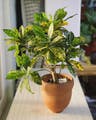





 Similar to Pelargonium 'Henhurst Gleam'
✨ Discover rare plants

Fagraea ceilanica
Anthurium papillilami…

Royal Flush Split Rock
Hoya 'Memoria'

Echeveria Esther

Hoya 'Millie'

Chandelier Plant

Kudu Lily

Stomatium acutifolium

Anthurium Fingers

Philodendron 'Glorius'

Ruby Ball

Sedum 'White Diamond'

Eden Climbing Rose

Chinese Evergreen 'Go…
Hoya crassipetiolata

Milky Widow's Thrill
