
Notocactus mammulosus
Taxonomy

Notocactus mammulosus
Notocactus
Cactaceae
Caryophyllales

How to care for Notocactus mammulosus
How often to water your Notocactus mammulosus

every 12
Notocactus mammulosus needs 0.5 cups of water every 12 when it doesn’t get direct sunlight and is potted in a 5" pot.
Use our water calculator to personalize watering recommendations to your environment or download Greg for more advanced recommendations for all of your plants.
Water 0.5 cups every
12
Finding light for Notocactus mammulosus in your home

a window
Notocactus mammulosus love being close to bright, sunny windows 😎.
Place it less than 1ft from a south-facing window to maximize the potential for growth.
Notocactus mammulosus does not tolerate low-light 🚫.
Select your region to see how the current weather in your area affects the placement of Notocactus mammulosus in your home 🏡.
How to fertilize Notocactus mammulosus

Most potting soils come with ample nutrients which plants use to produce new growth.
By the time your plant has depleted the nutrients in its soil it’s likely grown enough to need a larger pot anyway.
To replenish this plant's nutrients, repot your Notocactus mammulosus after it doubles in size or once a year—whichever comes first.
-
Hi! I'm only 11, and I'm new to plants. Any tips on how to take care of this #newgrowth
-
#whatthesuccwednesday I no longer say, "I'm bad with these," but "I used to be bad with these until I stopped moving them around every minute." I used to take the old "rotate your cactus to keep it even" advice to a fault to find the perfect spot.
-
Hi #NotocactusUebelmannianus
-
Yellow along the bottom? It's a slightly medium yellow along the bottom of my cactus, but he seems perfectly fine. I bought him like that, is that normal?
-
Almost bloom time Happy Friday! I would like to share my cactus that is currently producing flower buds. That should be open soon as I can see the flower color peeking out of all the fuzz. #CactusClique #HappyPlants #SucculentLove #SucculentSquad
-
Will the needles get really long?just got this guy 2 weeks ago #ParodiaManificaBalloonCactus
-
Outdoor direct sunlight? Hey guys I’m new to the cactus community and I was just wondering if outdoor direct sunlight is the best conditions for this plant?
-
What is happening here!? Oscar the Grouch has seen some trauma in his life. More trauma than a plant should go through, I thought we were on the road to recovery. He’s been growing, filling back in and now this… what is happening to him? He’s my oldest plant, but it’s not his time yet! What do we do!? Little back story if it helps: In the early days he was shaped like a hot air balloon and was a beauty to gaze upon. But he was placed in a too big pot and lost all his roots from root rot. He very slowly regained some roots while in a smaller pot, but was watered very sparingly in fear of overwatering. He then began to feel hollow and like a dry loofa sponge and again, I feared for him. But he’s a fighter! We just continued hoping for improvement. Then disaster struck when he was dropped and came out of the pot, knocked over and stepped on by a dog, and then dropped again, falling out of the pot. Again. All three of those within about a months time. When you look at Oscar you can see the trauma timeline in the spines and needles he wears. It’s like a badge of honor, of the fighter he is, what’s he’s made it through. And he’s still here! He’s seemed to be getting over the trauma, the hollow dry sponge sections had started to seem like they’re filling in, still a bit wrinkly, but more solid than previously. He has additional spines that have started to grow in a few places. His needles are stronger and more pokey. And he’s just had an explosion of growth over the last 2 months. I was really thinking he was getting past all that, well on the road of recovery and was starting to look quite happy. But now… This… What is happening to him? #CactusClique #GreggersSupportingGreggers #GregGang #NotSoHappyPlants #help #BalloonCactus #PlantAddict #PlantsMakePeopleHappy #SucculentLove #VerdantFlora
-
When do I fertalize her??? lol I’m new to taking care of this plant would help so much if I could get some advice😭
-
#cactusclique #succulentsquad You have a lot to say, and I apologize that I can't find any agreeable bees to wander the house.


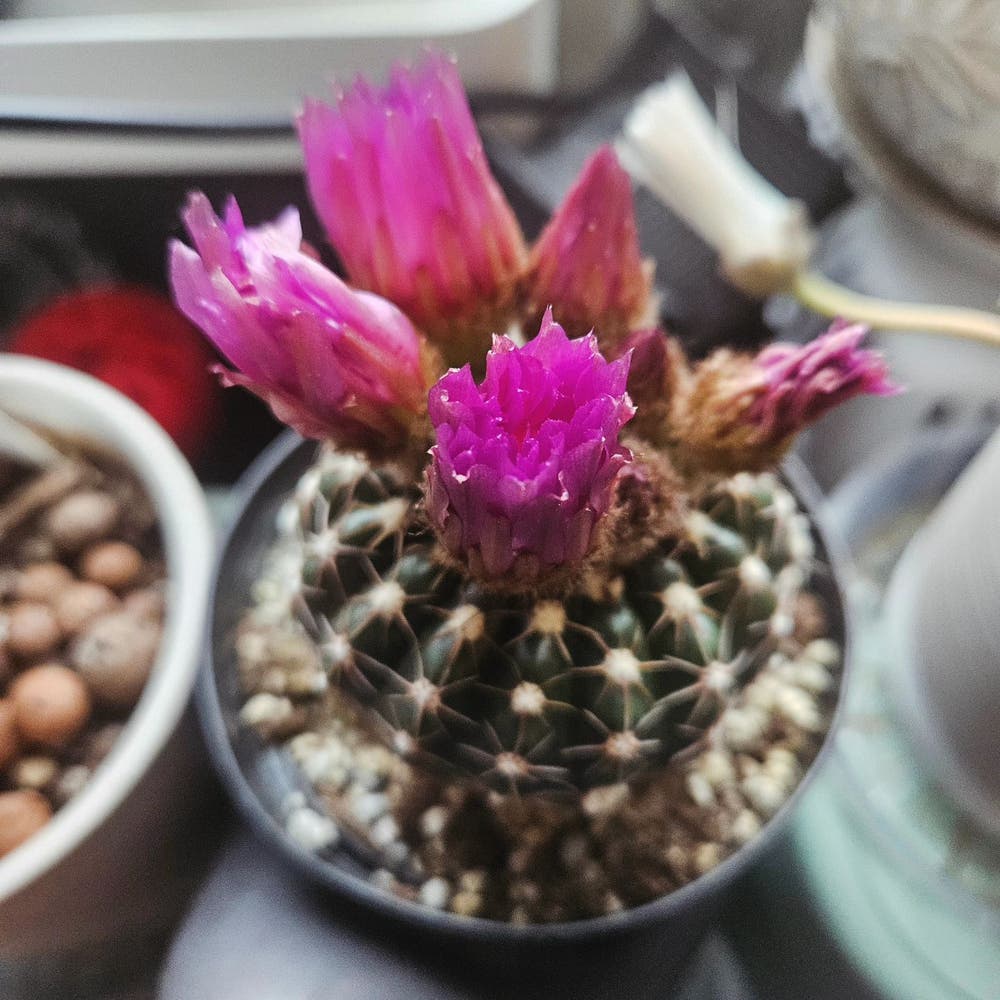
Care Summary for Notocactus mammulosus

Notocactus mammulosus
 Greg recommends:
 Water
Water
0.5 cups every 12 days
 Placement
< 1ft from a window
 Nutrients
Repot after 2x growth
Based on the 4” pot your plant is in, and that it doesn’t get direct sunlight.
 Trending in your area











 Similar to Notocactus mammulosus

✨ Discover rare plants

Stomatium acutifolium
Rosularia platyphylla
Philodendron 'Silver …

Kudu Lily

Electric Blue Gecko

Miss All-American Bea…

Radiator Plant

Ace of Spades

Anthurium 'Fantasy Lo…

Picasso's Paintbrush

Starfish Snake Plant

Fagraea ceilanica

Philodendron eximium

Chandelier Plant

Hoya kalimantan

Sedum 'White Diamond'

Hoya pottsii 'Khao Ya…
