
Papua New Guinea Heliconia
Taxonomy

Heliconia papuana
Heliconia
Heliconiaceae
Zingiberales

How to care for Papua New Guinea Heliconia
How often to water your Papua New Guinea Heliconia

every 9
Papua New Guinea Heliconia needs 0.5 cups of water every 9 when it doesn’t get direct sunlight and is potted in a 5" pot.
Use our water calculator to personalize watering recommendations to your environment or download Greg for more advanced recommendations for all of your plants.
Water 0.5 cups every
9
Finding light for Papua New Guinea Heliconia in your home

a window
Papua New Guinea Heliconia love being close to bright, sunny windows 😎.
Place it less than 1ft from a south-facing window to maximize the potential for growth.
Papua New Guinea Heliconia does not tolerate low-light 🚫.
Select your region to see how the current weather in your area affects the placement of Papua New Guinea Heliconia in your home 🏡.
How to fertilize Papua New Guinea Heliconia

Most potting soils come with ample nutrients which plants use to produce new growth.
By the time your plant has depleted the nutrients in its soil it’s likely grown enough to need a larger pot anyway.
To replenish this plant's nutrients, repot your Papua New Guinea Heliconia after it doubles in size or once a year—whichever comes first.
-
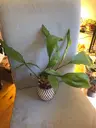
What’s next for my heliconia? #Heliconia help, it’s a bit of a long story but would love some advice. A few months ago I was walking in my neighborhood and found several tall stalks of this plant, roots and tubers intact, discarded on the sidewalk. I brought them home and put them in a pot, cleaned up the damaged parts as much as possible. Since then one stalk has put out a new leaf, while the other stalk was damaged to the point that I’ve had to cut all its leaves off. BUT I’ve also got three brand new shoots coming up, so overall I think it’s been a successful #PlantRescue. Now I am curious what I should do next. I don’t know if I should cut the tall damaged stalks down to nothing since I have new growth, or if I should let it be until the stalks die off. I don’t believe the damaged existing stalks will regrow, but I have no experience with this type of plant.
-
The tips and up to half of several leaves have turned black. What could cause this?

Care Summary for Papua New Guinea Heliconia
Papua New Guinea Heliconia
 Greg recommends:
 Water
Water
0.5 cups every 9 days
 Placement
< 1ft from a window
 Nutrients
Repot after 2x growth
Based on the 4” pot your plant is in, and that it doesn’t get direct sunlight.
 Trending in your area








 Similar to Papua New Guinea Heliconia


✨ Discover rare plants

Orange Lipstick Plant

Black Monkey Thorn Tr…

Anthurium Fingers

Hoya sipitangensis
Crassula 'Calico Kitt…

Tillandsia caerulea A…

Sarcochilus fitzgeral…

Dinteranthus microspe…

Electric Fern

Echeveria Esther
Stanhopea tigrina

Eden Climbing Rose

Aglaonema 'Green Bowl'

Ceropegia simoneae

Miss All-American Bea…

Radiator Plant
