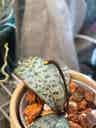
Bleeding Heart 'Amore Rose'
Taxonomy

Dicentra 'Amore Rose'
Dicentra
Papaveraceae
Ranunculales

How to care for Bleeding Heart 'Amore Rose'
How often to water your Bleeding Heart 'Amore Rose'

every 9
Bleeding Heart 'Amore Rose' needs 0.5 cups of water every 9 when it doesn’t get direct sunlight and is potted in a 5" pot.
Use our water calculator to personalize watering recommendations to your environment or download Greg for more advanced recommendations for all of your plants.
Water 0.5 cups every
9
Finding light for Bleeding Heart 'Amore Rose' in your home

a window
Bleeding Heart 'Amore Rose' may have difficulty thriving, and will drop leaves 🍃, without ample sunlight.
Place it less than 3 feet from a south-facing window to maximize the potential for growth.
Select your region to see how the current weather in your area affects the placement of Bleeding Heart 'Amore Rose' in your home 🏡.
How to fertilize Bleeding Heart 'Amore Rose'

Most potting soils come with ample nutrients which plants use to produce new growth.
By the time your plant has depleted the nutrients in its soil it’s likely grown enough to need a larger pot anyway.
To replenish this plant's nutrients, repot your Bleeding Heart 'Amore Rose' after it doubles in size or once a year—whichever comes first.
-
I’m so excited, I thought my bleeding heart wasn’t going to make it! It came in the mail a root ball with no visible shoots whatsoever. So all I had was a pot of dirt, haha. Suddenly overnight this week it sprouted out of the dirt!!! I literally gasped when I saw it two days ago. 😆 #BleedingHeart #BleedingHeartVine
-
Hello! #OregonBleedingHeart a coworker gave me one of his Oregon bleeding hearts. We potted it and it’s been slowing getting yellower and wilting as the days go. Idk how to save it or what it needs. Please help :(


Care Summary for Bleeding Heart 'Amore Rose'
Bleeding Heart 'Amore Rose'
 Greg recommends:
 Water
Water
0.5 cups every 9 days
 Placement
< 3ft from a window
 Nutrients
Repot after 2x growth
Based on the 4” pot your plant is in, and that it doesn’t get direct sunlight.
 Trending in your area










 Similar to Bleeding Heart 'Amore Rose'


✨ Discover rare plants

Scotch Moss
Rosularia platyphylla
Graptopetalum 'Marqui…

Blue Moon Wisteria

Sedeveria 'Blue Elf'

Electric Blue Gecko

White Apple Moth Orch…
Astroloba congesta

Pseudorphipsalis 'Blu…

Sarcochilus fitzgeral…
Philodendron 'Silver …

Tillandsia caerulea A…

Variegated Arrowhead …

Hoya 'Millie'

Ace of Spades

Lavandula Pedunculata