
Hawaiian Ti 'Lilinoe'
Taxonomy

Cordyline fruticosa 'Lilinoe'
Cordyline
Asparagaceae
Asparagales

How to care for Hawaiian Ti 'Lilinoe'
How often to water your Hawaiian Ti 'Lilinoe'

every 9
Hawaiian Ti 'Lilinoe' needs 0.5 cups of water every 9 when it doesn’t get direct sunlight and is potted in a 5" pot.
Use our water calculator to personalize watering recommendations to your environment or download Greg for more advanced recommendations for all of your plants.
Water 0.5 cups every
9
Finding light for Hawaiian Ti 'Lilinoe' in your home

a window
Hawaiian Ti 'Lilinoe' love being close to bright, sunny windows 😎.
Place it less than 1ft from a south-facing window to maximize the potential for growth.
Hawaiian Ti 'Lilinoe' does not tolerate low-light 🚫.
Select your region to see how the current weather in your area affects the placement of Hawaiian Ti 'Lilinoe' in your home 🏡.
How to fertilize Hawaiian Ti 'Lilinoe'

Most potting soils come with ample nutrients which plants use to produce new growth.
By the time your plant has depleted the nutrients in its soil it’s likely grown enough to need a larger pot anyway.
To replenish this plant's nutrients, repot your Hawaiian Ti 'Lilinoe' after it doubles in size or once a year—whichever comes first.
-
What is happening to my ti plant? When I got it a few months ago it had so many leaves and was so lush (See my first pic). The last few weeks the bottom leaves turned brown dried out and fell off. I am reading so many conflicting things here and online. #TiPlant
-
The leaves are getting brown on my Ti plant. #TiPlant
-
Top ok. Bottom keeps dropping leaves. In lanai. Was outdoors in direct direct sun fried them. Have 2 both sad #TiPlant
-
Rescued this Hawaiian Ti from tractor supply. Just a little rhyme for the time. I'll stop rhyming it's probably bad timing. I promise I won't do anymore when I rescue from a store. Am I on your nerves now in anyway? time has come to bid you a great day! #TiPlant #insatiable #grateful #happy #plant
-
Weird frond pattern ? Is this a watering issue or a pest issue? Maybe stress? I'm unsure. I rescued achilles from lowes and it looked very sad. :/
-
Is this an indoor plant #TiPlant
-
My plant is declining fast and I’m not sure the problem, lots of yellow to crisp brown to desd leaves, any help? #TiPlant
-
Not a happy Ti About half of the leaves have begun to turn brown and incredibly dry and crispy. I’ve been following the directions for watering. This guy doesn’t get any direct sunlight. Is that the problem maybe?
-
What’s going on with my leaves? 😭 #CordylineGlauca
-
My cordyline has a baby! 🥰🥰


Care Summary for Hawaiian Ti 'Lilinoe'
Hawaiian Ti 'Lilinoe'
 Greg recommends:
 Water
Water
0.5 cups every 9 days
 Placement
< 1ft from a window
 Nutrients
Repot after 2x growth
Based on the 4” pot your plant is in, and that it doesn’t get direct sunlight.
 Trending in your area








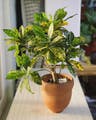
 Similar to Hawaiian Ti 'Lilinoe'

✨ Discover rare plants

Lithops

Rainbow Echeveria

Ace of Spades
White Apple Moth Orch…

Dinteranthus microspe…
Philodendron 'Silver …

Hoya pottsii 'Khao Ya…

Fernleaf Lavendar

Milky Widow's Thrill

Radiator Plant

Pseudorphipsalis 'Blu…
Philodendron 'Rio'

Philodendron 'Glorius'

Kudu Lily

Crassula 'Calico Kitt…

Large Leaf Elephant B…
