

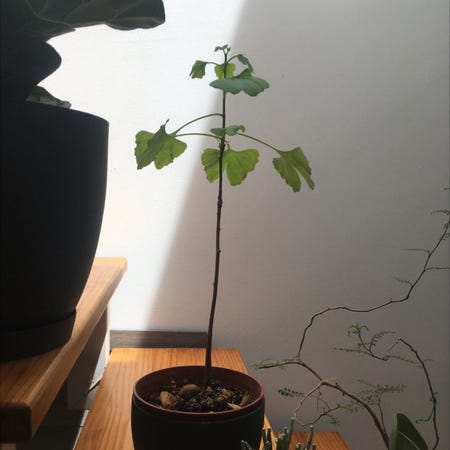


Ginkgo Tree
About Ginkgo Tree
Ginkgo is a large deciduous tree that reaches 50 to 80 feet in height and 30 to 40 feet wide. It has unique fan shaped leaves and plum like yellow orange seeds on the female trees only. It grows in Zone 8 and 9 in the Southeast and is tolerant of drought, heat and air pollution.
Taxonomy

Ginkgo biloba
Ginkgo
Ginkgoaceae
Ginkgoales
Also known as
Ginkgo, Maidenhair tree, Gingko and Ginkgo Tree

How to care for Ginkgo Tree
How often to water your Ginkgo Tree

every 9
Ginkgo Tree needs 0.5 cups of water every 9 when it doesn’t get direct sunlight and is potted in a 5" pot.
Use our water calculator to personalize watering recommendations to your environment or download Greg for more advanced recommendations for all of your plants.

Water 0.5 cups every
9
Finding light for Ginkgo Tree in your home

a window
Ginkgo Tree love being close to bright, sunny windows 😎.
Place it less than 1ft from a south-facing window to maximize the potential for growth.
Ginkgo Tree does not tolerate low-light 🚫.
Select your region to see how the current weather in your area affects the placement of Ginkgo Tree in your home 🏡.
How to fertilize Ginkgo Tree

Most potting soils come with ample nutrients which plants use to produce new growth.
By the time your plant has depleted the nutrients in its soil it’s likely grown enough to need a larger pot anyway.
To replenish this plant's nutrients, repot your Ginkgo Tree after it doubles in size or once a year—whichever comes first.
-
Can I propagate this? I have a little sprouting that came off of a ginko tree, can I turn into a plant? #GinkoTree #PropagationStation
-
Droopy leaves and stem #GinkoTree Help, its been raining for a few days ginko has drooped. Moisture meter said soil was not very moist. I watered it one more time. No yellowing of leaves so not sure what to do
-
How do I eat and fix the fruit from this plant #GinkoTree
-
How do I take care of a piece of this plant?Do I put it in water?Someone cut off a piece for me.What do I do next #GinkoTree
-
Propagation advice? #GinkoTree I’m trying to propagate from a shoot from a male tree. The original shoot didn’t seem to like water only, so I trimmed it down and put it in soil. It hadn’t had enough light, so I’ve moved it. Any advice is appreciated! #PropagationStation #Propagation


Care Summary for Ginkgo Tree

Ginkgo Tree
 Greg recommends:
 Water
Water
0.5 cups every 9 days
 Placement
< 1ft from a window
 Nutrients
Repot after 2x growth
Based on the 4” pot your plant is in, and that it doesn’t get direct sunlight.
 Trending in your area








 Similar to Ginkgo Tree
✨ Discover rare plants

Christmas Candle
Crassula 'Calico Kitt…

Dinteranthus microspe…

Kilimanjaro Plant
Ace of Spades
Graptopetalum 'Marqui…

Hoya 'Millie'

Electric Fern

Pink Ruby Sedevaria

Aeonium 'Blushing Bea…
Rosularia platyphylla

Scindapsus pictus 'Si…

Betel

Maroon Pitcher Plant

Radiator Plant

Euphorbia baioensis

Hoya kalimantan
