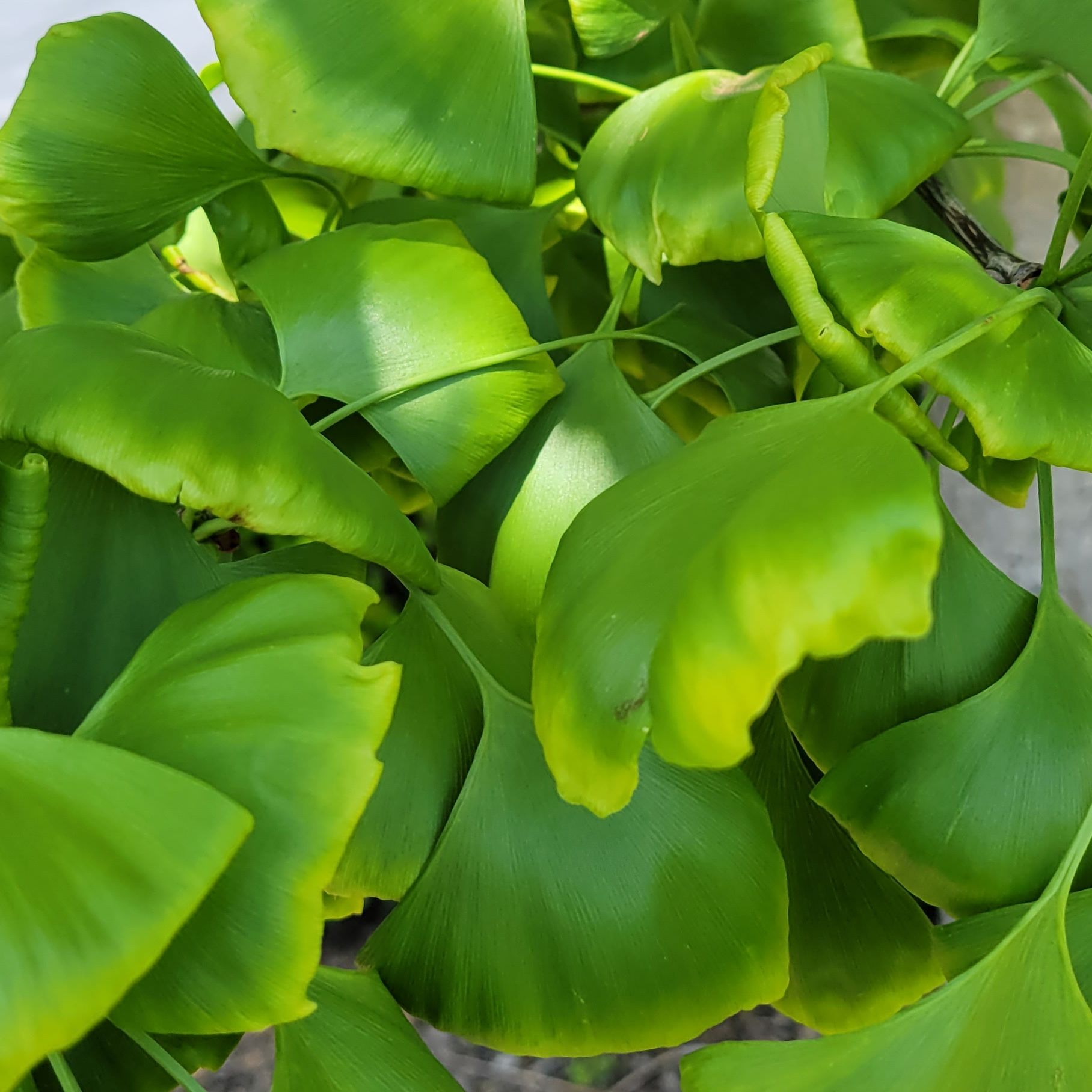
Ginkgo Tree

What's Eating Your Ginkgo Tree?

Ginkgo biloba
Reviewed by Kiersten Rankel M.S.
Quick Answer

Ginkgo is one of the most pest-free trees you can plant. The few pests that do hit are minor and rare. A 200-million-year-old chemistry deters almost everything. Watch for the occasional aphid cluster on a spring flush, the rare scale bump on a young trunk, and spider mites on container ginkgos pushed into drought stress.

Stay on top of plant care
Get seasonal reminders for watering and fertilizing, personalized for your plants.
Try Greg Free

What does the damage look like?

Tap the closest match to jump straight to the fix.

Pests, ranked by impact

Dense colony of aphids clustered on a plant stem

Aphids

Damage
Low
Removal
Easy
What it looks like

Tiny pear-shaped insects 1 to 3 mm long, in green or black. Cluster occasionally on the soft spring flush of fan-shaped leaves and on the underside of young leaves where the parallel veins are still pale. Rare on ginkgo because the tree's terpenes deter most aphid species.

What the damage looks like

Faint curling along the leaf edge of a spring flush, sometimes a thin sticky film on the leaves below. The damage is almost always cosmetic. By midsummer the affected leaves harden off and the colonies disappear without intervention.

How to get rid of them
Option 1

Strong water blast every 3 days for a week

Hold a hose nozzle 12 inches from the affected new growth and spray at high pressure. Most aphids dislodge and don't make it back to the tree. Ginkgo's leathery fan leaves shrug off a hard rinse. Repeat every 3 days for a week. Almost always enough on a tree this resistant.

Option 2

Insecticidal soap on the new growth, once

Spray ready-to-use insecticidal soap (Safer Insect Killing Soap, ~$10) on the underside of affected fan leaves at dusk. One application usually clears it because aphid pressure on ginkgo is light to begin with. Skip if you see ladybugs or lacewings already on the tree.
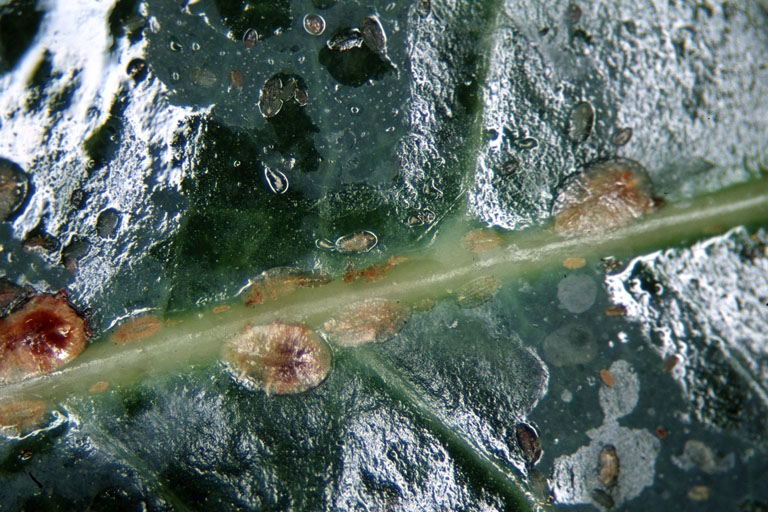
Brown soft scale (Coccus hesperidum) clustered on a plant stem

Scale insects

Damage
Low
Removal
Moderate
What it looks like

Hard or soft brown bumps stuck to young bark and along smaller branches, 1 to 4 mm wide. Don't move because they're glued in place. Rarely seen on mature ginkgo. Mostly an issue on stressed nursery trees or young container specimens before the tree's chemistry fully matures.

What the damage looks like

A few brown bumps on smooth young bark, sometimes a faint sticky film below. Mature ginkgos almost never carry a damaging population. The fan leaves and yellow fall color are unaffected. Heavy clusters on a single young branch are the only time treatment is worth the effort.

How to get rid of them
Option 1

Scrub and oil once in early spring

1

Wet the affected bark with horticultural oil (Bonide All Seasons, ~$15) before bud break in early spring.

2

Scrub gently with a soft toothbrush to dislodge the bumps and break the waxy seal.

3

Spray a final coat of oil and leave on. One round is usually enough on ginkgo because reinfestation is rare.

Option 2

Prune a heavily encrusted young branch

If a single young branch carries a dense cluster, cut it off and dispose. Ginkgo recovers from pruning easily and the tree's branching structure is forgiving. Bag and dispose, do not compost. Faster than spraying when the problem is local to one branch.

Spider mite infestation on a stem with fine silk webbing and pale speckled leaf damage

Spider mites

Damage
Low
Removal
Easy
What it looks like

Almost invisible without a hand lens. Yellow-green to red-orange specks on the underside of fan-shaped leaves. Show up only on container or nursery ginkgos pushed into drought stress through a hot dry summer. Mature ginkgos in the ground almost never see them.

What the damage looks like

Tiny pale yellow dots scattered across the fan leaves, then a dull bronze cast over the upper surface. Fine webbing rare and only in heavy drought. The iconic yellow fall color usually still arrives normally. Damage is cosmetic and the tree recovers fully the next year once water stress eases.

How to get rid of them
Option 1

Water deeply and shower the foliage once

Soak the rootball thoroughly until water runs from the drainage holes, then spray the underside of the leaves with cool water for 30 seconds. Ginkgo's fan leaves tolerate a hard rinse. The combination of restored soil moisture and the rinse usually ends a drought-stress mite outbreak in one round.

Option 2

Move container ginkgo into afternoon shade

Container ginkgos heat up faster than in-ground trees, which is what drives the rare mite outbreak. Move the pot to morning sun and afternoon shade through the hottest weeks. Step up to a larger pot the following spring. The water stress is the real cause and the mites disappear once it resolves.

Stay ahead of all of them

Four habits that keep ginkgo's already-rare pest pressure even rarer.
1

Spring flush check, once a week through May

The tender new fan leaves are the only window when aphids ever show. A 30-second scan once a week through the spring flush catches the rare colony. By June the leaves harden off and aphids move on without help.

2

Plant a male cultivar to skip the seed problem

Female ginkgos drop fleshy seed coats every fall that smell like rotten butter. Male cultivars (Autumn Gold, Princeton Sentry, Magyar) avoid the issue entirely. Ginkgo is otherwise so trouble-free that picking a male tree at planting solves the only real long-term problem with the species.

3

Deep water a container ginkgo through summer

In-ground ginkgos shrug off heat and drought. Container ginkgos do not. Water deeply when the top 2 inches of the pot dry out, especially through July and August. Drought stress is the only thing that ever brings spider mites to ginkgo.

4

Trust the tree, skip the routine spraying

Ginkgo's 200 million years of chemistry handles almost every pest by itself. Routine preventive sprays waste money and kill the beneficial insects that already keep populations in check. Watch the spring flush, water container trees through summer, and let the tree do the rest.

Stay on top of plant care
Get seasonal reminders for watering and fertilizing, personalized for your plants.
Try Greg Free

About This Article

Kiersten Rankel M.S.
Botanical Data Lead at Greg · Plant Scientist
About the Author
Kiersten Rankel holds an M.S. in Ecology & Evolutionary Biology from Tulane University. A certified Louisiana Master Naturalist, she has over a decade of experience in science communication, with research spanning corals, cypress trees, marsh grasses, and more. At Greg, she curates species data and verifies care recommendations against botanical research.
See Kiersten Rankel's full background on LinkedIn.
Editorial Process
Pest identification and treatment guidance verified against Ginkgo biloba field reports from Greg's botanical database, cross-referenced with university extension sources and published horticultural research.