


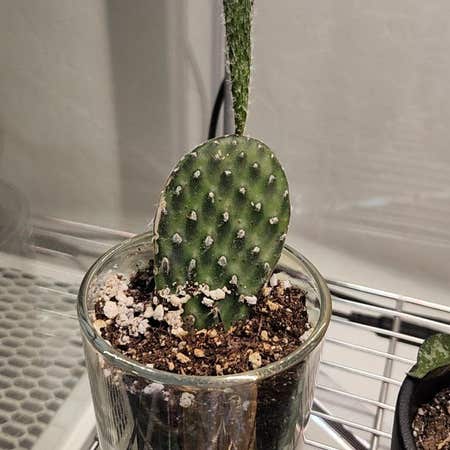


Arpon
About Arpon
Arpon is a super rare houseplant 🌿 that needs very little water to thrive. They do best in long-lasting, direct light ☀️ and should be less than 1 foot from a window.
Arpon likes soil that is extremely well-draining. Your plant shouldn't need added fertilizers if you repot each time it doubles in size.
⚠️ Arpon is not safe to consume. If you, a family member, or a pet has ingested any amount of plant material contact Poison Control, US (800) 222-1222, or your veterinarian. If you have children, cats, or dogs in the home, we suggest keeping this plant out of reach.
Taxonomy

Opuntia decumbens
Opuntia
Cactaceae
Caryophyllales
Also known as
Lengua de Vaca, Nopal de Culebra and Nopal de Tortuga

How to care for Arpon
How often to water your Arpon

every 12
Arpon needs 0.5 cups of water every 12 when it doesn’t get direct sunlight and is potted in a 5" pot.
Use our water calculator to personalize watering recommendations to your environment or download Greg for more advanced recommendations for all of your plants.

Water 0.5 cups every
12
Finding light for Arpon in your home

a window
Arpon love being close to bright, sunny windows 😎.
Place it less than 1ft from a south-facing window to maximize the potential for growth.
Arpon does not tolerate low-light 🚫.
Select your region to see how the current weather in your area affects the placement of Arpon in your home 🏡.
How to fertilize Arpon

Most potting soils come with ample nutrients which plants use to produce new growth.
By the time your plant has depleted the nutrients in its soil it’s likely grown enough to need a larger pot anyway.
To replenish this plant's nutrients, repot your Arpon after it doubles in size or once a year—whichever comes first.
-
Woke to find my final bunny ear crumbled. Yesterday it was fine and waiting for water this AM! Is there anything to be done? Two years old. TIA! #BunnyEarsCactus
-
Why do I feel like its connected to me? #DroopingPricklyPear
-
Hey yall! Quick question… now that my cactus is outside I don’t want to use liquid fertilizer- the kind that mixes with water. She gets enough water with the recent weather. What do you all use to fertilize your Barbary Fig cacti?? #PricklyPear #NewGrowth #OutdoorGrowing
-
When will it grow fruit #FewSpinedMarbleSeededPricklyPear
-
#freshleaffriday My big Opuntia survived the cold and is back with a new bloom. Yah, that's corking lol.
-
The parent plant (Opuntia D. Face) put off way too many pads last year, so I trimmed a bunch and tossed this one in a pot. Cue Operation Big Opuntia Stay Outside All Utah Winter. There was a point in February where the wind blew this guy out of the pot, and that's when I saw it had miraculously grown roots. Truly, this plant just won't stop growing.
-
This is a clipping I propagated last fall. I was surprised over leaf growth but genuinely shocked over a flower bud, as this has all happened under grow lights. (Also pictured is the mother plant RIP. This species needs a lot of room.) #succulentsquad #freshleaffriday
-
A couple cuttings from a friend. Need to repot with drainage.
-
Advice needed New plant carer - I was recently given a false christmas cactus, a snow prickly pear, and a jade plant. Any advice welcome!
-
Why is he so scraggley and droopy;--; #DroopingPricklyPear


Care Summary for Arpon

Arpon
 Greg recommends:
 Water
Water
0.5 cups every 12 days
 Placement
< 1ft from a window
 Nutrients
Repot after 2x growth
Based on the 4” pot your plant is in, and that it doesn’t get direct sunlight.
 Trending in your area











 Similar to Arpon

✨ Discover rare plants

Vatricania guentheri

Picasso's Paintbrush

Pine Cone Plant
Astroloba congesta
Philodendron 'Silver …

Scindapsus pictus 'Si…

Rhipsalis clavata
Rosularia platyphylla

Radiator Plant

Cereus peruvianus 'Pa…

Rainbow Echeveria

Electric Fern

Sedeveria 'Blue Elf'
Philodendron 'Rio'

Tillandsia caerulea A…

Black Monkey Thorn Tr…
