Purple Pixie
Taxonomy

Tradescantia pallida 'Purple Pixie'
Tradescantia
Commelinaceae
Commelinales

How to care for Purple Pixie
How often to water your Purple Pixie

every 9
Purple Pixie needs 0.5 cups of water every 9 when it doesn’t get direct sunlight and is potted in a 5" pot.
Use our water calculator to personalize watering recommendations to your environment or download Greg for more advanced recommendations for all of your plants.
Water 0.5 cups every
9
Finding light for Purple Pixie in your home

a window
Purple Pixie may have difficulty thriving, and will drop leaves 🍃, without ample sunlight.
Place it less than 3 feet from a south-facing window to maximize the potential for growth.
Select your region to see how the current weather in your area affects the placement of Purple Pixie in your home 🏡.
How to fertilize Purple Pixie

Most potting soils come with ample nutrients which plants use to produce new growth.
By the time your plant has depleted the nutrients in its soil it’s likely grown enough to need a larger pot anyway.
To replenish this plant's nutrients, repot your Purple Pixie after it doubles in size or once a year—whichever comes first.
-
Last year my plant was beautiful and now it looks like this I have left it alone and it started coming back and then I put new soil in it and I mean he's still alive but I wanted to look like he did last year #PurpleHeart
-
Help Darwin leaves are spotted and Mirasoil is dry.
-
How do I save my plant? I received this plant a couple of months ago and it’s been slowly dying ever since. The leaves are starting to dry and the stems are leaning and droopy. I water this once a week and it gets indirect light. Any advice is appreciated! #TradescantiaNanouk
-
Time to repot Are these plants ready repot to bigger pot
-
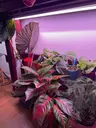
Too much Light/Heat? I have my plants under a grow light and I've noticed the center most leaves are duller then others. I'm worried maybe it is getting too much direct light/heat? (I'm sorry the photo isn't that clear, the difference in leaves is much more noticeable in person.)
-
This is in a hanging coconut liner basket...so how do I categorize what kind of pot. It doesn't give me opinions #Zebrina
-
Is my Tradescantia Zebrina dead/beyond help? I had a Tradescantia Zebrina that I bought from a garden centre and it was happy for a while and grew big and dangly, but then all the leaves kept wilting off until it was basically just stalks, but I managed to take a cutting from it and grow that as this plant called Luna. This has grown as one tendril and similarly grew longer but at a certain point the leaves started wilting. Then a few weeks ago, I was moving it while watering and when I held the main stalk, it just snapped/pulled out of the soil with no roots attached. I trimmed down to below a leaf and put it in water to try and regrow it as a cutting, but no roots have started to develop and the lower leaves are wilting as they did when it was in soil, yet the leaves at the stop still look bright and healthy. Is there anything I can do to get it back to life or is it beyond help at this point? #TradescantiaZebrina
-
Should i cut? My main plant fell a bit ago and broke... But has sprouted up a little one attached. Should i cut off the rest of the main stem or will it get mad-
-
UPDATE: TLDR: Greg giveaway update, talking about my life currently like moving back into my house and getting a job soon. Just watered and cleaned up my tradescantia plant. I had to clean up a lot of dead leaves. A lot of my plants are dying because I’m currently living somewhere else for a little bit. I come back every so often and take care of my plants and bugs. But, yeah, unfortunately it’s taken a huge toll on my plants. I’m also all out of repotting supplies which sucks because spring is pretty much here. I just don’t have the money right now as I am trying to find a job. Things are getting better though. I’m gonna be moving back into my house in a little while. So that’s good 🙂 also, a little update about the Greg giveaway: I realized that I’m not the right person for the Greg gift card for the Greg plant shop so I asked the Greg team if I could switch it out for a box of goodies instead and they are so wonderful. They said they would send me a box. So excited! The Greg team truly are an awesome bunch. 💝 (ignore my dirty glass in the photos I know I gotta clean it. Also, I have no idea why the photos are sideways. Sorry about that.) #PlantsMakePeopleHappy #PlantAddict #PlantTherapy #PlantCorner #PlantLove #TropicalPlants
-
How often should you trim your baby bunny bellies? Mine is looking a little sad. I just repotted it today. #BabyBunnyBellies


Care Summary for Purple Pixie
Purple Pixie
 Greg recommends:
 Water
Water
0.5 cups every 9 days
 Placement
< 3ft from a window
 Nutrients
Repot after 2x growth
Based on the 4” pot your plant is in, and that it doesn’t get direct sunlight.