
Patē
About Patē
Patē is a super rare houseplant 🌿 that needs regular watering to thrive. They do best in abundant sunlight ☀ and should be less than 3 feet from a window.
Patē likes soil that is well draining. Your plant shouldn't need added fertilizers if you repot each time it doubles in size.
⚠️ Patē is not safe to consume. If you, a family member, or a pet has ingested any amount of plant material contact Poison Control, US (800) 222-1222, or your veterinarian. If you have children, cats, or dogs in the home, we suggest keeping this plant out of reach.
Taxonomy

Schefflera digitata
Schefflera
Araliaceae
Apiales
Also known as
patē, seven-finger and umbrella tree

How to care for Patē
How often to water your Patē

every 9
Patē needs 0.5 cups of water every 9 when it doesn’t get direct sunlight and is potted in a 5" pot.
Use our water calculator to personalize watering recommendations to your environment or download Greg for more advanced recommendations for all of your plants.
Water 0.5 cups every
9
Finding light for Patē in your home

a window
Patē may have difficulty thriving, and will drop leaves 🍃, without ample sunlight.
Place it less than 3 feet from a south-facing window to maximize the potential for growth.
Select your region to see how the current weather in your area affects the placement of Patē in your home 🏡.
How to fertilize Patē

Most potting soils come with ample nutrients which plants use to produce new growth.
By the time your plant has depleted the nutrients in its soil it’s likely grown enough to need a larger pot anyway.
To replenish this plant's nutrients, repot your Patē after it doubles in size or once a year—whichever comes first.
-
found my schefflera wilted this morning due to the crazy heat in london... she spent the day inside in medium light and looks a lot happier!! #Schefflera
-
Two new stands! Also found a varigated Schefflera and Cebu Blue Pothos for 5 bucks each! #schefflera #plantsmakepeoplehappy #plantaddict #pothos
-
I shouldn’t be allowed out of the house. I don’t even know what all of these are. I know most, but not all, and I’m iffy on whether one of them is a Prince of Orange (PoO *giggle*) or some other kind of prince or wizard or whatever (gotta love the Arthurian philo gang). Lowe’s is not known for good labeling. Also, Target has a few goodies on clearance. Might be worth checking out to see if there’s any left at your local store. And for those who know her, you’ll see that Pip is out on parole for a bit this evening, getting acclimated to the rest of the house now that she’s no longer riddled with a super contagious fungal infection. Welcome to the jungle, little girl. Please don’t eat any of it. #PlantHaul #NoWillpower #HappyPlants #PlantsMakePeopleHappy #RescuePlants #PipsAdventures #PipSqueakTheIntrepid #PLANTMAFIA #AlocasiaAddicts #PhiloFlock #Schefflera #WetheWild #Arber #SaleAlert #PetsAndPlants #PetsOfGreg
-
Is this an umbrella tree? #Schefflera just curious if this is an umbrella tree. It’s over 50 years old.
-
#FreshLeafFriday (Sunday Edition) #EpipremnumPinnatum unfurling has begun!!! And it’s tough to beat #Schefflera #UmbrellaTree fresh leaves 😍🌿💚 Happy Sunday everyone 😌 #HappyPlants #PlantsMakePeopleHappy #GregGang #GreggersSupportingGreggers
-
What's wrong with my Dwarf Umbrella Tree? #help #schefflera #umbrellatree Hi guys! In two days a lot of leaves turned brown and have fallen down. They are not dry. I water the plant once, sometimes twice a week (with Rhizotonic sometimes). What's wrong with my plant? ☹️ Can I save it somehow?
-
At work this was give to us about a year ago. Half the plat is looking dead and the other half doesn't look well. It is about 7 to 8 feet tall. It is several feet from our big sliding glass door. Is it not getting enough sun? #Schefflera
-
Help with Dwarf Umbrella Y’all, besides the weird aphids happening to my plant, what is happening to her? She also has weird colors on her baby leaves. #Schefflera #DwarfUmbrellaTree #PlantsMakePeopleHappy
-
On one of the stalks of my dwarf umbrella, all the leaves shriveled up and fell off. Will they grow back or do I need to get rid of that stalk? The other stalk seems to be doing well. #Schefflera
-
Hey. How con I take care of my Schaffere plant, I feel like it doesn’t looks happy at all. How do I water it, does it needs direct sunlight or low light? Please help me.thanks in advance #Schefflera


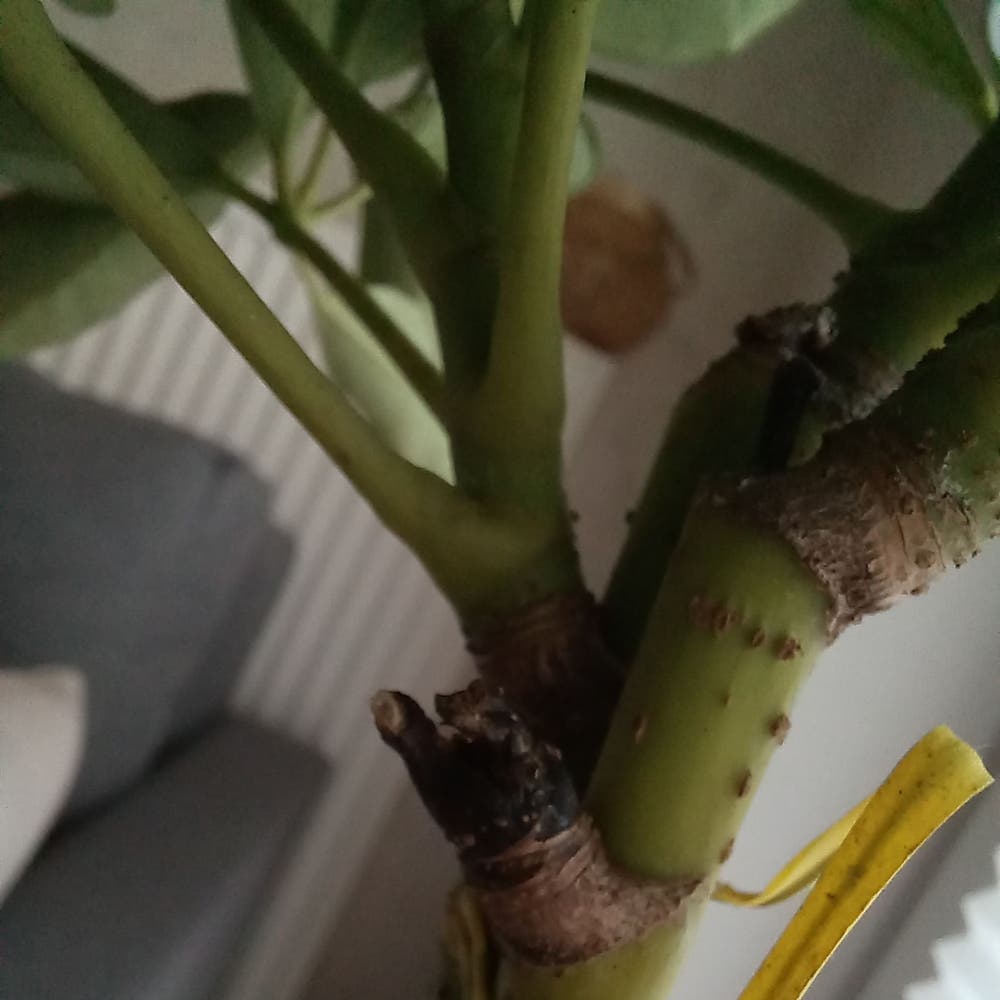


Care Summary for Patē
Patē
 Greg recommends:
 Water
Water
0.5 cups every 9 days
 Placement
< 3ft from a window
 Nutrients
Repot after 2x growth
Based on the 4” pot your plant is in, and that it doesn’t get direct sunlight.
 Trending in your area
Bird's Nest Fern

Aloe vera
Lady Finger Cactus
Mini Monstera

Arabian Coffee Plant
Bunny Ears Cactus

Blushing Bride Air Pl…

Cathedral Windows

Tradescantia Nanouk

String of Buttons

Golden Barrel Cactus
Majesty Palm
Baby Rubber Plant

English Ivy
Bird of Paradise

Window Leaf

Emerald Ripple Pepero…

Pearl Echeveria
 Similar to Patē


✨ Discover rare plants

Sedum 'White Diamond'

Large Leaf Elephant B…

Hoya sipitangensis

Cleistocactus icosago…

Bonsai Crassula
Hoya crassipetiolata

Rainbow Echeveria
Astroloba congesta

Fagraea ceilanica

Echeveria 'Joan Danie…

Hoya 'Millie'

Stomatium acutifolium

Crassula 'Purple Drag…

Red Mistletoe Cactus

Begonia hydrocotylifo…

Fernleaf Lavendar

Kudu Lily
