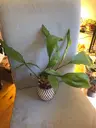
English Ivy 'Cockle Shell'
Taxonomy

Hedera helix 'Cockle Shell'
Hedera
Araliaceae
Apiales

How to care for English Ivy 'Cockle Shell'
How often to water your English Ivy 'Cockle Shell'

every 9
English Ivy 'Cockle Shell' needs 0.5 cups of water every 9 when it doesn’t get direct sunlight and is potted in a 5" pot.
Use our water calculator to personalize watering recommendations to your environment or download Greg for more advanced recommendations for all of your plants.
Water 0.5 cups every
9
Finding light for English Ivy 'Cockle Shell' in your home

a window
English Ivy 'Cockle Shell' may have difficulty thriving, and will drop leaves 🍃, without ample sunlight.
Place it less than 3 feet from a south-facing window to maximize the potential for growth.
Select your region to see how the current weather in your area affects the placement of English Ivy 'Cockle Shell' in your home 🏡.
How to fertilize English Ivy 'Cockle Shell'

Most potting soils come with ample nutrients which plants use to produce new growth.
By the time your plant has depleted the nutrients in its soil it’s likely grown enough to need a larger pot anyway.
To replenish this plant's nutrients, repot your English Ivy 'Cockle Shell' after it doubles in size or once a year—whichever comes first.
-
I know ivy likes to grow up. Can I let it grow down? #Hedera
-
Should I cut this off or let it be? The rest of the plant looks great #Hedera
-
PLANT HAULLL I couldn’t resist these Ivies at Lowe’s they were only $8 each for very beautiful well established plants! First one is an asterisk Ivy (her names Astrid) and the second is a pixie dixie Ivy (her name is Hecate). I love them so muchhhhh I already have an English Ivy which is now doing great after I learned how to deal with pests! #PlantHaul #Ivy #PixieDixieIvy #AsteriskIvy #PlantsMakePeopleHappy
-
Meet my new plant - Tigger -rescued from Lowe’s clearance section. #PlantsMakePeopleHappy #HappyPlants #PlantAddict #lowesclearance #ClearanceSectionRescueBabies #Ivy #ivyleague
-
UPDATEE!!!! For those of you who remember my english ivy situation, I am pleased to inform you that from each end of the Ivy THERE ARE BABY LEAVES!!! I wasn’t able to take a picture of all of them since my camera quality is terrible but here’s a few pics! #EnglishIvy #NewGrowth #spidermites
-
Help, I’m losing my ivy, quickly! She looks like she needs were but I’m watering her weekly, fertilized last week but her leaves are shriveled and Styx I’m afraid I’ve already lost her. Any ideas/suggestions please? #HappyPlants
-
Okay I want peoples opinions: does my English Ivy look like it’s dying yet? I don’t think so but it’s been shedding leaves like crazy due to spider mites. I’ve been doing treatments on it that thankfully have eliminated the majority of spider mites, however at this point it’s lost half of its original leaves. So does this look like it can recover? #EnglishIvy #spidermites #plantcare
-
Help me out here, what does she need? #Hedera
-
What are these bumps? Hey Greg gang, I haven’t posted in a while but I was just checking on my plants and I saw that my ivy was browning on some leaves but when I looked at the stem of one of the off shoots I noticed these little bumps on it that burst when pressed on and yellow liquid comes out. I just need someone with more plant knowledge to tell me what this is and how to deal with it. The ivy is away from other plants just a precaution #PlantsMakePeopleHappy #PlantAddict #EnglishIvy #questions #PestControl #plantdad #plantadvice #PlantCorner
-
I'm just wondering why the ends of leaves are dying, I don't know what I'm doing wrong. My other plants are doing well. #help


Care Summary for English Ivy 'Cockle Shell'
English Ivy 'Cockle Shell'
 Greg recommends:
 Water
Water
0.5 cups every 9 days
 Placement
< 3ft from a window
 Nutrients
Repot after 2x growth
Based on the 4” pot your plant is in, and that it doesn’t get direct sunlight.
 Trending in your area






 Similar to English Ivy 'Cockle Shell'

✨ Discover rare plants

Hoya sipitangensis

Hoya fitchii
Linnaei Kunth

Echeveria Arrow

Large Leaf Elephant B…

Kudu Lily

Euphorbia baioensis

Black Monkey Thorn Tr…

Miss All-American Bea…

Rhipsalis clavata

Caladium

Maroon Pitcher Plant

Starfish Snake Plant
Philodendron 'Rio'

Tuber Fleeceflower

Anthurium Fingers