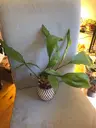
Episcia
Taxonomy

Episcia spp.
Episcia
Gesneriaceae
Lamiales

How to care for Episcia
How often to water your Episcia

every 9
Episcia needs 0.5 cups of water every 9 when it doesn’t get direct sunlight and is potted in a 5" pot.
Use our water calculator to personalize watering recommendations to your environment or download Greg for more advanced recommendations for all of your plants.

Water 0.5 cups every
9
Finding light for Episcia in your home

a window
Episcia may have difficulty thriving, and will drop leaves 🍃, without ample sunlight.
Place it less than 3 feet from a south-facing window to maximize the potential for growth.
Select your region to see how the current weather in your area affects the placement of Episcia in your home 🏡.
How to fertilize Episcia

Most potting soils come with ample nutrients which plants use to produce new growth.
By the time your plant has depleted the nutrients in its soil it’s likely grown enough to need a larger pot anyway.
To replenish this plant's nutrients, repot your Episcia after it doubles in size or once a year—whichever comes first.
-
OH MY GODDDDDD
-
Pink Panther plant, Should I repot or wait ? Hello my lovely plant friends! I'm brand new to the app and finding my way around. I'm not new to plants, just starting completely over and getting my collection going after not having any for 6+ years. I used to have a lot of luck with African violets, and even successful at starting new ones from my grandma plant. I am, however, new to Pink panther plants. It reminds me of the African violet . My question for you is, this pretty girl is brand new. She just arrived yesterday and the pot I was planning to put her in is a 7" pot, which will swallow her tiny self whole 😂. Should I leave her in the current 2" pot for a little while and allow some growth or go ahead and repot to the big one? I know with African violets they prefer to be a tad root bound. Any input would be greatly appreciated. #happyplants, #newplantmom
-
I have no idea what I’m doing, please help!! Firstly, I believe I have misidentified this plant and the app can’t seem to decide which plant it is. Secondly, I found him like this today. I believe he may be overwatered but I’m not sure. Any help would be appreciated!!
-
I just got her today, and her flowers were beautiful! I feel so bad, she had to be in my car for about an hour with me and at work for about 7 hours. Should I cut off the flowers? Please let me know I’m so new to plants!!! #FlameViolet
-
Is it spider mites? #PestControl #help
-
The leaves look like theyre eaten, is this a sign of pests Hello, i am very new to plants and got this one from my bf’s mom and the leaves look like they are eaten. i have a few other plants and im really scared of pests so i searched online and a lot of others had the same thing? I am just double checking since i couldnt find much. Thank you in advance! Edit: there is also some browning on the bigger leaf.
-
Can anyone please tell me what kind of plant this is? The app says it's a begonia but it doesn't look like any of the other ones I've seen.
-
Episcia Cleopatra not looking too good… hi everyone!! i have a 4” cleopatra that i got at the same time as my mother. hers seems to be thriving while mine’s leaves are crusting up a bit and just doesn’t seem to be happy. her leaves are turning brown. i water her about once a week with fertilizer and have her on the bottom of a 3-tiered plant stand, the top having 3 grow lights to hang over each tier. what am i doing wrong?
-
Hi! My episcia is a little sad I got her from Lowe’s and she had lots of dying leaves and now she has browning on the edges of her leaves. What kind of soil do you use for yours? And light amount she should be receiving? Help I don’t want her to die 😭
-
I need plant help!! Hello!! I just bought a flame violet about two weeks ago, but its leaves have started to go dry and curled. I'm not sure what I'm doing wrong or how to fix it. Is anyone able to tell from these pictures?? #help #helpneeded #FlameViolet #NewPlants #NewPlantMom


Care Summary for Episcia

Episcia
 Greg recommends:
 Water
Water
0.5 cups every 9 days
 Placement
< 3ft from a window
 Nutrients
Repot after 2x growth
Based on the 4” pot your plant is in, and that it doesn’t get direct sunlight.
 Trending in your area
Phalaenopsis Orchid

Mini Monstera

Rex Begonia

Avocado

Arabian Coffee Plant

Chinese Evergreen
Heartleaf Philodendron

Tradescantia Zebrina

Golden Barrel Cactus
Triostar Stromanthe
Sweet Basil
Snake Plant

Tradescantia Nanouk
Philodendron Birkin

Fairy Washboard

Window Leaf

False Christmas Cactus
Money Tree
 Similar to Episcia
✨ Discover rare plants
Linnaei Kunth

Anastasia Weeping Fig

Graptoveria 'Douglas …

Fernleaf Lavendar

Orange Lipstick Plant

Euphorbia

Cereus peruvianus 'Pa…

Electric Blue Gecko

Euphorbia baioensis

Eden Climbing Rose

Scindapsus pictus 'Si…

Pine Cone Plant

Aglaonema Spitfire

Milky Widow's Thrill

Haworthia emelyae com…

Starfish Snake Plant

Echeveria Esther