

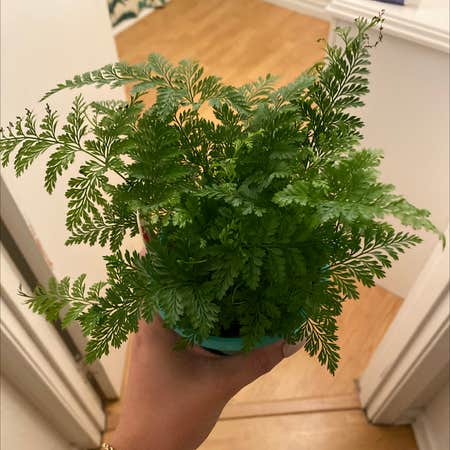


Black Rabbit's Foot Fern
Also known as
Squirrel's Foot Fern
Taxonomy

Davallia trichomanoides
Davallia
Davalliaceae
Polypodiales

How to care for Black Rabbit's Foot Fern
How often to water your Black Rabbit's Foot Fern

every 9
Black Rabbit's Foot Fern needs 0.5 cups of water every 9 when it doesn’t get direct sunlight and is potted in a 5" pot.
Use our water calculator to personalize watering recommendations to your environment or download Greg for more advanced recommendations for all of your plants.

Water 0.5 cups every
9
Finding light for Black Rabbit's Foot Fern in your home

a window
Black Rabbit's Foot Fern may have difficulty thriving, and will drop leaves 🍃, without ample sunlight.
Place it less than 3 feet from a south-facing window to maximize the potential for growth.
Select your region to see how the current weather in your area affects the placement of Black Rabbit's Foot Fern in your home 🏡.
How to fertilize Black Rabbit's Foot Fern

Most potting soils come with ample nutrients which plants use to produce new growth.
By the time your plant has depleted the nutrients in its soil it’s likely grown enough to need a larger pot anyway.
To replenish this plant's nutrients, repot your Black Rabbit's Foot Fern after it doubles in size or once a year—whichever comes first.
-
Has lost a lot of leaves and is still losing some (I believe due to slight draft so I moved the plant out of the draft area) but has new little sprouts popping up. Tips on better care? I love this plant and don’t want to lose it #RabbitFootFern
-
Just wanted to share a photo of my rabbits foot fern!! He’s soooo prettyyy. When my other plants are being picky, this guys always happy lol. Also it’s growing more fronds!!! #RabbitFootFern #Fern #HappyPlants
-
Put this girl out today. Took off some sad pieces, gave her a dunk & hung her up to get some ☀️ #TarantulaFern #rabbitsfootfern #TheThread #TheWateringHole #PlantsMakePeopleHappy #PlantTherapy #brunchataudreys
-
I finally found that rabbits foot fern! It’s super healthy and the rhizomes (aka “rabbits feet”) are already super developed and some of them are already crawling out of the pot! I’m naming it remy, I’m not sure why it just looks like a remy to me lol. #PlantHaul
-
I just received my plants today should I water them and how much #GoldenMosaicPlant
-
I was told that epsom salt would help a wilting fern. Thoughts? Mine is loosing leaves and thinning out. 😔 #RabbitFootFern
-
Happy feet
-
Enjoying life
-
Loving it!
-
Any advice on how to perk this guy up? #RabbitFootFern


Care Summary for Black Rabbit's Foot Fern

Black Rabbit's Foot Fern
 Greg recommends:
 Water
Water
0.5 cups every 9 days
 Placement
< 3ft from a window
 Nutrients
Repot after 2x growth
Based on the 4” pot your plant is in, and that it doesn’t get direct sunlight.
 Trending in your area










 Similar to Black Rabbit's Foot Fern

✨ Discover rare plants

Kilimanjaro Plant

Electric Fern

Chinese Evergreen 'Ga…

Euphorbia

Rhipsalis clavata

Scindapsus pictus 'Si…
Hoya 'Memoria'

Black Monkey Thorn Tr…

Burro's Tail

Blue Moon Wisteria

Ceropegia simoneae

Lithops

Christmas Candle

Treasure Flower

Chinese Evergreen 'Go…
Skeleton Key Pothos
Philodendron 'Rio'
