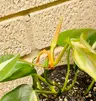
Dahlia 'Kernow Jazzy Bee'
Taxonomy

Dahlia 'Kernow Jazzy Bee'
Dahlia
Asteraceae
Asterales

How to care for Dahlia 'Kernow Jazzy Bee'
How often to water your Dahlia 'Kernow Jazzy Bee'

every 9
Dahlia 'Kernow Jazzy Bee' needs 0.5 cups of water every 9 when it doesn’t get direct sunlight and is potted in a 5" pot.
Use our water calculator to personalize watering recommendations to your environment or download Greg for more advanced recommendations for all of your plants.
Water 0.5 cups every
9
Finding light for Dahlia 'Kernow Jazzy Bee' in your home

a window
Dahlia 'Kernow Jazzy Bee' love being close to bright, sunny windows 😎.
Place it less than 1ft from a south-facing window to maximize the potential for growth.
Dahlia 'Kernow Jazzy Bee' does not tolerate low-light 🚫.
Select your region to see how the current weather in your area affects the placement of Dahlia 'Kernow Jazzy Bee' in your home 🏡.
How to fertilize Dahlia 'Kernow Jazzy Bee'

Most potting soils come with ample nutrients which plants use to produce new growth.
By the time your plant has depleted the nutrients in its soil it’s likely grown enough to need a larger pot anyway.
To replenish this plant's nutrients, repot your Dahlia 'Kernow Jazzy Bee' after it doubles in size or once a year—whichever comes first.
-
What’s going on? I don’t understand what’s going on with my plant 🤔 I do t see any pest on it, but it somehow looks weird… Can someone enlighten me? Or is it the normal look of the leaves before the flower blooms? (It’s my first year having it, planted it from the bulbs)
-
How do you prevent caterpillars from eating the leaves? #GardenDahlia
-
Why do my Dahlia leaves look like this. Spots everywhere. #GardenDahlia
-
My Dahlias are not looking very well. Is it possible, from looking at the leaves, that it might have bugs? I sprayed them for bugs a few days ago but they look worse. #GardenDahlia
-
Why are the leaves on my plant so dry and crumbly? #GardenDahlia
-
Hi everyone, I have deadheaded my dahlia because I understand it will produce flowers off the side shoots. I am thinking should I cut the leaves back a bit? Will this help it focus energy on producing flowers? #GardenDahlia
-
Iceberg dailia What is wrong with my plant Leaves are eaten
-
What is wrong with my dahlia could it be the tubers are rotting? Should I repot it and will it come back. It’s August. My other two dahlias are lush and beautiful #GardenDahlia
-
After I trimmed her leaves she started blooming flowers left and right, I knew I did the right thing!! I'm so sad 😭 these kids I think were trying to help, they're under the age of 10-4 they pour water 🌊 allover my plants!! I couldn't save her. mad/sad #GardenDahlia
-
My son bought her for me on mother's Day! I was in love instantly, doing so well at keeping her alive, allowing her flowers to bloom,by trimming her leaves back a bit because she was so busy keeping her leaves green that her flowers were littletoNONE #GardenDahlia


Care Summary for Dahlia 'Kernow Jazzy Bee'
Dahlia 'Kernow Jazzy Bee'
 Greg recommends:
 Water
Water
0.5 cups every 9 days
 Placement
< 1ft from a window
 Nutrients
Repot after 2x growth
Based on the 4” pot your plant is in, and that it doesn’t get direct sunlight.
 Trending in your area








 Similar to Dahlia 'Kernow Jazzy Bee'

✨ Discover rare plants

Chinese Evergreen 'Go…

Lithops
Crassula 'Calico Kitt…

Sedeveria 'Blue Elf'

Maroon Pitcher Plant

Kilimanjaro Plant

Treasure Flower

Aglaonema 'Green Bowl'

Burro's Tail

Electric Fern

Christmas Candle

Miss All-American Bea…

Black Monkey Thorn Tr…

Radiator Plant

Bonsai Crassula

Croton Nervia

Hoya kalimantan