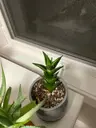
Kurdish Cotyledon
Taxonomy

Cotyledon radiciflora var. kurdica
Cotyledon
Crassulaceae
Saxifragales

How to care for Kurdish Cotyledon
How often to water your Kurdish Cotyledon

every 12
Kurdish Cotyledon needs 0.5 cups of water every 12 when it doesn’t get direct sunlight and is potted in a 5" pot.
Use our water calculator to personalize watering recommendations to your environment or download Greg for more advanced recommendations for all of your plants.
Water 0.5 cups every
12
Finding light for Kurdish Cotyledon in your home

a window
Kurdish Cotyledon love being close to bright, sunny windows 😎.
Place it less than 1ft from a south-facing window to maximize the potential for growth.
Kurdish Cotyledon does not tolerate low-light 🚫.
Select your region to see how the current weather in your area affects the placement of Kurdish Cotyledon in your home 🏡.
How to fertilize Kurdish Cotyledon

Most potting soils come with ample nutrients which plants use to produce new growth.
By the time your plant has depleted the nutrients in its soil it’s likely grown enough to need a larger pot anyway.
To replenish this plant's nutrients, repot your Kurdish Cotyledon after it doubles in size or once a year—whichever comes first.
-
What are those brown dots on my Bear Paw? This week I've noticed the appearance of tiny brown dots and some leaves having bigger spots as well. Should I be worried? Forgot to add: I've been watering every 2 weeks now it's sunnier and protecting it from most scorching sun in the heatwave that we have now #succulentsquad #succulentlove #succulents
-
why would my bear claw plant do this? i pulled this leaf off of her earlier, yesterday i checked on her this morning and i had to pull the leaf off. should i move her and if so where?
-
how can i tell if my plant is getting what he needs? i keep my bear with most my other plants on the porch and he’s not really grown at all, i just want to make sure he’s getting what he needs
-
Is this plant labeled correctly? #Cotyledon #PigsEar
-
When do I know when it’s time to change my plant into a different pot?? #BearsPaw
-
Can I propagate my bearpaw from those cuttings? I actually haven’t made any cuts yet. I was researching and there was something someone said about using non-woody stems only as my cuttings. I watched a lot of videos and they were about bear paws much bigger than mine with a lot of green stems, but mine only has brown stems (and I’m sure it’s not sick). So I’m here to ask if propagation would be possible if I make a cutting from any of those 3 sections in red. (I would only be making a single cut ideally). #PlantAddict #PropagationStation #Propagation #PropDontShop #SucculentLove #SucculentSquad
-
Help me ID this beauty? I’m thinking she’s most likely a Cotyledon Orbiculata variety, but I’m not sure which. Silver Peak or Lady Fingers, maybe? I realize she may be a bit etiolated for her species (I got her like this), so that makes IDing more difficult. If anyone knows or has any guesses, I’d love to hear them! #SucculentSquad #PlantID
-
#succulentsquad Here's the thing about succulents: they are complicated. The other side of that is that they are full of surprises and quirks. That aloe used to be bright green. The Astrophytum flowers resemble bird plumage and do three different billboard displays of color before/during/after a bloom. One of the grey nubs grew a second arm. The surprise with the Bear Paw is that it loves a little intense sun; no surprise that it's finicky and basically got its own special grow light.
-
Do they have to be inside for sunlight? I’m new at this 😅 #BearsPaw
-
#WhatTheSuccWednesday #WhereIsWhatTheSuccWednesday Got to repot some of my babies today, I used the last flower shaped pot of the three I got, this is the mid size one (I got small, medium and a large). Two of the three plants are propagations, (the Snow White panda plant & super donkey tail). The third plant is Cliff Cotyledon, it seems to be a fast grower, it has tripled in size since I’ve gotten it about a month and half ago. Please drop your #Succulent photos in the comments! & join the group if you love #Succulents and miss our OG #WhatTheSuccWednesday ! 🌿💕 #HappyPlants #NewGrowth #GrowingSuccs #SucculentSquad #SucculentLove #SuccerForSucculents #WhatTheSucc #PandaPlant #Cotyledon #DonkeyTail #SuperDonkeyTail #succulentarrangements #repot


Care Summary for Kurdish Cotyledon
Kurdish Cotyledon
 Greg recommends:
 Water
Water
0.5 cups every 12 days
 Placement
< 1ft from a window
 Nutrients
Repot after 2x growth
Based on the 4” pot your plant is in, and that it doesn’t get direct sunlight.
 Trending in your area







 Similar to Kurdish Cotyledon


✨ Discover rare plants

Munstead Lavender

Sedum 'White Diamond'
Skeleton Key Pothos
Thelocactus macdowell…

Kudu Lily

Anthurium 'Fantasy Lo…

Cleistocactus icosago…

Cereus peruvianus 'Pa…

Graptoveria 'Douglas …
Graptopetalum 'Marqui…

Miss All-American Bea…
Carolina Reaper

Begonia hydrocotylifo…

Hoya 'Millie'

Dinteranthus microspe…

Lithops

Lavandula Pedunculata