
Cauliflower 'Snowball Self Blanching'
Taxonomy

Brassica oleracea (Botrytis Group) 'Snowball Self Blanching'
Brassica
Brassicaceae
Brassicales

How to care for Cauliflower 'Snowball Self Blanching'
How often to water your Cauliflower 'Snowball Self Blanching'

every 9
Cauliflower 'Snowball Self Blanching' needs 0.5 cups of water every 9 when it doesn’t get direct sunlight and is potted in a 5" pot.
Use our water calculator to personalize watering recommendations to your environment or download Greg for more advanced recommendations for all of your plants.
Water 0.5 cups every
9
Finding light for Cauliflower 'Snowball Self Blanching' in your home

a window
Cauliflower 'Snowball Self Blanching' love being close to bright, sunny windows 😎.
Place it less than 1ft from a south-facing window to maximize the potential for growth.
Cauliflower 'Snowball Self Blanching' does not tolerate low-light 🚫.
Select your region to see how the current weather in your area affects the placement of Cauliflower 'Snowball Self Blanching' in your home 🏡.
How to fertilize Cauliflower 'Snowball Self Blanching'

Most potting soils come with ample nutrients which plants use to produce new growth.
By the time your plant has depleted the nutrients in its soil it’s likely grown enough to need a larger pot anyway.
To replenish this plant's nutrients, repot your Cauliflower 'Snowball Self Blanching' after it doubles in size or once a year—whichever comes first.
-
How are folks keeping their broccoli sprouts from getting sun stretched? Mine grew so fast and now they’re very limp
-
can anyone identify this disease on my wild cabbage plant
-
Can you eat Chinese mustard #ChineseMustard
-
Looks like a cauliflower #WildCabbage
-
Welcome to my new plant, black mustard! I am watering it every day since it sprouted 2 days ago and the place where I live, Dubai the summer is starting and it is very hot especially july! Do you like it?
-
Can I save my wild cabbage? I’ve had it indoors for the last few months after searing them from my front porch planter. I have them in my sunroom. Are they getting g too much sun? #WildCabbage
-
This is actually snowball cabbage. It is planted in my garden, but it does not look well.
-
Why are my leaves wilted so badly ? I watered the cabbages this morning and they were fine. They’re indirect sunlight and wilted now. #WildCabbage
-
Hi. Does anyone know what can I do to help my green baby to get health ? Thank you #HappyPlants
-
Picked this little guy up during a sale . What can i do so he thrives ? #HappyPlants #PlantsMakePeopleHappy #NewPlantMom #EdiblePlants


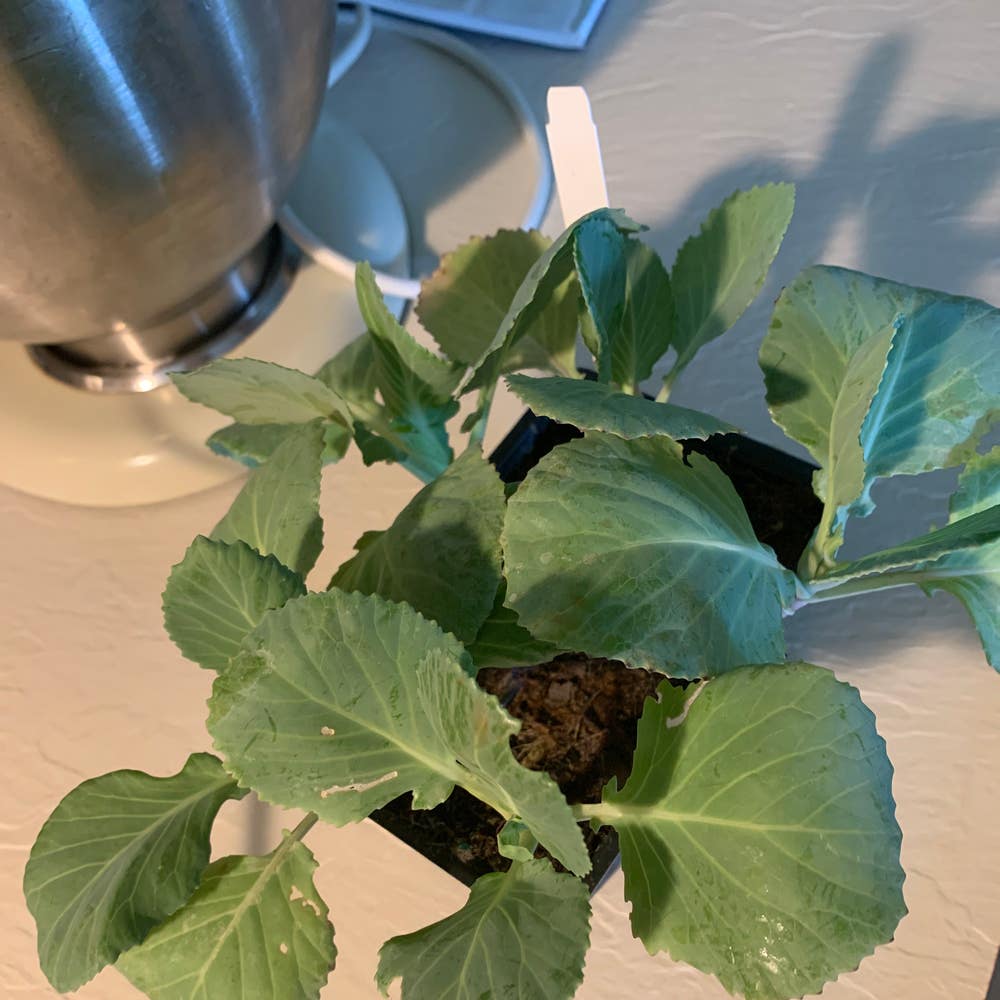
Care Summary for Cauliflower 'Snowball Self Blanching'
Cauliflower 'Snowball Self Blanching'
 Greg recommends:
 Water
Water
0.5 cups every 9 days
 Placement
< 1ft from a window
 Nutrients
Repot after 2x growth
Based on the 4” pot your plant is in, and that it doesn’t get direct sunlight.
 Trending in your area












 Similar to Cauliflower 'Snowball Self Blanching'

✨ Discover rare plants

Chinese Evergreen 'Ga…

Munstead Lavender
Astroloba congesta

Lithops

Milky Widow's Thrill

Echeveria Arrow

Echeveria Esther

Large Leaf Elephant B…

Scindapsus pictus 'Si…

Hoya pottsii 'Khao Ya…

Betel

Caladium

Fernleaf Lavendar

Anthurium 'Fantasy Lo…
Anthurium papillilami…

Euphorbia baioensis
