
Begonia guangxiensis
Taxonomy

Begonia guangxiensis
Begonia
Begoniaceae
Cucurbitales

How to care for Begonia guangxiensis
How often to water your Begonia guangxiensis

every 9
Begonia guangxiensis needs 0.5 cups of water every 9 when it doesn’t get direct sunlight and is potted in a 5" pot.
Use our water calculator to personalize watering recommendations to your environment or download Greg for more advanced recommendations for all of your plants.
Water 0.5 cups every
9
Finding light for Begonia guangxiensis in your home

a window
Begonia guangxiensis may have difficulty thriving, and will drop leaves 🍃, without ample sunlight.
Place it less than 3 feet from a south-facing window to maximize the potential for growth.
Select your region to see how the current weather in your area affects the placement of Begonia guangxiensis in your home 🏡.
How to fertilize Begonia guangxiensis

Most potting soils come with ample nutrients which plants use to produce new growth.
By the time your plant has depleted the nutrients in its soil it’s likely grown enough to need a larger pot anyway.
To replenish this plant's nutrients, repot your Begonia guangxiensis after it doubles in size or once a year—whichever comes first.
-
Soooo it’s grown some more since first posting of this… is this really a begonia? What am I doing wrong? Is it too soon to repot again? What should its pot and soil be? #randomclipling #justthrewindirt #Begonia
-
I am confused 🤔 the tag on my beautiful 🤩 fairly new, baby reads begonia. However,the Gregg app keeps coming up Chinese Elm. Now it has tiny pink flowers 🌺 all over the place. I'm lost and need to be set straight. HELP! #ChineseElm
-
I was gifted some clippings of this plat a few months ago. I’m looking for any tips that you might have in caring for them. I don’t feel like I’m seeing much growth in her. #Begonia
-
Has anyone had any experience with Miracle Gro shake n feed? It’s 10-18-9, after research high phosphorus is supposed to help blooms, I put it in about three weeks ago, but I’m only getting leaves on my Rieger Begonia. Advice/thought appreciated :) #Begonia #riegorbegonia #fertilizer #FloweringPlants
-
The leaves have a whitish haze. What’s wrong? #Begonia
-
This plant has had such a glowup ❤️ just look at the before and after #wetstick #HappyPlants #LecaLeague #leca #semihydroponics #semihydro #pon #lechuzaPon #Begonia #begonias
-
So I rescued this sweet girl from a Bigbox store, where she was obviously not treated properly. Any suggestions on the best way to help her recover would be lovely! Also, does anyone know what the burnt, brown crispy edges, and half missing leaves would be from? I’m guessing she was getting too much sun? Although I have always wanted one, this is my first Polka Dot Begonia, so I am still unsure of her needs and signs of distress, and or happiness. Any tips would be greatly appreciated! Thank you all in advance! I hope to help her recover.
-
Does anyone else have problems getting the bottom part of their upright rieger begonia to bloom? I have done the stem pinch and rotated to lighting. Any tips? #Begonia #RiegerBegonia #uprightbegonia
-
New plant advice Just got this plant & the soil was completely dry! Any tips on how much and how often to water it?
-
Begonia issues again @DreamMachine girl I rlly can’t keep it alive idk what I’m doing wrong it’s pale and the new growth is grey and floppy. The base is starting to dry up but the leaves that are grown look good. Pls help I don’t know what else to do I repotted it but the roots were too little #HappyPlants #PlantsMakePeopleHappy #PlantAddict #Begonia #BegoniaRex #BegoniaBunch #NewGrowth #PlantTherapy #PlantCorner


Care Summary for Begonia guangxiensis
Begonia guangxiensis
 Greg recommends:
 Water
Water
0.5 cups every 9 days
 Placement
< 3ft from a window
 Nutrients
Repot after 2x growth
Based on the 4” pot your plant is in, and that it doesn’t get direct sunlight.
 Trending in your area









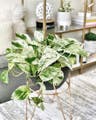
 Similar to Begonia guangxiensis


✨ Discover rare plants

Hoya pottsii 'Khao Ya…

Black Monkey Thorn Tr…

Scindapsus pictus 'Si…

Eden Climbing Rose

Anthurium Fingers

Aeonium 'Blushing Bea…

Lithops

Parrot Pitcher Plant
Graptopetalum 'Marqui…

Kilimanjaro Plant

Ruby Ball
Stanhopea tigrina

Rainbow Echeveria
Linnaei Kunth

Chandelier Plant

Hoya fitchii

Sarcochilus fitzgeral…
