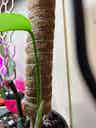
Aeschynanthus urdanetensis
Taxonomy

Aeschynanthus urdanetensis
Aeschynanthus
Gesneriaceae
Lamiales

How to care for Aeschynanthus urdanetensis
How often to water your Aeschynanthus urdanetensis

every 9
Aeschynanthus urdanetensis needs 0.5 cups of water every 9 when it doesn’t get direct sunlight and is potted in a 5" pot.
Use our water calculator to personalize watering recommendations to your environment or download Greg for more advanced recommendations for all of your plants.
Water 0.5 cups every
9
Finding light for Aeschynanthus urdanetensis in your home

a window
Aeschynanthus urdanetensis may have difficulty thriving, and will drop leaves 🍃, without ample sunlight.
Place it less than 3 feet from a south-facing window to maximize the potential for growth.
Select your region to see how the current weather in your area affects the placement of Aeschynanthus urdanetensis in your home 🏡.
How to fertilize Aeschynanthus urdanetensis

Most potting soils come with ample nutrients which plants use to produce new growth.
By the time your plant has depleted the nutrients in its soil it’s likely grown enough to need a larger pot anyway.
To replenish this plant's nutrients, repot your Aeschynanthus urdanetensis after it doubles in size or once a year—whichever comes first.
-
Yellowing leaves! I have this gorgeous mona lisa lipstick plant, but her leaves are turning yellow!! Any ideas what’s going on? #HappyPlants
-
My Thai pink lipstick flowered!!! My Thai pink lipstick flowered for the first time!!! It’s so beautiful and unexpected!!! Just wanted to share bc I’m so excited!!! 😄 #FloweringPlants #PlantsMakePeopleHappy #PlantAddict #NewGrowth #PlantTherapy #PlantCorner #PlantShelfie
-
What’s wrong with Harry?? I got this black pagoda lipstick plant as a rescue from my local plant stand on a very cold Thanksgiving night. Not sure what happened there but he was basically uprooted. So I replanted him into my chunky Grow Queen soil with some extra perlite and stuck him about 6 ft away from an east facing window, BUT he has his own grow light about 1 ft up & out so the crown and the leaves get light. He was beautiful when I first got him! But look at the second picture: that’s him now. Idk why he keeps loosing leaves. I thought maybe it was damage from the cold and to the roots. At first it was healthy-looking green leaves just falling, but now the leaves are yellowing and falling. So many naked vines, so I tried to wrap and bury nodes but that’ll take time. What’s wrong? What can I do? I water when top 2 inches are dry. #LipstickPlant #LoosingLeaves #PlantAddict #HappyPlants #PlantTherapy #GrowLights #NewPlantMom #PlantCorner #BeforeAndAfter #GregGang
-
A flower? 🐸☕️
-
My #BlackPagodaLipstickPlant is blooming! 🥹🥹🥹🥹 #HappyPlants #PlantsMakePeopleHappy #PlantAddict #NewGrowth #Blooming #LipstickPlant #ProudPlantParent
-
How do you care for these things?! Bought a lipstick plant. I didn’t have a planter big enough for it and it was not doing well in the plastic it came home in. I separated it into two small pots and it looked so much better- I thought it would thrive. Both pots are now brittle and dying. I am so sad. I water based off app recommendations & they are both near windows but not bright full direct light. Someone help please🥲
-
Hii! This is my twisted lipstic plant. I overwatered is once and ever since it looks like it’s on the verge of dying. I already gave it new soil. What do i do? Or is this a lost cause…🤷🏼♀️ #TwistedLipstickPlant
-
I'm soooo excited. My twisted Lipstick has started to bloom!!!! She is soo pretty #twistedlipstickplant #hoya
-
Hello Plant Peeps. My Lipstick Plant only has 2 stems and is trellised like a vine. Will it bloom like this? #LipstickPlant
-
Help needed Hello plant friends! I am new to this group. I got this little lipstick plant from a friend last year and I was super excited to see it flowering last month. Now I am having problems with some bugs and it already lost quite a few leaves. I think they come from little flies and the maggots get inside the leaves. Any suggestions on how to get rid of them? I heard about systemic pesticides.


Care Summary for Aeschynanthus urdanetensis
Aeschynanthus urdanetensis
 Greg recommends:
 Water
Water
0.5 cups every 9 days
 Placement
< 3ft from a window
 Nutrients
Repot after 2x growth
Based on the 4” pot your plant is in, and that it doesn’t get direct sunlight.
 Trending in your area









 Similar to Aeschynanthus urdanetensis

✨ Discover rare plants

Radiator Plant
Stanhopea tigrina
Anthurium papillilami…
Hoya crassipetiolata

Dinteranthus microspe…

Bonsai Crassula

Thelocactus macdowell…

Peperomia 'Harmony's …

Parrot Pitcher Plant
Astroloba congesta

Treasure Flower

Ceropegia simoneae

Eden Climbing Rose

Burro's Tail

Chinese Evergreen 'Go…
Chinese Evergreen 'Ga…

Electric Fern