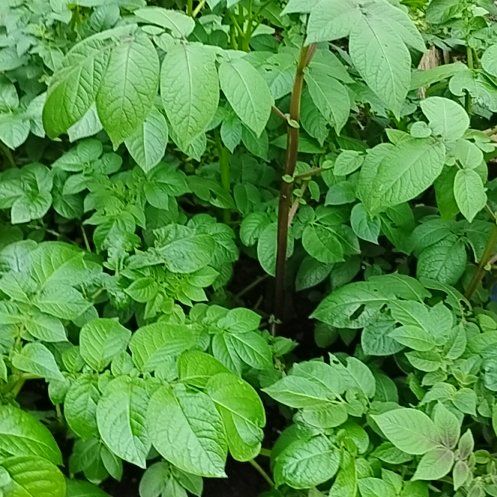
Potato

How to Prune Potato Plants

Solanum tuberosum
Reviewed by Kiersten Rankel M.S.
Quick Answer
Prune potato plants during the growing season by pinching off flowers and removing excess suckers that compete for energy. Focus pruning in early to mid-summer when plants are actively growing. Don't remove more than a quarter of the foliage at once, since the leaves fuel tuber development underground.

When is the best time to prune?

Potatoes are warm-season annuals that grow quickly from planting to harvest, so any pruning should happen during the active growing window before plants begin to die back naturally.

US pruning regions map
Pacific
May–Jul
Mountain
Jun–Aug
Midwest
Jun–Aug
Northeast
Jun–Aug
Southeast
Apr–Jun
Stay on top of plant care
Get seasonal reminders for watering and fertilizing — personalized for your plants.
Try Greg Free

Why Should I Prune My Potato Plants?

Most gardeners never think about pruning potatoes, but a little selective trimming can help your plants put more energy into tuber production. The main targets are flowers, excessive suckers, and any diseased foliage.

When potato plants flower, they're trying to set seed (those small green tomato-like fruits). Pinching flowers off redirects that energy into the tubers underground. Some varieties flower heavily and others barely at all, so this matters more for prolific bloomers.

If your potato plants are very bushy with lots of side shoots, thinning out a few of the weaker ones improves air circulation and reduces disease pressure, especially for late blight. Remove suckers that are growing from the base and competing with the main stems.

Don't go overboard. The leaves are the engine that drives tuber growth through photosynthesis. Removing too much foliage will give you smaller potatoes. The plant will naturally die back as the tubers mature, and that's your signal to stop any maintenance and prepare for harvest.

Know Before You Cut

Difficulty Easy
Max removal 1/4 of foliage at a time
Growth pattern Bushy annual
Tools Pruners or pinching by hand

What Should I Remove?

Pinch off flowers as they appear
Remove weak suckers at the base
Cut out any leaves with blight spots immediately
Thin crowded stems for better airflow
Don't remove more than 1/4 of foliage at once
Don't prune after plants start yellowing naturally
Don't cut the main stems

How Do I Prune Step by Step?

1
Pinch off flower buds
As soon as you see flower buds forming, pinch them off between your fingers. This is the simplest and highest-impact pruning you can do.
2
Identify weak or crowded stems
Look at the base of each plant. If more than 4–5 stems are growing from one seed potato, the weakest ones can be removed to reduce competition.
3
Remove suckers at the base
Pull or cut small side shoots growing from the base. Take only the thinnest ones and leave the strongest 3–4 stems per plant.
4
Remove diseased foliage promptly
Cut off any leaves showing brown or black spots immediately and dispose of them away from the garden. Don't compost them. This slows the spread of blight.
5
Stop pruning when plants yellow
When the foliage starts dying back on its own, the tubers are maturing. Leave the plant alone and wait 2–3 weeks after complete dieback before harvesting.

Got More Questions?

Do I really need to remove potato flowers?
It's optional but helpful. Removing flowers redirects a small amount of energy to tuber production. The difference is modest, but it's easy to do and has no downside.
Can I eat the small green fruits that form after flowering?
No. Those fruits contain solanine and are toxic. Remove them if you see them, especially if children or pets are around.
Should I cut potato plants back before harvest?
Some gardeners cut the foliage down a week or two before digging to toughen the skins. This is optional and mainly helps if you're storing the potatoes long-term.
My potato plants fell over. Should I prune them?
Falling over is common for tall varieties. Rather than pruning, hill more soil around the base for support. The stems will keep producing even if they're leaning.
What's the difference between hilling and pruning potatoes?
Hilling means mounding soil around the stems to cover developing tubers and encourage more to form. Pruning is removing above-ground growth. Both help, but hilling has a bigger impact on yield.
Stay on top of plant care
Get seasonal reminders for watering and fertilizing — personalized for your plants.
Try Greg Free

About This Article

Kiersten Rankel M.S.
Botanical Data Lead at Greg · Plant Scientist
About the Author
Kiersten Rankel holds an M.S. in Ecology & Evolutionary Biology from Tulane University. A certified Louisiana Master Naturalist, she has over a decade of experience in science communication, with research spanning corals, cypress trees, marsh grasses, and more. At Greg, she curates species data and verifies care recommendations against botanical research.
See Kiersten Rankel's full background on LinkedIn.
Editorial Process
Pruning guidance verified against Solanum tuberosum growth data from Greg's botanical database, cross-referenced with USDA hardiness zone data and published horticultural research.
1,549+ Greg users growing this plant
USDA hardiness zones 3a–10a
Grow plants with confidence