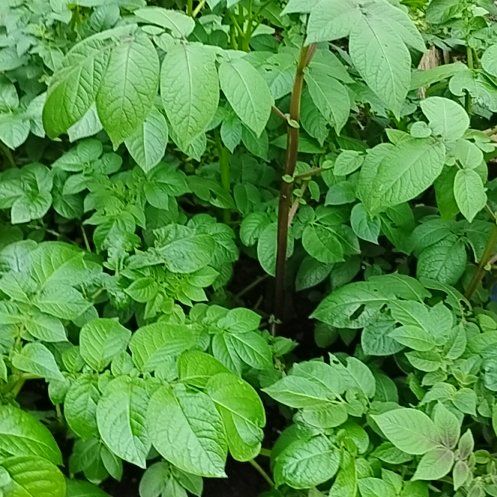
Potato

What's Eating Your Potato?

Solanum tuberosum
Reviewed by Kiersten Rankel M.S.
Quick Answer

For potatoes, the most likely culprits are Colorado potato beetles (yellow and black striped adults, red humped larvae stripping leaves) and aphids (small clusters on new growth that spread potato leafroll virus). Flea beetles riddle seedling leaves with pinholes. Wireworms tunnel into developing tubers underground and only show up at harvest.

Stay on top of plant care
Get seasonal reminders for watering and fertilizing, personalized for your plants.
Try Greg Free

What does the damage look like?

Tap the closest match to jump straight to the fix.

Pests, ranked by impact

Small leaf weevil resting on a green leaf

Colorado potato beetle

Damage
High
Removal
Moderate
What it looks like

Adults are 10 mm long, oval, with bright yellow-orange and black lengthwise stripes on the wing covers. Larvae are humped and brick-red with two rows of black dots down each side. Both stages feed on the compound leaves. Bright orange egg clusters sit on leaf undersides.

What the damage looks like

Compound leaves chewed down to the midrib, sometimes whole stems stripped within a few days. Heavy defoliation during tuber formation directly cuts yield, since the plant can't power tuber growth without leaves. Look for the orange egg clusters underneath nearby leaves to confirm.

How to get rid of them
Option 1

Hand-pick eggs, larvae, and adults into soapy water

1

Walk the potato rows every 2 to 3 days starting when plants are 6 inches tall.

2

Flip leaves to find the bright orange egg clusters and crush them, then drop any larvae and striped adults into a jar of soapy water.

3

Keep at it for 3 to 4 weeks. This is the most reliable home control because the beetles often shrug off chemical sprays.

Option 2

Spinosad spray when pressure is overwhelming

If hand-picking can't keep up, spray spinosad (Captain Jack's Deadbug Brew or Monterey Garden Insect Spray, ~$12 to $15) on leaf tops and undersides at dusk. Repeat every 7 days for 2 to 3 rounds. Spinosad still works on most populations even where the beetles have evolved resistance to older chemicals.

Option 3

Rotate potatoes away from last year's bed

Adults overwinter in the soil under the previous potato or tomato patch and emerge in spring to feed on whatever is planted there. Move potatoes at least 30 feet from last year's solanaceous beds. The further the better, since the beetles walk before they fly.

Dense colony of aphids clustered on a plant stem

Aphids

Damage
High
Removal
Easy
What it looks like

Soft pear-shaped insects 1 to 3 mm long, in green, pink, or black. Cluster densely on the youngest compound leaves at the top of the plant and on the undersides of expanding leaflets. Often the first sign is winged adults landing on new growth in late spring.

What the damage looks like

Leaf curling and sticky film on lower leaves are obvious, but the real damage is invisible. Aphids spread Potato leafroll virus and other viruses while they feed. Infected plants grow stunted vines, rolled upper leaves, and a smaller tuber harvest. The virus stays in the tubers if you save seed.

How to get rid of them
Option 1

Strong water blast every 2 to 3 days for 2 weeks

Hold a hose nozzle 12 inches from the affected new growth and spray at high pressure. Most aphids dislodge and don't make it back. Repeat every 2 to 3 days for 2 weeks. The fastest, cheapest fix and works without chemicals that would kill aphid predators.

Option 2

Lay reflective mulch between rows at planting

Roll out silver reflective plastic mulch (about $20 for a 25-foot roll) between potato rows. Winged aphids use the sky as a navigation cue, and the reflection disorients them so they don't land. The mulch also keeps the soil cooler, which potatoes like.

Option 3

Insecticidal soap on heavy clusters at dusk

Spray ready-to-use insecticidal soap (Safer Brand, ~$10) on the underside of affected leaves at dusk. Soap kills on contact but doesn't persist, so it spares ladybugs and lacewings that arrive after the spray dries. Repeat every 5 days for 2 rounds.

Small leaf weevil resting on a green leaf

Wireworms

Damage
High
Removal
Hard
What it looks like

Slender, hard-bodied yellow-orange larvae 15 to 30 mm long, the larvae of click beetles. Live in the top 4 to 6 inches of soil where the developing tubers form. You won't see them on the foliage. They show up only when you dig the harvest and find the tunnels.

What the damage looks like

Clean round holes about 2 mm wide drilled straight into the tubers, often with a thin tunnel continuing inside. Damaged tubers rot in storage and aren't usable for seed. The plant above ground looks healthy, which is what makes wireworms so frustrating. You discover the loss only when you dig.

How to get rid of them
Option 1

Avoid planting potatoes in recently grassed soil

Wireworm populations build up in sod and pasture. The single biggest prevention is to wait 2 to 3 years after breaking ground before planting potatoes there. If you must plant in newly turned grass, expect damage and plan for it.

Option 2

Trap with potato slices 2 weeks before planting

1

Bury halved potatoes about 4 inches deep every 3 feet across the bed, with a stick marking each one.

2

Dig the traps up after 5 to 7 days and crush any wireworms inside, then rebury fresh halves.

3

Repeat for 2 weeks before planting. This won't eliminate the population but it cuts pressure on the real crop.

Option 3

Rotate to non-host crops for 2 years

After a wireworm-damaged harvest, plant beans, peas, or lettuce in that bed for the next 2 years. Wireworm populations crash without root crops to feed on. Avoid corn, carrots, and other potatoes during the rotation.

Tiny shiny black flea beetle (Altica sp.) on a green leaf

Flea beetles

Damage
Medium
Removal
Moderate
What it looks like

Tiny shiny black beetles 2 to 3 mm long that hop like fleas when disturbed. Hard to spot on the leaf at first because they jump as soon as you lean in. Cluster on potato seedlings during the first 4 to 6 weeks after emergence, especially in warm dry spring weather.

What the damage looks like

Leaves riddled with tiny round pinholes 1 to 2 mm wide, sometimes giving the leaf a shothole or pepper-shake look. Heavy damage on small seedlings can stunt growth or kill them outright. Established plants with full canopy mostly shrug it off and grow past the damage.

How to get rid of them
Option 1

Floating row cover from emergence to 6 inches tall

Lay lightweight floating row cover (Agribon AG-15, ~$25 for a 50-foot length) over the bed as soon as shoots emerge. Bury the edges with soil. The cover blocks the beetles entirely until plants are big enough to outgrow damage. Pull it off when plants hit 6 inches.

Option 2

Spinosad spray on seedlings every 7 days

If row cover isn't an option, spray spinosad (Captain Jack's Deadbug Brew, ~$12) on seedlings at dusk every 7 days for the first month. Once plants are taller than 6 inches and the canopy fills in, you can usually stop spraying.

Option 3

Plant a sacrificial trap row of radish

Sow a row of radishes 3 to 5 days before planting potatoes. Flea beetles strongly prefer radish leaves and concentrate there. Spray or pull the radishes once damage is heavy, removing the bulk of the local beetle population before they hit the potatoes.

Bright green tobacco hornworm caterpillar (Manduca sexta) with white diagonal stripes on a tomato plant

Hornworm

Damage
Medium
Removal
Easy
What it looks like

Bright green caterpillars up to 4 inches long with white or yellow diagonal stripes along the body and a soft horn at the tail end. The same Manduca species that hit tomato also feed on potato foliage. Camouflage well against the green compound leaves and are easiest to spot at dusk.

What the damage looks like

Big ragged gaps chewed out of compound leaves, sometimes whole leaflets stripped to the petiole. Dark green pellet droppings on lower leaves and the soil below give them away even when the caterpillar is hidden. Potato canopy is dense enough that established plants outgrow moderate damage.

How to get rid of them
Option 1

Hand-pick at dusk under a UV blacklight

1

Walk the bed an hour after sunset with a UV blacklight ($10 to $15 on Amazon).

2

Hornworms glow neon green under UV and stand out from the foliage.

3

Pick them off by hand and drop into a jar of soapy water. Repeat every 2 to 3 nights through July and August.

Option 2

Bt spray on leaf undersides at dusk

Mix 1 teaspoon Bt (Monterey or Safer Caterpillar Killer, ~$15) per quart of water. Spray the underside of every compound leaf at dusk because Bt breaks down in sunlight. Reapply after rain or every 7 days until you stop seeing droppings.

Option 3

Leave wasp-cocooned hornworms alone

If you find a hornworm covered in white rice-grain cocoons on its back, leave it on the plant. Those are braconid wasp pupae, and the wasps that hatch will hunt down more hornworms in the bed. The parasitized hornworm has stopped feeding and won't do further damage.

Stay ahead of all of them

Four habits that keep potato pests rare and easy to catch.
1

Underleaf check, twice a week from emergence

Colorado potato beetle egg clusters and aphid colonies both start on the undersides of upper leaves. A 2-minute scan twice a week catches them before populations explode. Crush egg clusters as you find them.

2

Rotate potatoes 30 feet from last year's bed

Colorado potato beetles and wireworms both overwinter in the soil where potatoes grew. Moving the bed 30 feet or more from last year's solanaceous patch leaves the emerging adults and larvae with nothing to feed on.

3

Cover seedlings with row cover until 6 inches tall

Flea beetles do most of their damage in the first 4 to 6 weeks after emergence. Floating row cover blocks them entirely during the vulnerable window. Pull the cover off once plants outgrow the damage threshold.

4

Hill soil over the developing tuber zone

Mound 4 to 6 inches of soil over the row when plants are 8 inches tall. Hilling buries the developing tubers deeper, makes them harder for wireworms to reach, and keeps tubers out of light so they don't green. Repeat once more 3 weeks later.

Stay on top of plant care
Get seasonal reminders for watering and fertilizing, personalized for your plants.
Try Greg Free

About This Article

Kiersten Rankel M.S.
Botanical Data Lead at Greg · Plant Scientist
About the Author
Kiersten Rankel holds an M.S. in Ecology & Evolutionary Biology from Tulane University. A certified Louisiana Master Naturalist, she has over a decade of experience in science communication, with research spanning corals, cypress trees, marsh grasses, and more. At Greg, she curates species data and verifies care recommendations against botanical research.
See Kiersten Rankel's full background on LinkedIn.
Editorial Process
Pest identification and treatment guidance verified against Solanum tuberosum field reports from Greg's botanical database, cross-referenced with university extension sources and published horticultural research.