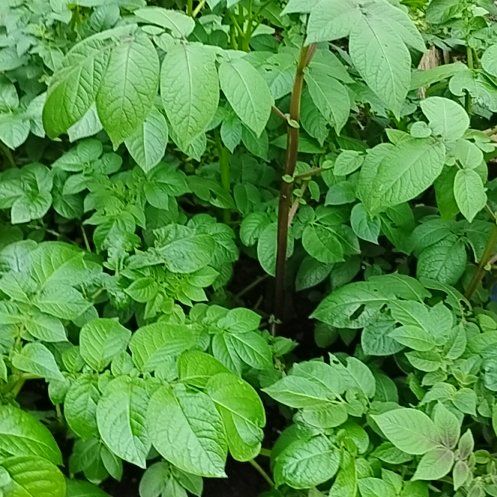


Colorado potato beetle
Adults are 10 mm long, oval, with bright yellow-orange and black lengthwise stripes on the wing covers. Larvae are humped and brick-red with two rows of black dots down each side. Both stages feed on the compound leaves. Bright orange egg clusters sit on leaf undersides.
Compound leaves chewed down to the midrib, sometimes whole stems stripped within a few days. Heavy defoliation during tuber formation directly cuts yield, since the plant can't power tuber growth without leaves. Look for the orange egg clusters underneath nearby leaves to confirm.
Hand-pick eggs, larvae, and adults into soapy water
Walk the potato rows every 2 to 3 days starting when plants are 6 inches tall.
Flip leaves to find the bright orange egg clusters and crush them, then drop any larvae and striped adults into a jar of soapy water.
Keep at it for 3 to 4 weeks. This is the most reliable home control because the beetles often shrug off chemical sprays.
Spinosad spray when pressure is overwhelming
If hand-picking can't keep up, spray spinosad (Captain Jack's Deadbug Brew or Monterey Garden Insect Spray, ~$12 to $15) on leaf tops and undersides at dusk. Repeat every 7 days for 2 to 3 rounds. Spinosad still works on most populations even where the beetles have evolved resistance to older chemicals.
Rotate potatoes away from last year's bed
Adults overwinter in the soil under the previous potato or tomato patch and emerge in spring to feed on whatever is planted there. Move potatoes at least 30 feet from last year's solanaceous beds. The further the better, since the beetles walk before they fly.


