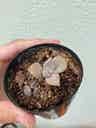
Swan Lake Echeveria
About Swan Lake Echeveria
There are hundreds of plants belonging to the Echeveria genus, each with its own unique colors and patterns.The wild species are native to Central America and were named after the botanical illustrator Atanasio Echeverría y Godoy. They're super easy to grow as long as they get lots of sunlight. ☀️ They can be easily propagated by stem or leaf, making it easy to catch 'em all!
Taxonomy

Echeveria 'Swan Lake'
Echeveria
Crassulaceae
Saxifragales

How to care for Swan Lake Echeveria
How often to water your Swan Lake Echeveria

every 12
Swan Lake Echeveria needs 0.5 cups of water every 12 when it doesn’t get direct sunlight and is potted in a 5" pot.
Use our water calculator to personalize watering recommendations to your environment or download Greg for more advanced recommendations for all of your plants.

Water 0.5 cups every
12
Finding light for Swan Lake Echeveria in your home

a window
Swan Lake Echeveria love being close to bright, sunny windows 😎.
Place it less than 1ft from a south-facing window to maximize the potential for growth.
Swan Lake Echeveria does not tolerate low-light 🚫.
Select your region to see how the current weather in your area affects the placement of Swan Lake Echeveria in your home 🏡.
How to fertilize Swan Lake Echeveria

Most potting soils come with ample nutrients which plants use to produce new growth.
By the time your plant has depleted the nutrients in its soil it’s likely grown enough to need a larger pot anyway.
To replenish this plant's nutrients, repot your Swan Lake Echeveria after it doubles in size or once a year—whichever comes first.
-
Bought these in memory of my baby cousin Courtney Palmer
-
Does my echeveria look leggy? My echeveria has kinda always been like this but my other one is bunched up a lot nicer and they get good light. Am I doing something wrong?
-
My Libby(Encheveria Lime and Chile) is dying and idk why. Help? Maybe because i got it from Walmart 😂 What can i do to save her or is she done for?
-
PVN progress photo from the last year and since purchase. It has changed so much! #HappyPlants #SucculentLove #GrowLights #Echeveria
-
What’s happening with it? I came back from a long week of not being home and came back home to this, what does this mean?
-
My plant has some leaves that feel squishy and filled with water, i know this is caused by giving it too much water but does anyone know any tips to treating it? #Echeveria
-
Sharing my pearl blue mystery echeveria and its babies. Mother plant is around three years old and the largest offset is coming up on a year. #HappyPlants #NewGrowth #SucculentLove #Echeveria
-
Hi there! I was gifted this for Mother’s Day and recently it has been shriveling and droopy. I water on schedule and fertilize. Plenty of sunlight, drainage. I’m not sure what else to try to help it. #Echeveria
-
Why is my plant growing a stem? #Echeveria
-
Can I use plant lights for my succulents as I don't have windows that recieve direct sunlight? #Echeveria


Care Summary for Swan Lake Echeveria

Swan Lake Echeveria
 Greg recommends:
 Water
Water
0.5 cups every 12 days
 Placement
< 1ft from a window
 Nutrients
Repot after 2x growth
Based on the 4” pot your plant is in, and that it doesn’t get direct sunlight.
 Trending in your area













 Similar to Swan Lake Echeveria
✨ Discover rare plants

Red Mistletoe Cactus

Bonsai Crassula

Crassula 'Calico Kitt…

Chinese Evergreen 'Go…

Black Monkey Thorn Tr…

Crassula 'Purple Drag…

Aglaonema Spitfire

Croton Nervia
Carolina Reaper

Aeonium 'Blushing Bea…

Fagraea ceilanica
Philodendron 'Silver …
Chinese Evergreen 'Ga…

Christmas Candle
Hoya crassipetiolata

Kudu Lily