

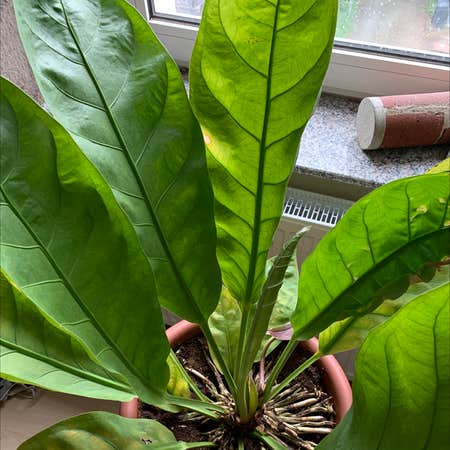


Bird's nest anthurium
About Bird's nest anthurium
Bird's nest anthurium is a popular houseplant 🌿 that needs regular watering to thrive. They do best in abundant sunlight ☀ and should be less than 3 feet from a window.
Bird's nest anthurium likes soil that is good at retaining moisture. You may want to supplement with a gentle, organic fertilizer throughout the peak growing season.
⚠️ Bird's nest anthurium is extremely dangerous if consumed. If you, a family member, or a pet has ingested any amount of plant material contact Poison Control, US (800) 222-1222, or your veterinarian immediately. These plants are not recommended for homes with children, cats, or dogs.
Taxonomy

Anthurium hookeri
Anthurium
Araceae
Alismatales

How to care for Bird's nest anthurium
How often to water your Bird's nest anthurium

every 9
Bird's nest anthurium needs 0.5 cups of water every 9 when it doesn’t get direct sunlight and is potted in a 5" pot.
Use our water calculator to personalize watering recommendations to your environment or download Greg for more advanced recommendations for all of your plants.

Water 0.5 cups every
9
Finding light for Bird's nest anthurium in your home

a window
Bird's nest anthurium may have difficulty thriving, and will drop leaves 🍃, without ample sunlight.
Place it less than 3 feet from a south-facing window to maximize the potential for growth.
Select your region to see how the current weather in your area affects the placement of Bird's nest anthurium in your home 🏡.
How to fertilize Bird's nest anthurium

Most potting soils come with ample nutrients which plants use to produce new growth.
By the time your plant has depleted the nutrients in its soil it’s likely grown enough to need a larger pot anyway.
To replenish this plant's nutrients, repot your Bird's nest anthurium after it doubles in size or once a year—whichever comes first.
-
It is getting some dark spots on the leaves. Is that normal? #Anthurium
-
Bday plant! + ID & name suggestions? Got this BEAUTY tday as a 3day overdue bday present, quick question—is it Anthurium crystallinum, A.magnificum or a hybrid? [Name suggestions pls! ;) ] #HappyPlants #PlantsMakePeopleHappy #PlantAddict #NewPlants #Anthurium #CrystalAnthurium #AnthuriumCrystallinum #AnthuriumMagnificum #GregGang
-
Anthurium Is it okay to put two anthuriums in one pot? #Anthurium #FlamingoPlant
-
Is now the right time to repot my anthirium? I have a king Antherium, that is very rootbound, and she dries out about every two days. Can I repot her now? Or is it too late in the season? Here’s a semi old photo of her! #Anthurium #Indoorplants #RepotSeason #help #HappyPlants #GrowLights #TropicalPlants 
-
#thegreenshouse #HappyPlants #PlantsMakePeopleHappy #PlantAddict #NewGrowth #PropagationStation #SnakePlant #SnakePlantSquad #Sansevieria #SucculentLove #SucculentLove #PlantTherapy #floweringsnake #Sanserveriaflowering #PothosPack #Monstera #CalatheaCrew #Calathea #Hoya #HoyaHangout #HoyaHeads #PrayerPlant #Philodendron #VariegatedPinkLemon #ZamioculcasZamiifolia #ZzPlant #RavenZzPlant #Aglaonema #AlocasiaAddicts #Bonsai #Ficus #FiddleLeafFig #Anthurium #WhaleFinSnakePlant #ZeylanicaSnakePlant #WhitneySanserveria #SayuriSnakePlant #Cacti #AfricanMilkBush #dragonboneeuphorbia #VariegatedOpuntia , #PricklyPearCactusvariegated https:// I am a person who normally doesn’t try new sellers, but this one popped up in my Etsy (because you viewed section) and I did some research and looked at comments so I said why not…….I received such a beautiful shipment from #thegreenshouse yesterday……Richard (I assume he’s the owner) helped me pick out 3 basic plants. They arrived in perfect condition. My heart just 💕 swelled with joy. I posted his Etsy shop above. The blooming (smells like heaven) #sansevieriablackcoral has sooo many new babies and the pot is about to bust open from the new growth. #happywifehappylife
-
I had my anthurium for 3 yrs now. I changed the pot size it's growing new green leaves but over the last yr it has not produced the bright red flowers it used to any suggestions? #Anthurium
-
Anthurium Forgetii Hi!!! Anyone have any advice or tips for an Anthurium Forgetii? I just ordered a little baby!! 🌱 and I'm so excited! I've never owned an Anthurium before though. Thank you!! 💚🌱🤙🏻🫶🏻 #anthurium #centraltexasgang #plantsmakepeoplehappy #help #idkstephs
-
Some #Anthurium we saw at the Swap yesterday. First 2 pics we got this big No ID (anyone have any ideas) and this wasn't even the biggest leaf! It had reddish petioles if that helps. I was so shook by these guys I forgot to take pics and had to screen grab video! Then the next 2 are a HUGE hanging Anthurium, but can't remember what he said even tho I asked like 6 times! I'm definitely getting into Anthurium soon!! #greggang #greggers #northtexasgreggang #greginyourcity #gregmagic #easttexasgreggang #plants #houseplants #theplantdadlife #heyyall #plantparenthood #plantparent #plantmom #plantdad #plantcommunity #payitforward #giveback #happyplants #bebetter #spreadlove #keepgrowing #community
-
Identification help A seller included a baby anthurium in with my other plants, but I have no idea what kind it could be. Anyone wanna make a more educated guess, before I message him? #Anthurium
-
#seedlingraceseries race 3 update There's about a week left to enter the race, or if they sell out of seeds before then. If you haven't joined here's the link ➡️ https:// What's in the kit? Kit includes two vittarifoliumx mystery hybrid seeds (open pollination, most likely crossed with another vittarifollium by bugs), label, ruler, and full instructions. WHO'S EXCITED?! I AM! 🪴🤓 #plantsmakepeoplehappy #plantaddict #hangingplants #anthurium #anthuriumassembly #anthuriumvittarifolium #sisterhoodofthetravelingplants #seedlings @PlantMompy @Kaleyeeaah @tango


Care Summary for Bird's nest anthurium

Bird's nest anthurium
 Greg recommends:
 Water
Water
0.5 cups every 9 days
 Placement
< 3ft from a window
 Nutrients
Repot after 2x growth
Based on the 4” pot your plant is in, and that it doesn’t get direct sunlight.
 Trending in your area












 Similar to Bird's nest anthurium


✨ Discover rare plants

Thelocactus macdowell…

Parrot Pitcher Plant

Fagraea ceilanica

Aeonium 'Blushing Bea…

Graptoveria 'Douglas …

Black Monkey Thorn Tr…

Scindapsus pictus 'Si…

Echeveria Arrow

Milky Widow's Thrill
Chinese Evergreen 'Ga…

Electric Fern

Vatricania guentheri

Burro's Tail

Peperomia 'Harmony's …

Aloe 'Lavender Star'

Hoya pottsii 'Khao Ya…
