


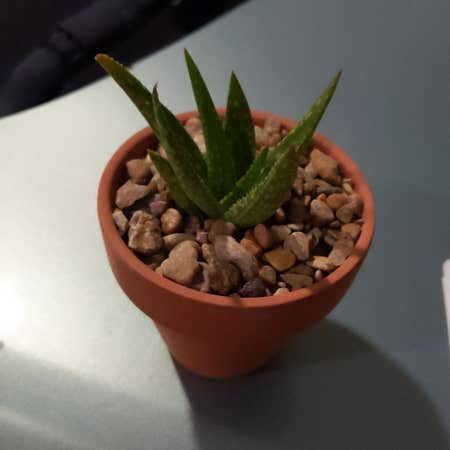


Aloe pictifolia
About Aloe pictifolia
Many people are familiar with Aloe vera, but this genus of plants contains tons of other beautiful succulent plants that come in all sorts of colors! Their succulent leaves evolved to store water in dry climates, which makes them a perfect fit if you're a busy plant parent. With great care (and a lot of sunlight) you may even see your Aloe bloom! Their flowers grow out of a large spike and can be shades of red, orange, and yellow. 🔥
Taxonomy

Aloe pictifolia
Aloe
Asphodelaceae
Asparagales

How to care for Aloe pictifolia
How often to water your Aloe pictifolia

every 12
Aloe pictifolia needs 0.5 cups of water every 12 when it doesn’t get direct sunlight and is potted in a 5" pot.
Use our water calculator to personalize watering recommendations to your environment or download Greg for more advanced recommendations for all of your plants.

Water 0.5 cups every
12
Finding light for None in your home

a window
Aloe pictifolia love being close to bright, sunny windows 😎.
Place it less than 1ft from a south-facing window to maximize the potential for growth.
Aloe pictifolia does not tolerate low-light 🚫.
Select your region to see how the current weather in your area affects the placement of Aloe pictifolia in your home 🏡.
How to fertilize Aloe pictifolia

Most potting soils come with ample nutrients which plants use to produce new growth.
By the time your plant has depleted the nutrients in its soil it’s likely grown enough to need a larger pot anyway.
To replenish this plant's nutrients, repot your Aloe pictifolia after it doubles in size or once a year—whichever comes first.
-
I wasn’t getting enough light in my room so I put him outside but it was too hot for him and he’s starting to turn brown and be frail and I don’t know what to do #AloeVera
-
This is my partners tigertooth aloe. He has had her for years from a small baby succulent. We recently repotted, and the plant became sick extremely brown,wilting. We were super worried about her as she was ill for around a month and looking worse and worse, worried we ruined her roots in the process. We moved her and left her, didn't water, waited for her to adjust. Fast forward to now.. she is super green and healthy. Living proof that sometimes you just need patience for a bit of rivaval and recovery 🥰🥰
-
This plant had been re-potted recently, but since the colour has drained. It's been a month now and not sure how much to water as she is so big! #TigerToothAloe
-
Aloe help! Keanu Leaves looks so sad. Getting droopy and brown/yellowing….what do I need??
-
My Aloe is outside enjoying the Sun
-
How do I get this one growing?
-
Leaves are turning brown The leaves on my alo plant are turning brown black. I just want to know if anyone has any advice.I could take
-
New-ish to gardening so I dont really know but my aloe Vera plant has this spot on it and it looks like it got pinched and flattened so will it heal on its own or fall off? #AloeVera
-
Some parts are turning brown #AloeVera
-
Why is my Aloe Vera turning yellow? It used to be a vibrant green.


Care Summary for Aloe pictifolia

Aloe pictifolia
 Greg recommends:
 Water
Water
0.5 cups every 12 days
 Placement
< 1ft from a window
 Nutrients
Repot after 2x growth
Based on the 4” pot your plant is in, and that it doesn’t get direct sunlight.
 Trending in your area

Fiddle Leaf Fig

Ghost Plant

Marble Queen Pothos

Golden Pothos

Chinese Evergreen

Elephant Bush

Marijuana

Rose Calathea

Small-Leaf Spiderwort

Florist Kalanchoe

Chinese Money Plant

Philodendron Birkin

Pothos N' Joy

Purple Shamrocks

String of Hearts

False Christmas Cactus

Emerald Ripple Pepero…

Venus Fly Trap
 Similar to Aloe pictifolia
✨ Discover rare plants

Crassula 'Purple Drag…

Begonia lubbersii

Anthurium Fingers

Tuber Fleeceflower

Fagraea ceilanica
Stanhopea tigrina

Ace of Spades

Thelocactus macdowell…

Skeleton Key Pothos

Electric Fern

Graptopetalum 'Marqui…

Starfish Snake Plant

Sedum 'White Diamond'

White Apple Moth Orch…
Philodendron 'Gabby'

Aeonium 'Blushing Bea…
