

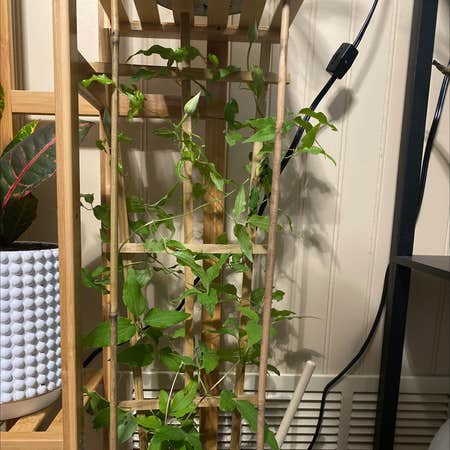


Mandevilla boliviensis
Taxonomy

Mandevilla boliviensis
Mandevilla
Apocynaceae
Gentianales

How to care for Mandevilla boliviensis
How often to water your Mandevilla boliviensis

every 9
Mandevilla boliviensis needs 0.5 cups of water every 9 when it doesn’t get direct sunlight and is potted in a 5" pot.
Use our water calculator to personalize watering recommendations to your environment or download Greg for more advanced recommendations for all of your plants.

Water 0.5 cups every
9
Finding light for None in your home

a window
Mandevilla boliviensis love being close to bright, sunny windows 😎.
Place it less than 1ft from a south-facing window to maximize the potential for growth.
Mandevilla boliviensis does not tolerate low-light 🚫.
Select your region to see how the current weather in your area affects the placement of Mandevilla boliviensis in your home 🏡.
How to fertilize Mandevilla boliviensis

Most potting soils come with ample nutrients which plants use to produce new growth.
By the time your plant has depleted the nutrients in its soil it’s likely grown enough to need a larger pot anyway.
To replenish this plant's nutrients, repot your Mandevilla boliviensis after it doubles in size or once a year—whichever comes first.
-
Mine is turning brown and only getting morning sun in Las Vegas #BrazilianJasmine
-
My leaves are turning brown #BrazilianJasmine
-
Do these do better indoor or outdoor #BrazilianJasmine
-
Brazilian jasmine is super leggy—should I chop? I’ve had this #BrazilianJasmine for three years now. It stays outside all summer and comes inside to live under a grow light every winter. The first year, it threw a fit and dropped all its leaves, but since then, it’s happy. I learned to acclimate it slowly. So, over time, it’s vined around two trellises (I put the taller one in when it got too tall for the smaller wooden one, but by then, some vines had hardened into wood around the small trellis, so I left it in. It’s growing ridiculously tall, about 5 feet from the bottom of the pot to the top of the vines, and the bottom half of the plant has very few leaves. Should I try to chop and prop it? I’d also like to repot it, because I’m sure by now it’s getting root bound. It’s been in the same pot for three years (I replace the soil on top every spring because I didn’t want to deal with repotting with the trellises, but I’m willing to wrestle with it now, lol). I’m inclined to wait until spring no matter what, since it’s really happy right now and growing tons of new vines and leaves, I don’t want to disturb it. Anyway, I’m curious what other owners of plants like this do when it gets very bare on the bottom. Thanks for your thoughts! 🤗🩷🪴 #HappyPlants #PlantsMakePeopleHappy #NewGrowth #PropagationStation #PlantTherapy #ToChopOrNotToChop #babevila #FloweringPlants #GregGang #Greggers
-
#HappyPlants Wanting to move this gal inside before outdoor Indiana gets too cold. Suggestions on how to prepare to move inside. Never tried that before
-
My sweet Madonna has fungus and I can’t seem to get it taken care of 😭 That’s what she looks like and this is the fungicide I’m using. She sits outside in the sun/rain. What am I doing wrong?!? #BrazilianJasmine
-
BrazilianJasmine... I have some leaves that are turning yellow, am I watering it too much? #
-
Jasmine was doing fine now one stem has lost all its leaves. We've had a lot of rain lately. Could that be the problem? Thanks for any suggestions. #BrazilianJasmine
-
Trying to add more flowering plants to my indoor collection. This seems like a great choice. From all the issues some folks are having, what’s some advice on keeping “Jazzy” healthy and thriving? I’m using grow lights. #BrazilianJasmine
-
Most of my flowers say that they should be watered daily but this app is telling me that most shouldn’t be watered till next week. Not sure what to believe at this point 🫠


Care Summary for Mandevilla boliviensis

Mandevilla boliviensis
 Greg recommends:
 Water
Water
0.5 cups every 9 days
 Placement
< 1ft from a window
 Nutrients
Repot after 2x growth
Based on the 4” pot your plant is in, and that it doesn’t get direct sunlight.
 Trending in your area

Parlour Palm
Purple Shamrocks

Cathedral Windows
Triostar Stromanthe
Marble Queen Pothos
Cornstalk Dracaena
Philodendron Birkin

Chinese Evergreen
Waxplant

Painter's Palette

Jade
Jade Pothos

Blushing Bride Air Pl…
Fiddle Leaf Fig

Window Leaf

Lipstick Echeveria

Tradescantia Zebrina

False Christmas Cactus
 Similar to Mandevilla boliviensis

✨ Discover rare plants
Skeleton Key Pothos

Dinteranthus microspe…
Philodendron 'Rio'

Large Leaf Elephant B…

Echeveria Arrow

Treasure Flower
Crassula 'Calico Kitt…

Bonsai Crassula

Aeonium 'Blushing Bea…

Eden Climbing Rose

Hoya 'Millie'

Kilimanjaro Plant

Ruby Ball

Hoya kalimantan

Aloe 'Lavender Star'

Cereus peruvianus 'Pa…

Croton Nervia
