


White Sansevieria
About White Sansevieria
Records of Dracaena fossils have been found in Europe and North Africa, near the site of the Tethys Ocean, which existed 252 to 66 million years ago. More recently, snake plant leaves and stems have been used to treat fever, pain, bleeding, and inflammation throughout many cultures in Africa and India. 🤒
Taxonomy

Dracaena 'Bantel's Sensation'
Dracaena
Asparagaceae
Asparagales

How to care for White Sansevieria
How often to water your White Sansevieria

every 12
White Sansevieria needs 0.5 cups of water every 12 when it doesn’t get direct sunlight and is potted in a 5" pot.
Use our water calculator to personalize watering recommendations to your environment or download Greg for more advanced recommendations for all of your plants.

Water 0.5 cups every
12
Finding light for White Sansevieria in your home

a window
White Sansevieria can tolerate being far from a window and light source.
Place it less than 6 feet from a south-facing window to ensure it receives enough light to survive 💪.
Select your region to see how the current weather in your area affects the placement of White Sansevieria in your home 🏡.
How to fertilize White Sansevieria

Most potting soils come with ample nutrients which plants use to produce new growth.
By the time your plant has depleted the nutrients in its soil it’s likely grown enough to need a larger pot anyway.
To replenish this plant's nutrients, repot your White Sansevieria after it doubles in size or once a year—whichever comes first.
-
#whatthesuccwednesday My dragon's tail zebrina & pink paradise tradescantia grew like crazy this summer! Had to propagate them alot! #happyplants #plantsmakepeoplehappy #plantaddict #planttherapy #plantmafia #newgrowth #gregplantshop #greggers #greggang #succulentlove #succulentsquad #newplantmom #dracaena #freshleaffriday
-
What’s the best potting soil for snake plants? #Dracaena
-
Is Sansan healthy? I got Sansan 2 months ago. There used to be three groups here, one group expired probably of over watering since the tips turned brown and mushy, the other group turned brown black and crisp. Now, there's only one left, with a baby. I'm worried if I should just transfer the whole thing in water or keep it as is. Currently, I have no access to fertile soil. #Dracaena
-
Help please... I found weird blotches on my moonshine leaves. What are they? Thank you #Dracaena
-
Browning leaves. What's going on? #Dracaena I thought it was bruising from the store or something but it's definitely escalated. Should I remove the worst part? Is it something I may be doing or not doing to cause this?
-
Yellowing and crispy leaves Dracaena leaves have been gradually yellowing for about two months now—not sure what’s causing it. Can anyone identify the problem? I’m considering repotting it into a bigger pot that has a drainage hole but I’m scared of shocking the plant. #Dracaena
-
What are these yellow spots on my Dracaena? These spots have been here for a couple months; isolated to the underside of just some leaves. The spots seem to be spreading. I re-potted yesterday into a larger pot with fresh soil, plant food, and a larger more robust stake. #HappyPlants #GregGang #Dracaena #NewGrowth
-
The leaves are all curled. Is that ok? #Dracaena
-
Kobe, my Snake Plant is not thriving as well as I think he should. I spotted two new leaves but he doesn’t seem to be growing. Any thoughts or suggestions? #helpneeded #Dracaena
-
Is this the correct plant species? #Dracaena


Care Summary for White Sansevieria

White Sansevieria
 Greg recommends:
 Water
Water
0.5 cups every 12 days
 Placement
< 6ft from a window
 Nutrients
Repot after 2x growth
Based on the 4” pot your plant is in, and that it doesn’t get direct sunlight.
 Trending in your area









 Similar to White Sansevieria


✨ Discover rare plants

Tuber Fleeceflower

Anthurium Fingers

Peperomia 'Harmony's …
Hoya crassipetiolata

Haworthia emelyae com…

Croton Nervia
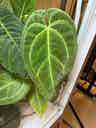
Ace of Spades

Black Monkey Thorn Tr…
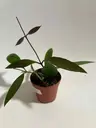
Hoya 'Memoria'

Electric Blue Gecko
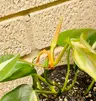
Philodendron 'Rio'
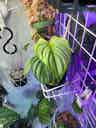
Philodendron 'Silver …

Milky Widow's Thrill

Hoya kalimantan

Munstead Lavender
Skeleton Key Pothos

Lavandula Pedunculata
